Why Is the RBI Building a Digital Rupee When UPI Already Works?
By Anish Pujari
UPI already moves billions of payments a month. So why is the RBI piloting a digital rupee (e₹) too? Here's what it actually does differently and how the pilot is going.
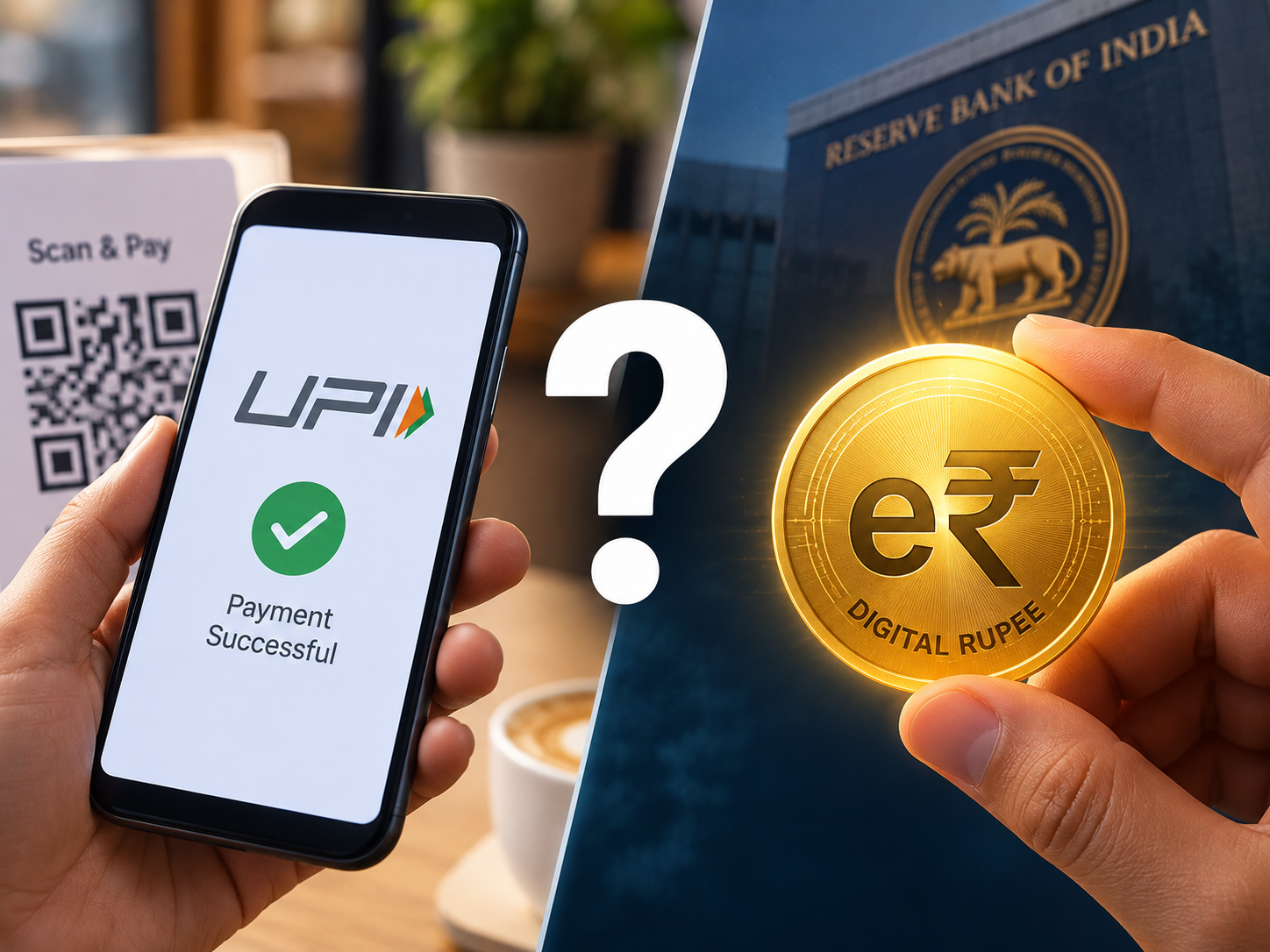
India solved digital payments years ago. So why is the central bank quietly testing a whole new kind of money?
A student splits a cafe bill with a Unified Payments Interface (UPI) scan and the money lands in seconds, yet somewhere in the background, the Reserve Bank of India (RBI) is testing something called the digital rupee.
If UPI Already Works, Why Build Something New?
Here's the thing. In August 2026 alone, UPI processed a record 24.51 billion transactions, a system that basically solved digital payments for a billion people.
So why would the RBI spend years building a "digital rupee," or e₹, if paying someone instantly already looks solved?
You might wonder if this is just the RBI reinventing the wheel. It isn't. The RBI isn't trying to replace UPI. It's answering a completely different question.
Payment Method vs Money Itself
To understand this, separate two things people usually lump together: how money moves, and what money actually is.
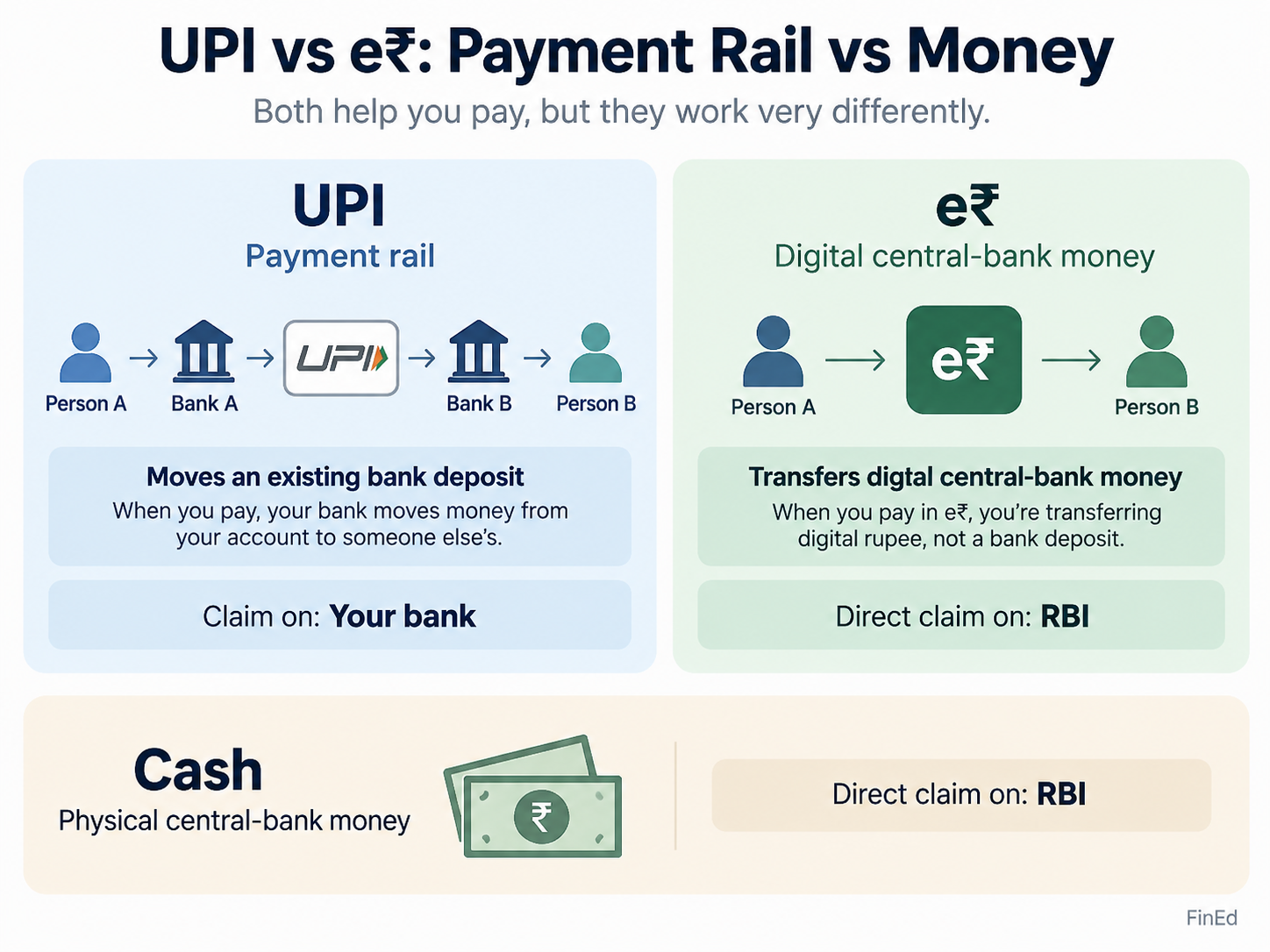
UPI is a payment rail. When you scan a Quick Response (QR) code and pay ₹250, you aren't creating new money. You're instructing your bank to move ₹250 out of your account into someone else's. That money was always a bank deposit, a claim on your bank, not on the RBI.
Cash works differently. A ₹500 note is a direct claim on the central bank itself, with no bank in between.
The e₹ brings that same direct claim into digital form. If Aarav pays ₹250 in e₹ instead of UPI, he isn't moving a bank deposit. He's transferring digital central-bank money, with the RBI itself on the other side of that claim.
In short, UPI answers "how do I pay?" The e₹ asks a different question: "what kind of money am I actually paying with?"
Why Would a Central Bank Care About That Difference?
As daily life moves onto private apps, wallets, and eventually private digital tokens like stablecoins, cash becomes less central to how people actually transact.
The RBI's worry isn't speed. It's making sure people still have access to public money, not just money living inside private companies' systems, even as payments go fully digital.
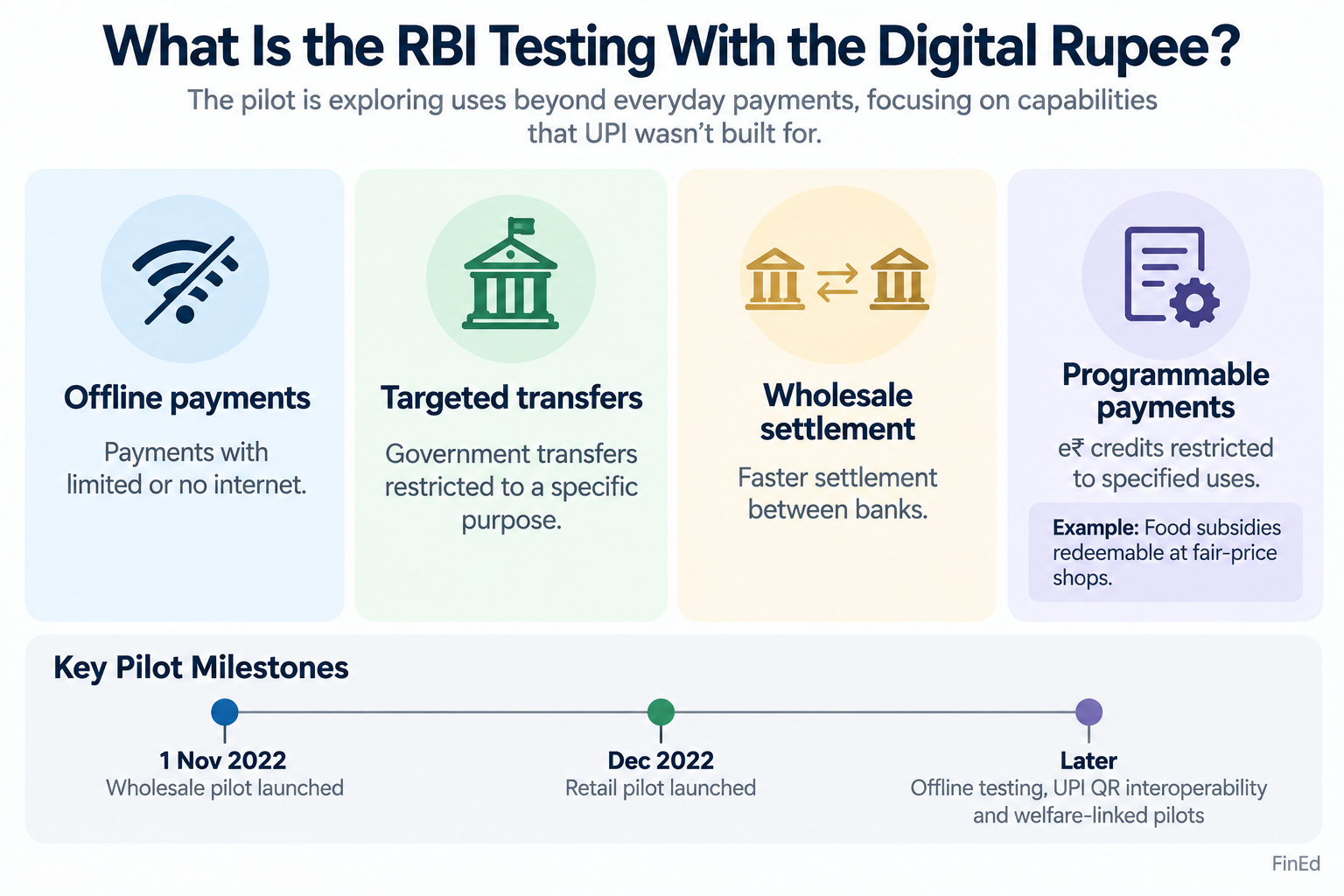
Beyond that, the pilot is testing things UPI wasn't built for: payments that work with limited or no internet, targeted government transfers restricted to a specific purpose, and faster settlement between banks on the wholesale side.
How Is the Digital Rupee Pilot Actually Going?
Not as smoothly as a headline might suggest.
The RBI launched the wholesale pilot on 1 November 2022 and the retail pilot a month later. Since then, it has expanded to offline testing, QR interoperability with UPI, and welfare-linked e₹ payments in states like Gujarat, Puducherry, and Chandigarh, where public distribution system beneficiaries now receive food subsidies as programmable digital rupee credits redeemable at fair-price shops.
But here's the uncomfortable number. According to the RBI's Annual Report 2025-26, retail e₹ in circulation fell from ₹1,016.46 crore in March 2025 to ₹771.66 crore in March 2026, a drop of over 24 percent. Wholesale e₹ circulation stood at nil on both dates.
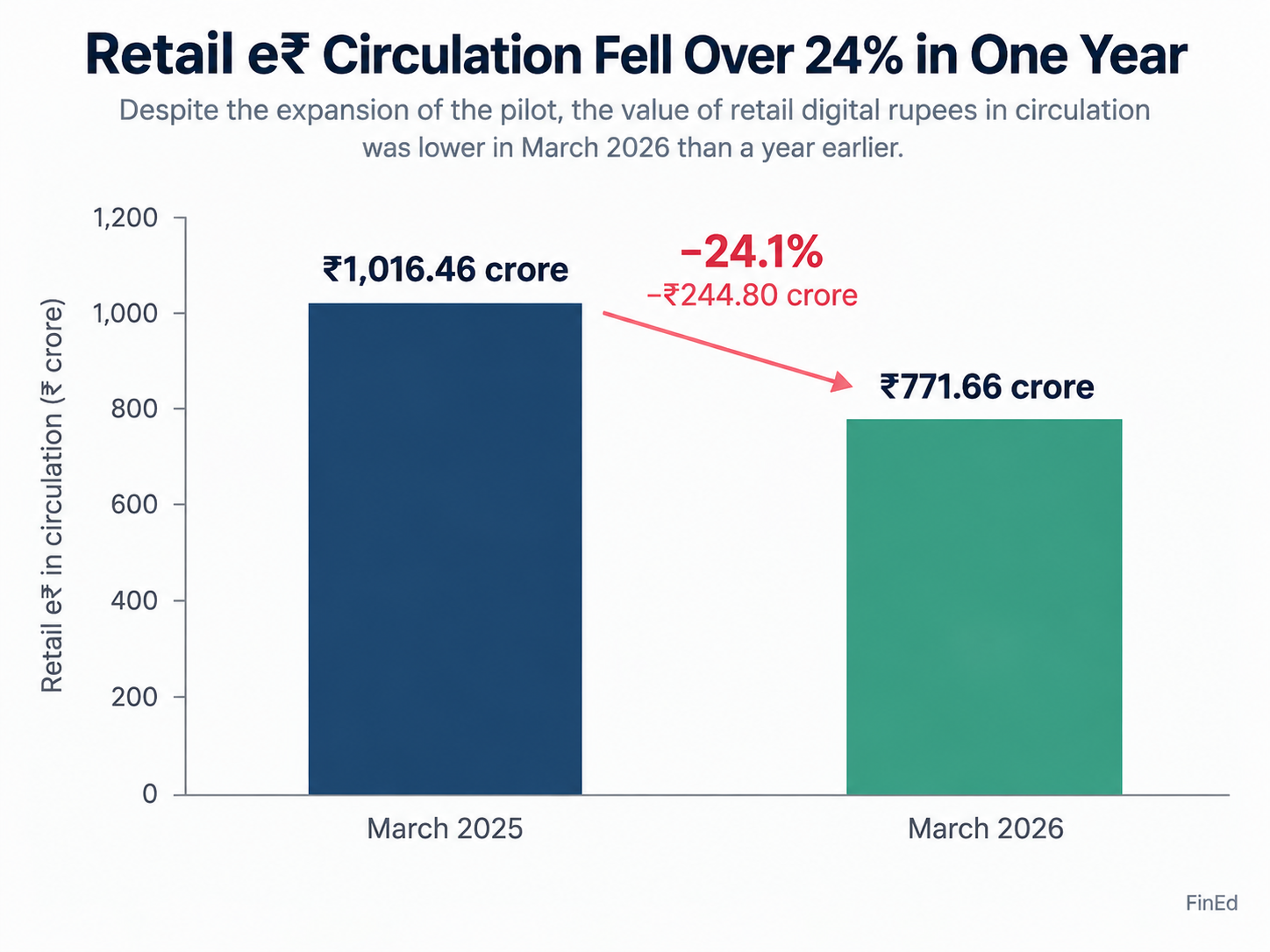
That doesn't mean the project failed. Circulation fluctuates during a controlled pilot, and the RBI isn't trying to maximise usage right now. But it does mean adoption can't be assumed just because the technology exists. Pilots in other countries have seen similar patterns, with wallets created but rarely used.
What's the Catch?
A safer, central-bank-backed rupee sounds like an easy win. But it comes with trade-offs.
If people could instantly move money out of bank deposits into e₹, banks could lose a stable source of funding, especially during a crisis when everyone rushes to the "safer" option at once. That's partly why the RBI keeps the pilot intermediated through banks rather than letting people bypass them.
There's also privacy. The RBI has floated "managed anonymity," where small transactions stay largely private and larger ones remain traceable, similar to cash. But the exact design is still being worked out, not finalised.
The Takeaway
The digital rupee isn't trying to out-compete UPI at what UPI already does brilliantly: fast, everyday payments. It's a slower, more cautious experiment in whether India needs a new form of public money alongside private payment apps as the economy goes digital. Whether that need turns into something people actually use is still open, and the falling circulation numbers suggest even the RBI doesn't have a final answer yet.
Key Takeaways
- UPI is a payment method that moves money already sitting in bank accounts; the e₹ is meant to be digital money itself, a direct claim on the RBI.
- The RBI isn't building e₹ to replace UPI, but to test offline payments, targeted government transfers, and faster institutional settlement.
- India's retail e₹ circulation actually fell by over 24 percent between March 2025 and March 2026, showing that adoption isn't guaranteed just because a pilot exists.
- A widely used digital rupee could pull deposits out of banks, which is why the RBI has kept the pilot intermediated through banks rather than fully open.
- Privacy in a digital rupee system depends on design choices that are still being finalised, not a settled feature.