Can the Weather Move the Stock Market?
By Puja Tayal
An explainer of how heatwaves, monsoons and cyclones affect Indian companies, and why stock prices react to weather surprises, not headlines

A heatwave, a weak monsoon or a Mumbai downpour can dent a company's sales in a single quarter. So why don't share prices always move when the weather turns?
Every summer and every monsoon, weather quietly shapes what Indians buy, what factories produce and how goods move, and some of those ripples eventually reach company earnings reports and share prices.
In May 2024, India was baking.
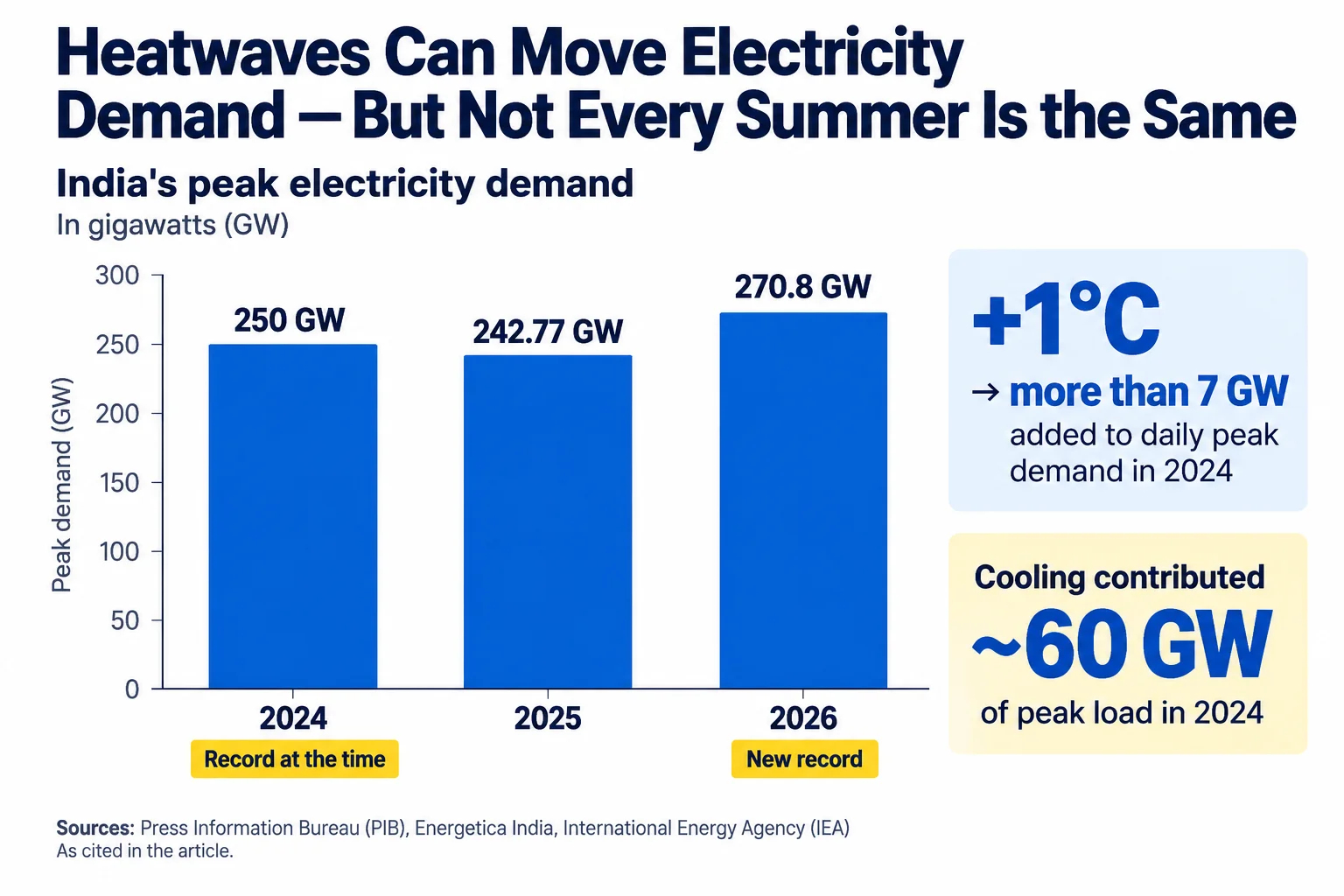
Prolonged, intense heatwaves swept across the country, and demand for cooling soared. On 30 May, India met a record peak electricity demand of 250 gigawatts (GW), an all-time high at the time. That record has since fallen: peak demand reached 270.8 GW in May 2026 during another brutal summer.
The investing logic seems almost too easy. Hotter days mean more electricity sold. More electricity means higher profits for power companies. Higher profits mean rising share prices.
Almost every step in that chain can break, though. So does the weather really move stock prices? And if it does, how?
The short answer is that weather can move the share prices of specific companies, but usually only when it changes their expected profits by more than investors had already priced in. A heatwave or a weak monsoon on its own rarely moves the whole market.
Why Would a Company Care About the Weather?
Picture three businesses on the same stormy week. An ice cream brand hopes for a hot summer. A cement maker can't deliver to a flooded construction site. An airline can't fly without visibility.
In each case, weather is doing one of four things. It can change what people buy, like cooling products in a heatwave. It can change what businesses can produce, like crops in a dry season. It can raise costs, from fuel to freight. Or it can physically stop operations by flooding stores or closing airports.
A Reserve Bank of India (RBI) study found that weather conditions have a statistically significant link with food inflation in India, and with several indicators of economic activity, including electricity demand, industrial output, trade, tourist arrivals, and tractor and automobile sales.
In other words, weather changes a company's scorecard: its sales, costs and profits. But the research doesn't say weather decides stock returns. To see why, follow the path from the sky to the share price.
How Does a Heatwave Travel to a Share Price?
It helps to picture the journey as a chain:
Weather event → change in demand, supply or costs → change in business performance → change in earnings expectations → possible change in share price.
Every arrow comes with conditions.
Does the company have more to sell? Do its costs rise faster than sales? And had investors already expected it?
That last question matters most. The final arrow, from earnings to share price, is the least automatic of all.
India's power sector is a good place to watch this chain being tested.
Does Record Power Demand Mean Record Power Profits?
If any industry should cash in on a heatwave, it's power. Heat and electricity really are closely linked. The International Energy Agency (IEA) estimates that in 2024, every 1°C rise in daily average temperature added more than 7 GW to India's daily peak electricity demand, twice the effect seen in 2019. Cooling alone contributed an estimated 60 GW of peak load that year.
Fewer than 20% of Indian households had an air conditioner in 2024, even as a record 14 million units were sold, so cooling demand has plenty of room to grow.
National demand, however, is not the same as one company's profit.
Contracts and capacity
Many generators sell most of their electricity under long-term power-purchase agreements, or PPAs, contracts that fix the selling price in advance. PPAs work like a hedge: they protect the company when power prices fall, but they also cap what it earns when demand spikes.
The bigger opportunity lies in spare, or "merchant", capacity that isn't tied to a contract. A company that can run those plants harder in a heatwave can sell the extra power on exchanges such as the Indian Energy Exchange (IEX), where prices tend to rise in peak hours. Even that isn't guaranteed. In May 2024, the month of the 250 GW record, the average day-ahead price on IEX was ₹5.3 per unit, more than 20% below bilateral contract prices, because government measures pushed surplus power onto the exchanges.
Fuel and the grid
A plant can't turn demand into revenue without coal or gas, and higher fuel costs can eat into gains. The Ministry of Power said sustained coal supply helped India meet the 250 GW peak. The grid matters too. When northern India hit a record 89 GW peak on 17 June 2024, 25% to 30% of the region's requirement had to be imported from neighbouring regions.
It's similar to why Swiggy and Zomato still struggle to make profits despite handling huge order volumes. Busy is not the same as profitable.
Power shows how demand can fail to become profit. The monsoon shows something trickier: the same rain can help and hurt at once.
How Does Rain in a Village Reach a Soap Company's Results?
Why would a company selling shampoo and biscuits care whether it rains in July?
Because a large part of Indian farming still depends on the southwest monsoon, which usually runs from June to September. Rain affects crop output, farm income and food prices, and farm income shapes how much rural families spend on soap, packaged food and motorcycles. The RBI has noted that India's growth and inflation outlook still depends on how much monsoon rain falls and how it is spread.
For FY2023-24, Hindustan Unilever (HUL) said consumption recovered only with a lag after a long spell of high inflation, and uneven monsoons kept demand subdued, especially in rural areas. It reported underlying sales growth of 3% and volume growth of 2%. Looking ahead, its CEO said he expected demand to improve gradually, helped by a normal monsoon.
More rain isn't always better. Too much can damage crops, disrupt deliveries and push up food prices. Dabur's FY2023-24 annual report said uneven weather, including unseasonal rain and a delayed, shorter winter, hurt its seasonal products. And a normal national rainfall figure can hide a dry district in one state and floods in another.
In 2023, El Niño, a warming of the Pacific Ocean that can weaken the Indian monsoon, was developing. Yet the season ended at 94% of its long-period average, which the India Meteorological Department (IMD) counts as normal, and the monsoon core zone, where most rain-fed farming happens, received 101%. El Niño raises the risk. It doesn't write the outcome.
That lesson is back in play this year. El Niño returned in 2026, and IMD forecast below-normal rainfall at 90% of the long-period average. By early August, cumulative rainfall was running about 12% below normal, according to a government reply in Parliament. Whether that shows up in company earnings will depend on where the rain failed, by how much, and what investors had already assumed.
Even HUL named weather as one factor among several. Sometimes, though, weather stops business entirely.
What Happens When the Weather Shuts Business Down?
Mumbai found out on 8 July 2024. Heavy rain and poor visibility forced 50 flight cancellations at Mumbai airport by 11 am, 42 of them IndiGo's. Cancelled flights mean idle aircraft plus costs for rebooking, refunds and crew changes. Still, one bad day rarely decides a large airline's quarter. Fuel prices, fares and competition usually matter more.
A clearer case comes from cement. In December 2023, Cyclone Michaung brought extreme rain and flooding to Tamil Nadu and Andhra Pradesh, key markets for Ramco Cements. In its Q3 FY2024 earnings discussion, management said it lost roughly 300,000 tonnes of sales volume because of the weather and holidays.
Now the twist. Ramco's sales volumes still rose 10% that quarter. The headline number hid the damage. That 10% also fell short of the 14% to 15% growth analysts had expected, and profit missed estimates. So the cyclone did more than cut volumes. It widened the gap between what the market expected and what the company delivered.
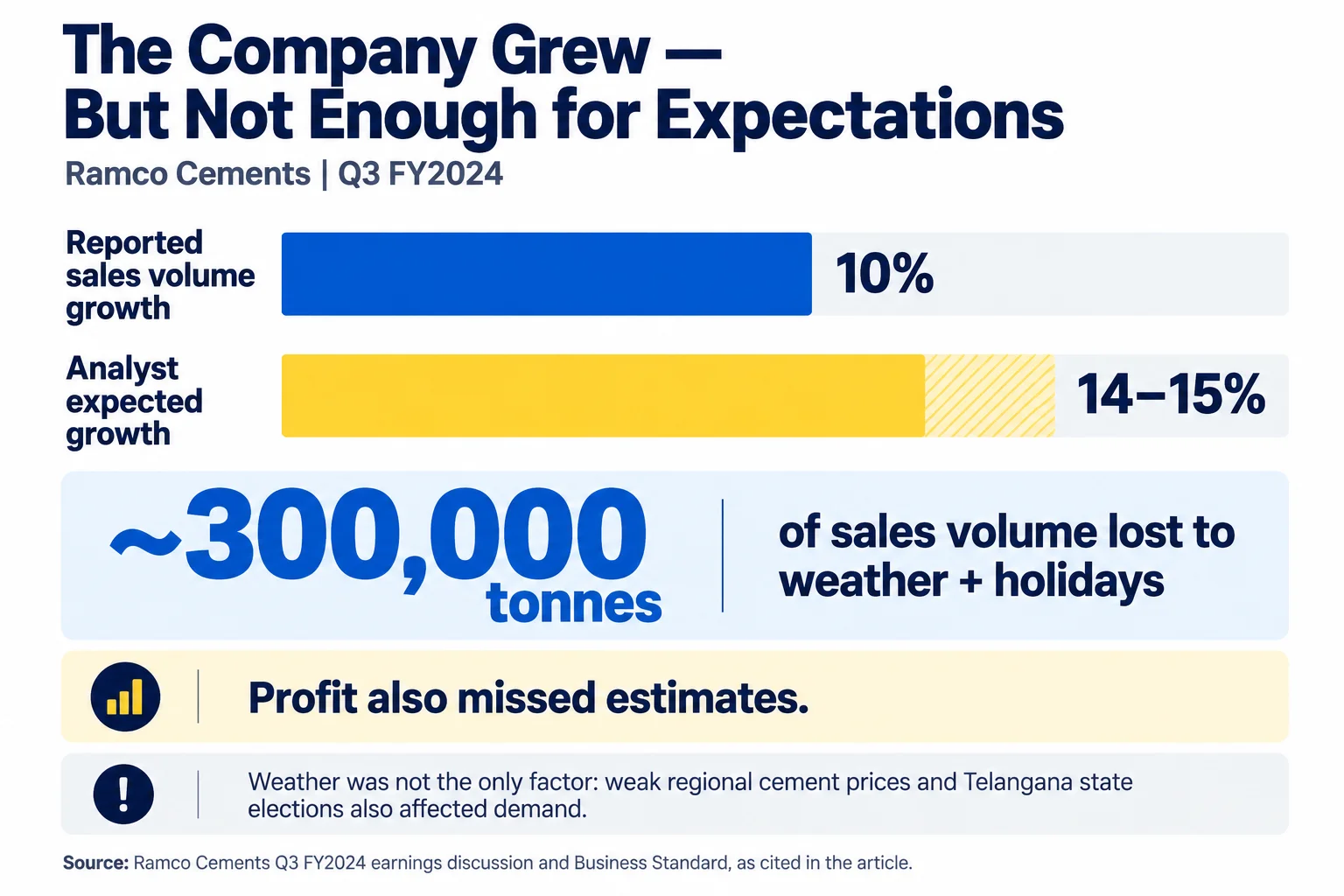
Weak regional cement prices and state elections in Telangana also weighed on demand, so weather wasn't the only driver. When judging weather's impact, ask what would have happened without it.
Which brings us to what investors care about most.
Why Do Stock Prices React to Weather Surprises, Not Headlines?
Think of a weather forecast as an exam question everyone knows is coming. People prepare in advance.
If investors already expect a scorching summer, they've probably raised their demand assumptions for power companies. When the heat arrives as predicted, there's little new information, and the share price may barely move.
Prices tend to move when reality differs from expectations: a longer heatwave, a far weaker monsoon, or a disruption nobody saw coming.
Summer 2025 showed that surprises can run the other way too. After the 2024 heat, the government had prepared for a peak of 277 GW, but demand topped out at 242.77 GW. The monsoon reached Kerala eight days early, and May 2025 electricity consumption fell more than 4% from a year earlier. Anyone who had banked on another record summer got a milder one instead.
Seasonality is one factor investors watch in power stocks. For many power companies, April to June is the busiest quarter of the year. Torrent Power's quarterly results on Screener show the June quarter bringing in its highest revenue of the financial year in each of the last three years, with the heatwave-hit June 2024 quarter the strongest of all. But seasonality is only one factor. Fuel costs, regulation, new capacity, interest rates and valuations also move power stocks, and a pattern everyone knows about is partly priced in already. In the record-heat summer of 2026, Torrent's June-quarter net profit was still lower than a year earlier.
Even then, what matters is whether future profits change, which is why investors lean on tools like the price-to-earnings (P/E) ratio to judge what those earnings are worth.
Research backs this caution. A study of major US natural disasters found that only a small share had statistically significant effects on stock returns, and those effects were confined to firms based in the affected areas, playing out over months rather than days.
What about mood? Earlier research found the New York Stock Exchange tended to do better on sunny days in New York. But a US National Bureau of Economic Research (NBER) paper found individual investors traded much the same on cloudy and sunny days, and the sunshine effect shrank sharply once the authors accounted for market makers widening their spreads on cloudy days. Closer home, a study of monthly rainfall and the Sensex from 1991 to 2020 found rainfall didn't help predict the index.
A rainy day doesn't move the whole market. A material, unexpected shock can move the specific companies exposed to it.
Conclusion
So, can the weather move the stock market?
Not in the simple way headlines suggest. Weather can change a company's scorecard, but a share price tends to react only if that change is large, specific to the company, and different from what investors expected.
This is a skill worth building. An RBI analysis of weather events in India since 1901 found that extreme events have become more frequent over the last two decades, and 2026 has already brought record heat and an El Niño monsoon. The goal isn't to predict the weather. It's to ask better questions about the companies it touches, like what they sell, where they operate, what their contracts lock in and what the market already expects.
Key Takeaways
- Weather affects businesses in four ways: what people buy, what companies can produce, what it costs to operate, and whether operations can run at all.
- High demand doesn't always mean high profit. Contracts, spare capacity, exchange prices, fuel and the grid decide whether a heatwave helps a power company.
- Both too little and too much rain can hurt, and a normal national monsoon figure can hide serious regional stress.
- Judge weather's impact against what would have happened without it. Ramco's volumes grew 10% even as it lost about 300,000 tonnes to weather and holidays, yet that growth still missed analyst expectations.
- Share prices tend to react to the gap between expectation and reality, not to the weather headline itself.
Frequently Asked Questions
Does weather affect the stock market in India?
It can affect specific companies more than the market as a whole. Heatwaves, monsoons and cyclones change sales, costs and operations, but a stock usually reacts only when the impact on expected profits is large and unexpected.
Which businesses are most exposed to weather in India?
Businesses whose demand or operations depend on the season tend to be most exposed. Examples include power generators, consumer goods companies with large rural sales, tractor and two-wheeler makers, cement and construction firms, airlines and cooling-appliance makers.
Does a weak monsoon always hurt consumer goods companies?
No. The impact depends on where rain falls short, how crops and farm incomes respond, food inflation, and how much of a company's sales come from rural India. A national shortfall can also hide normal rainfall in key farming regions, as happened in 2023.