India Ranked No. 1 in Crypto Activity. Here's What That Actually Means
A plain-language guide to digital assets in India, covering crypto laws, the 30% tax rule, TDS, and platform safety.

A beginner's guide to digital assets: what they are, how they work, and where India's law and tax rules really stand
In 2025, India topped a global ranking for crypto activity for the third year running, ahead of the US and Pakistan, sparking fresh curiosity among young Indians who may not fully understand what they are getting into.
Why Everyone's Suddenly Talking About Digital Assets
In September 2025, research firm Chainalysis ranked countries by crypto activity, and India came first, topping every sub-index in the report. Sounds like a big deal, but this ranking measures activity, not ownership. It doesn't tell you what percentage of Indians own crypto, and no reliable national figure exists.
What we do know is that interest skews young: on one Indian platform, roughly 38 percent of users in a recent quarter were 18 to 25. App-based comfort, curiosity and social-media buzz likely play a role, though the last one cuts both ways, spreading hype as much as awareness.
Before deciding whether the excitement is justified, it helps to know what a digital asset actually is.
What Exactly Is a Digital Asset?
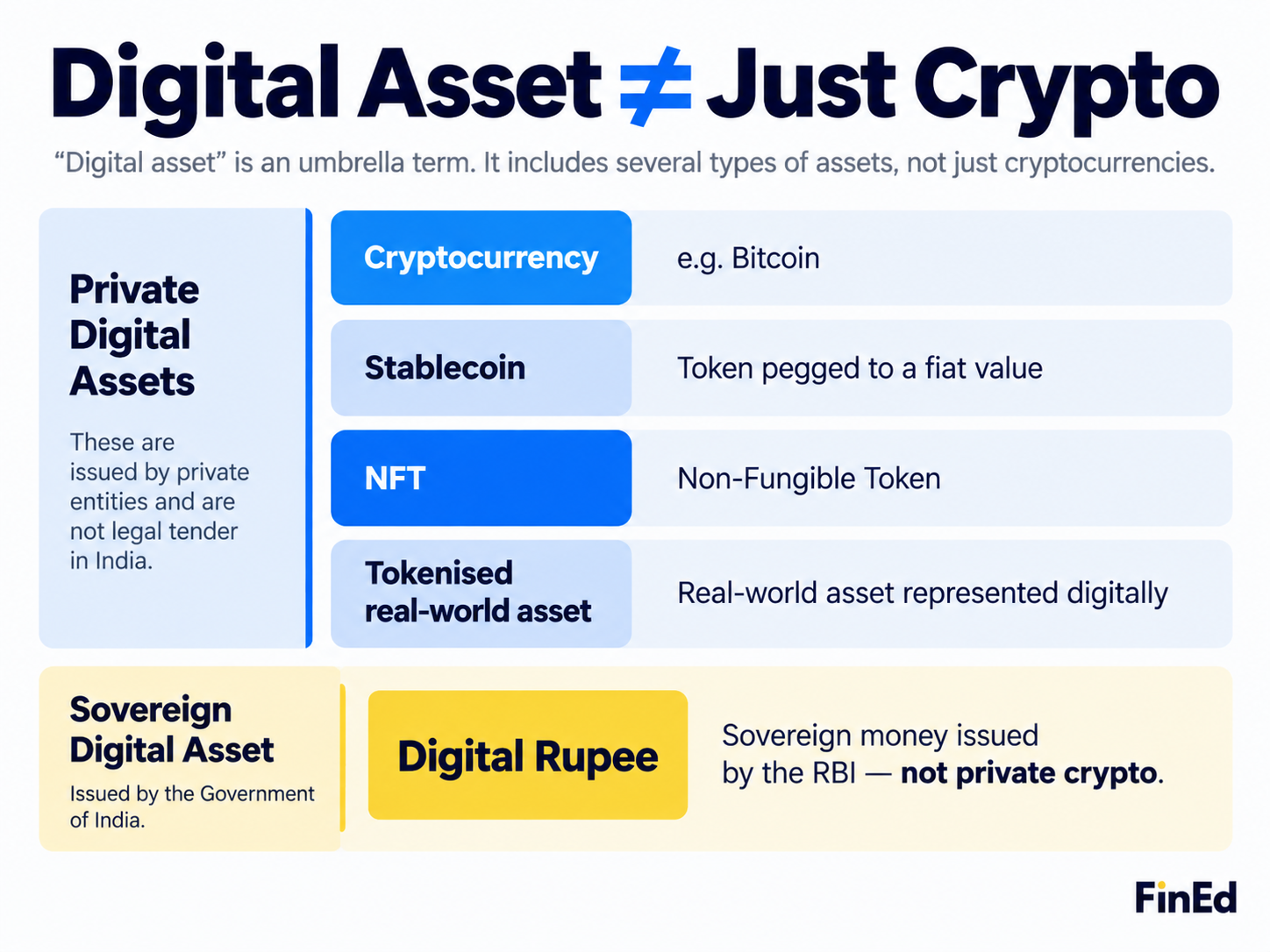
A digital asset is something of value that exists digitally and can be held, transferred or traded electronically: cryptocurrencies like Bitcoin, stablecoins pegged to a fiat value, Non-Fungible Tokens (NFTs) and tokenised real-world assets all fall under this umbrella. India's own digital rupee, issued by the Reserve Bank of India (RBI), is sovereign money, not private crypto.
The idea traces to 2008, when a person or group using the name Satoshi Nakamoto proposed Bitcoin: not just a coin, but a blockchain, a shared ledger where transactions are grouped into blocks and cryptographically linked to earlier ones, making tampering difficult. Using it requires a wallet and a private key; lose that key, and there's often no way back in.
Now, the more pressing question: is any of this actually allowed in India?
Where Does India Actually Stand, Legally?
"Legal or illegal" is too simple a lens. Hong Kong licenses trading platforms, the European Union (EU) regulates crypto under the Markets in Crypto-Assets (MiCA) framework, and China restricts crypto business outright. Every country sits somewhere on a spectrum, and India sits closer to the permissive end, without a comprehensive law.
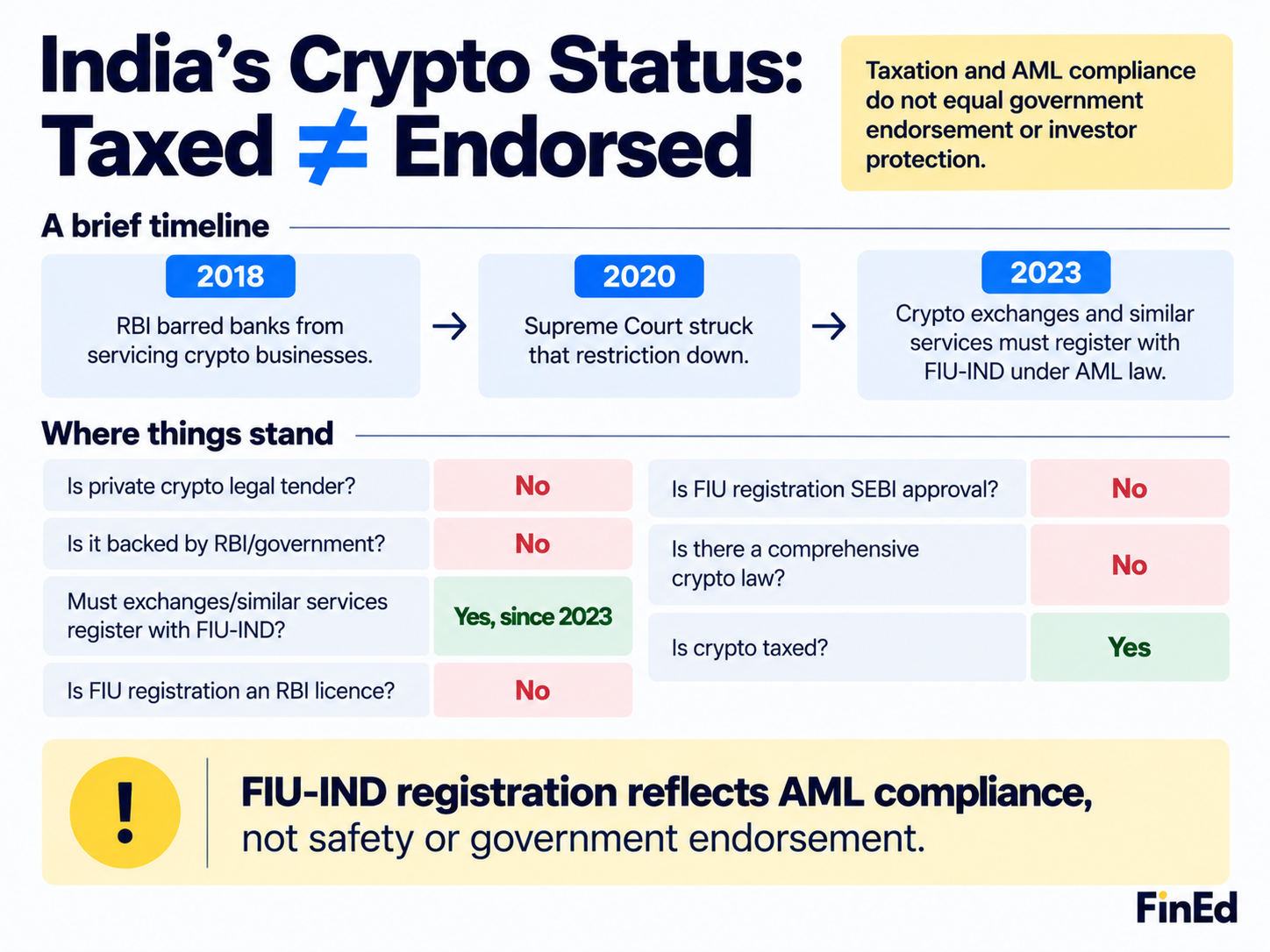
Private crypto is not legal tender and isn't backed by the RBI or government. In 2018, the RBI barred banks from servicing crypto businesses, but the Supreme Court struck that down in 2020. Since 2023, crypto exchanges and similar services must register with the Financial Intelligence Unit (FIU-IND) under India's anti-money-laundering (AML) law, not an RBI licence, Securities and Exchange Board of India (SEBI) approval or government endorsement. Digital assets remain taxed and watched, without a dedicated investor-safety rulebook.
Which brings us to the part most people underestimate: the tax bill.
The Tax Rules Nobody Reads Until It's Too Late
Under India's Income Tax Act, what this article has been calling a digital asset has a specific legal name: a Virtual Digital Asset (VDA). That's the term the law actually uses, and it's the one that matters once you start talking about tax.
Since FY 2022-23, income from transferring a virtual digital asset is taxed at a flat 30 percent, plus surcharge and cess, on the income from the transfer, not the total sale amount, under Section 115BBH of the Income Tax Act. The catch most beginners miss: only the acquisition cost is deductible, and losses can't be offset against other gains or carried forward.
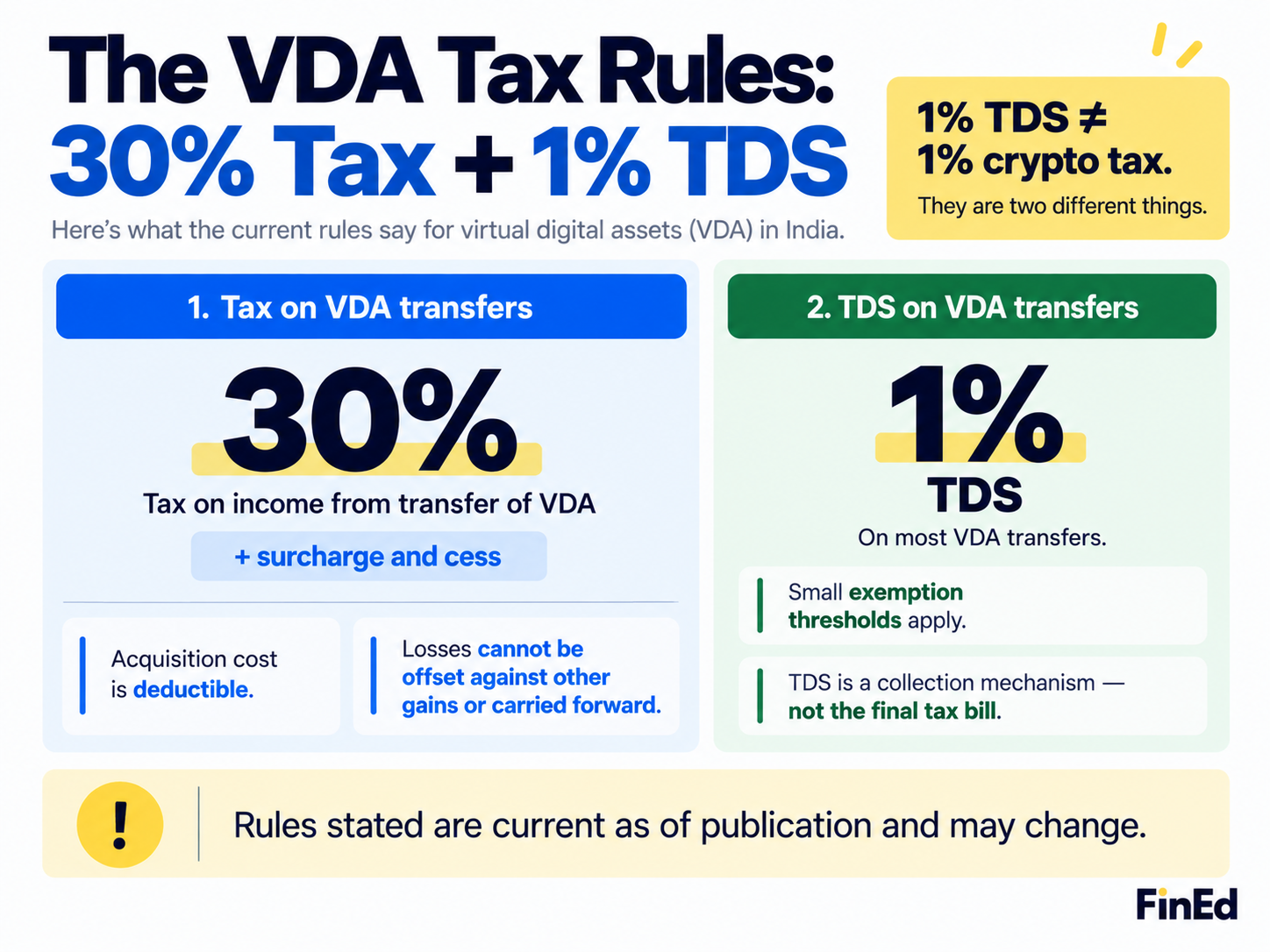
There's also a 1 percent Tax Deducted at Source (TDS) under Section 194S on most virtual digital asset transfers, with small exemption thresholds. That's a collection mechanism, not your final tax bill, and not proof the real rate is 1 percent.
These rates are set by law and can shift with a Union Budget, so treat any snapshot of them as current as of publication rather than permanent.
Given all this, where do Indians actually go to transact?
Where Do Indians Actually Trade, and Is It Safe?
Indian residents typically access digital assets through platforms registered with the FIU. That status is verifiable, but says nothing about a platform's solvency or ability to protect your money if things go wrong.
Security works in layers: the blockchain may be hard to alter, but that doesn't stop a fraudulent transaction, a stolen private key, or an exchange hack. Billions have been lost globally to crypto scams in recent years, per industry estimates.
AI cuts both ways too, flagging suspicious activity for platforms while also helping scammers build convincing deepfakes for investment fraud. An "AI trading bot" being marketed to you is no proof it works. Sharp price swings or a stablecoin's sudden depegging can matter more than any hype.
The Takeaway
So, is investing in digital assets legal in India? It exists in a space that's taxed and monitored for money laundering, but not comprehensively regulated or endorsed, a meaningful difference from being approved or protected by any authority.
Interest, especially among young Indians, is real and growing. But interest isn't the same as safety, and activity isn't the same as ownership, a gap worth understanding before deciding if this space is for you.
Key Takeaways
- India's number one crypto-activity ranking measures transactions and platform use, not how many Indians own digital assets.
- Digital assets span crypto, stablecoins, NFTs and tokenised assets, each with different risks.
- India taxes and monitors digital assets for money laundering, but has no comprehensive law approving them as investments.
- Income from transferring a Virtual Digital Asset (VDA), the Income Tax Act's term for it, is taxed at 30 percent with limited deductions, plus a separate 1 percent TDS.
- FIU-IND registration reflects anti-money-laundering compliance only, not safety or government endorsement.