· IPO
NSE Is About to List. Here's What Its Share Price Could Actually Turn Out to Be
By Anish Pujari · Reviewed by Deepan Datta
NSE's IPO price band is set at ₹1,700–₹1,785. Here's what it implies about its valuation, and why the listing-day price could differ.

SEBI has cleared India's largest exchange to go public. With listing just weeks away, here's how to think about what price it could realistically open at.
Somewhere in the coming days, India's most dominant stock exchange will finally trade in public markets - and the price it opens at could tell you more about investor appetite than about NSE's actual worth.
On 4 September 2026, SEBI issued its observation letter on NSE's draft IPO papers - regulatory-speak for "you may proceed," the clearest sign yet that listing is close after years of delay. Reports suggest a listing window as early as the week of 21 September.
Naturally, everyone wants to know: what price will NSE actually list at? That's fair, but answering it well takes more than a guess. What tells you whether a listing price makes sense is what it implies about NSE's earnings, its business quality, and how much of the company will genuinely be up for grabs on day one.
So instead of guessing a number, let's build the framework to judge any number that shows up.
Why NSE's Listing Price Is Harder to Predict Than It Looks
NSE filed its draft red herring prospectus on 17 June 2026. The issue is structured entirely as an offer for sale, or OFS, of up to about 14.89 crore shares - roughly 6% of paid-up equity, with SBI, Bank of Baroda and GIC Re among the sellers.
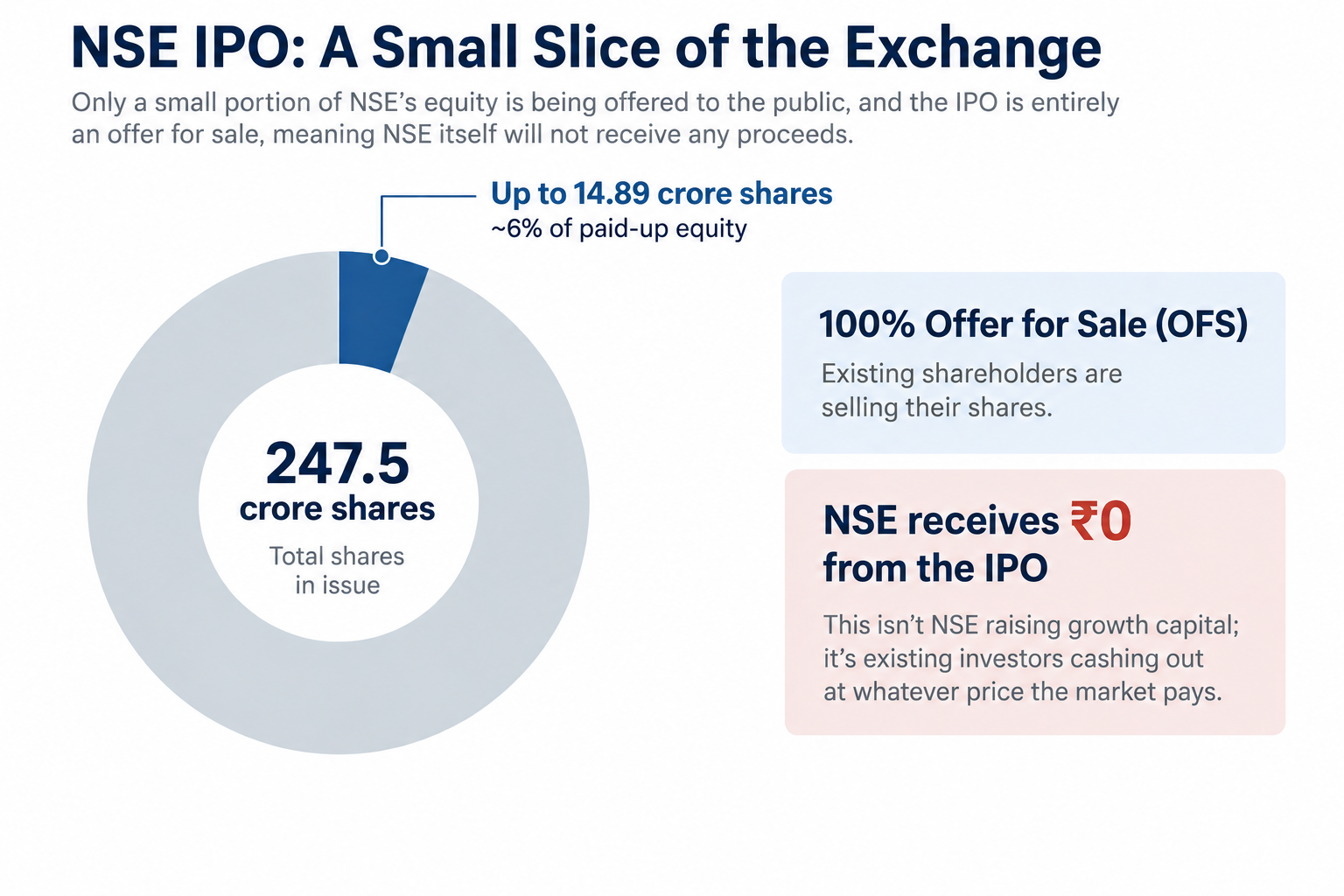
That structure matters. In an OFS, existing shareholders sell to the public - NSE itself doesn't receive a rupee. This isn't NSE raising growth capital; it's existing investors cashing out at whatever price the market pays.
The official price band still hasn't been announced, though some reports mention an issue size near ₹30,000 crore or a valuation around ₹5 lakh crore - reported expectations, not confirmed terms. Which brings us to the real exercise: how do you actually know what a realistic listing price for NSE looks like?
What Actually Turns a Share Price Into a Valuation
Imagine someone tells you a shop nearby is being sold for ₹2 crore. Is that a good deal? You can't tell - not until you know how much money it makes. ₹2 crore for a shop earning ₹2 lakh a year is very different from the same price for one earning ₹20 lakh.
A share price works the same way. It means nothing until you connect it to earnings and to the number of shares that earnings are divided across.
Market capitalisation equals share price multiplied by total shares outstanding. NSE has about 247.5 crore shares in issue, and since this IPO is a pure OFS, that count won't rise.
Divide the market capitalisation by profit and you get the price-to-earnings ratio, or P/E - how many years of current profit you're paying for. A P/E of 40 means paying 40 times last year's earnings. The higher the number, the more optimism is already baked into the price. This is the lens through which any NSE IPO price should be read.
Inside NSE's Numbers: Scale, Profit and a Curious Dip
For the year ended 31 March 2026, NSE reported revenue from operations of ₹16,601 crore and consolidated profit after tax of ₹10,302 crore, translating to an EPS of ₹41.62 — down from FY25's PAT of ₹12,188 crore and EPS of ₹49.24, roughly a 15% decline.
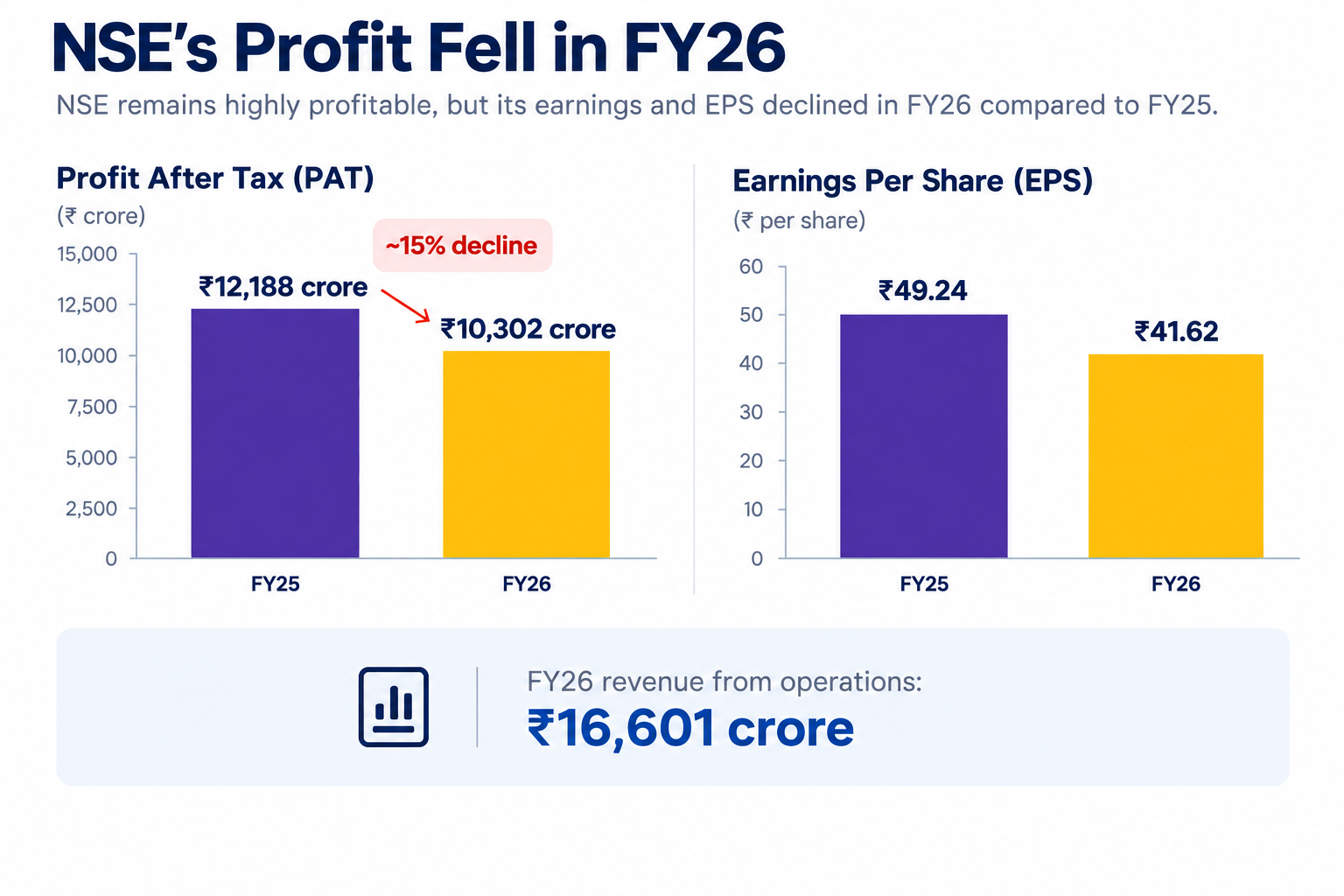
Part of that dip came from a SEBI-related settlement and provision, alongside a 4.2% fall in transaction charges. NSE cites a "normalised" operating margin of 76.23% against a reported 66.85% — though FY25's stronger numbers could equally have been flattered by an unusually active derivatives market. Neither year is automatically the "true" one.
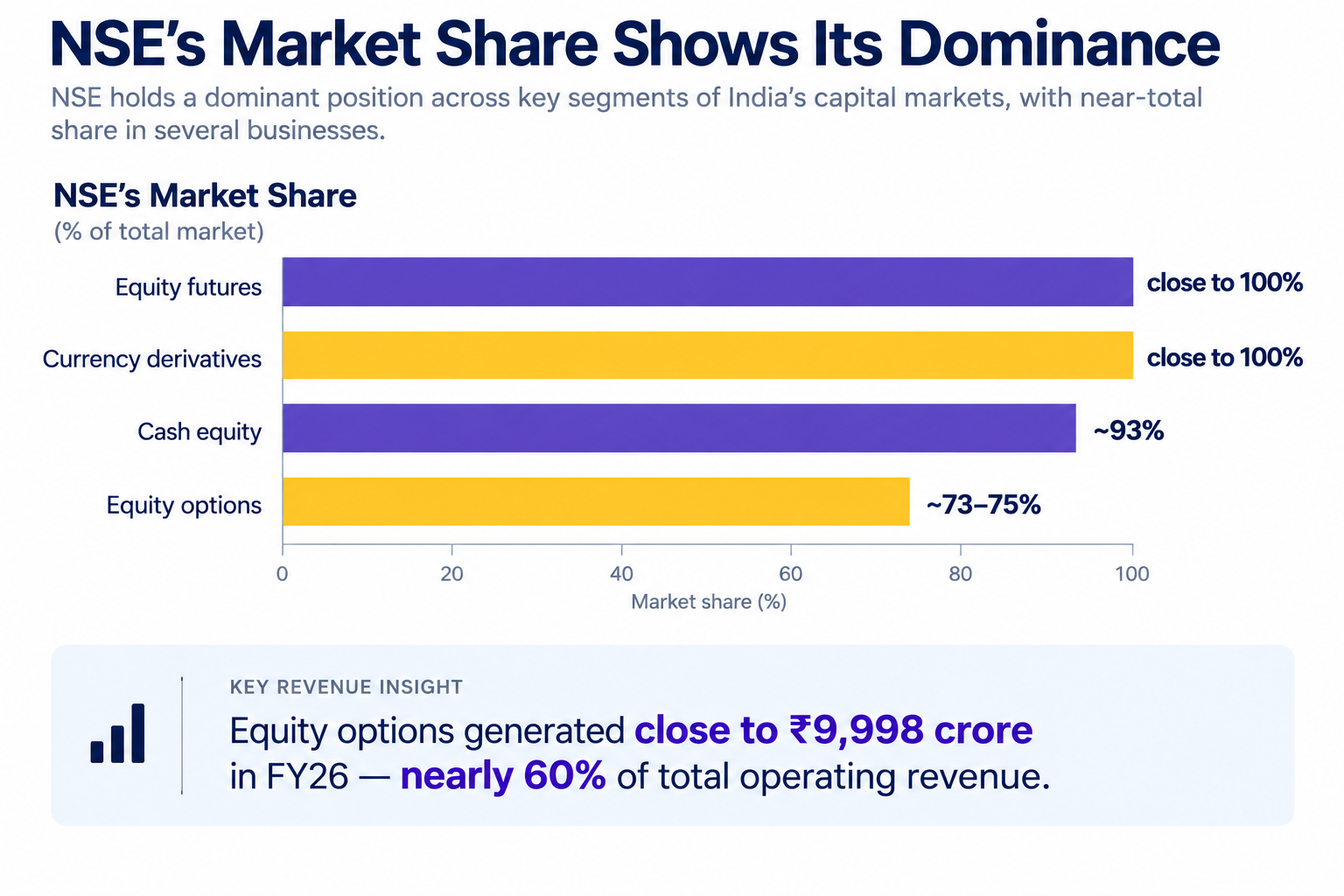
What isn't in dispute is NSE's dominance: roughly 93% of India's cash-equity market, close to 100% in equity futures and currency derivatives, and around 73-75% in equity options — the one segment a rival genuinely contests. Equity options alone generated close to ₹9,998 crore in FY26, nearly 60% of total operating revenue. NSE's biggest profit engine is also its most contested one.
Finding the Right Yardstick: BSE, MCX and the Trouble With Peer Comparisons
To judge whether a P/E is high or low, you need something to compare it against — which is where BSE and MCX, India's other two listed exchanges, come in.
BSE is the closer comparison, operating the same core businesses as NSE — cash equities, derivatives, listings and data — and genuinely contesting NSE's options share. Around early September 2026, its trailing P/E was reported at roughly 49x to 52x, depending on source and exact day.
MCX is weaker as a comparison, running commodity derivatives with different volume drivers. Its trailing P/E swung sharply too — from about 52.7x on 4 September to roughly 71x by 9 September, cautioning against treating any single peer multiple as a stable "fair" number. Neither can simply be stamped onto NSE, and averaging the two would be worse still.
The Variable P/E Math Doesn't Capture: Free Float
There's one more factor worth understanding before running any numbers, because it can matter just as much as the P/E comparisons above.
It's called free float: the portion of shares actually available for public trading, as opposed to those sitting with promoters or large institutions that rarely change hands. NSE's IPO offers only about 6% of paid-up equity, so its tradable float will be genuinely small relative to the company's size. A tiny float means fewer shares chasing whatever demand shows up, and if demand is large, price gets bid up sharply regardless of what a P/E calculation says is "fair."
This isn't hypothetical. When IRCTC listed in 2019, the government sold about 12.6% of its stake — a bigger float than NSE's proposed 6%, but still small — while retaining its near-monopoly over online railway ticketing. Priced at ₹320, and facing reportedly over 100 times more bids than shares on offer, the stock closed its debut day up around 129%, a record at the time for a state-owned listing.
That gain had little to do with a higher P/E. A monopoly-adjacent business with a small float met enormous demand, and price simply cleared the mismatch. NSE, with a scarcer float than IRCTC's and comparable dominance and retail buzz, faces a similar setup — no guarantee, but a real reason the listing price could run ahead of the P/E scenarios below.
Running the Numbers: What ₹1,800, ₹2,000 and ₹2,300 Would Really Mean
Keep the float point in mind — what follows is the fundamentals side of the picture, not a listing-day prediction. With FY26 EPS of ₹41.62 and about 247.5 crore shares, here's what a few hypothetical prices imply. None are official figures; they're illustrative scenarios showing how the maths works.
At ₹1,800 a share, market cap works out to roughly ₹4.46 lakh crore, a P/E of about 43x — below BSE's reported range at the time. At ₹2,000, market cap is about ₹4.95 lakh crore, a P/E of roughly 48x — close to where BSE was trading. At ₹2,300, market cap rises to about ₹5.69 lakh crore, a P/E near 55x — above BSE's range, though below MCX's more volatile reading.
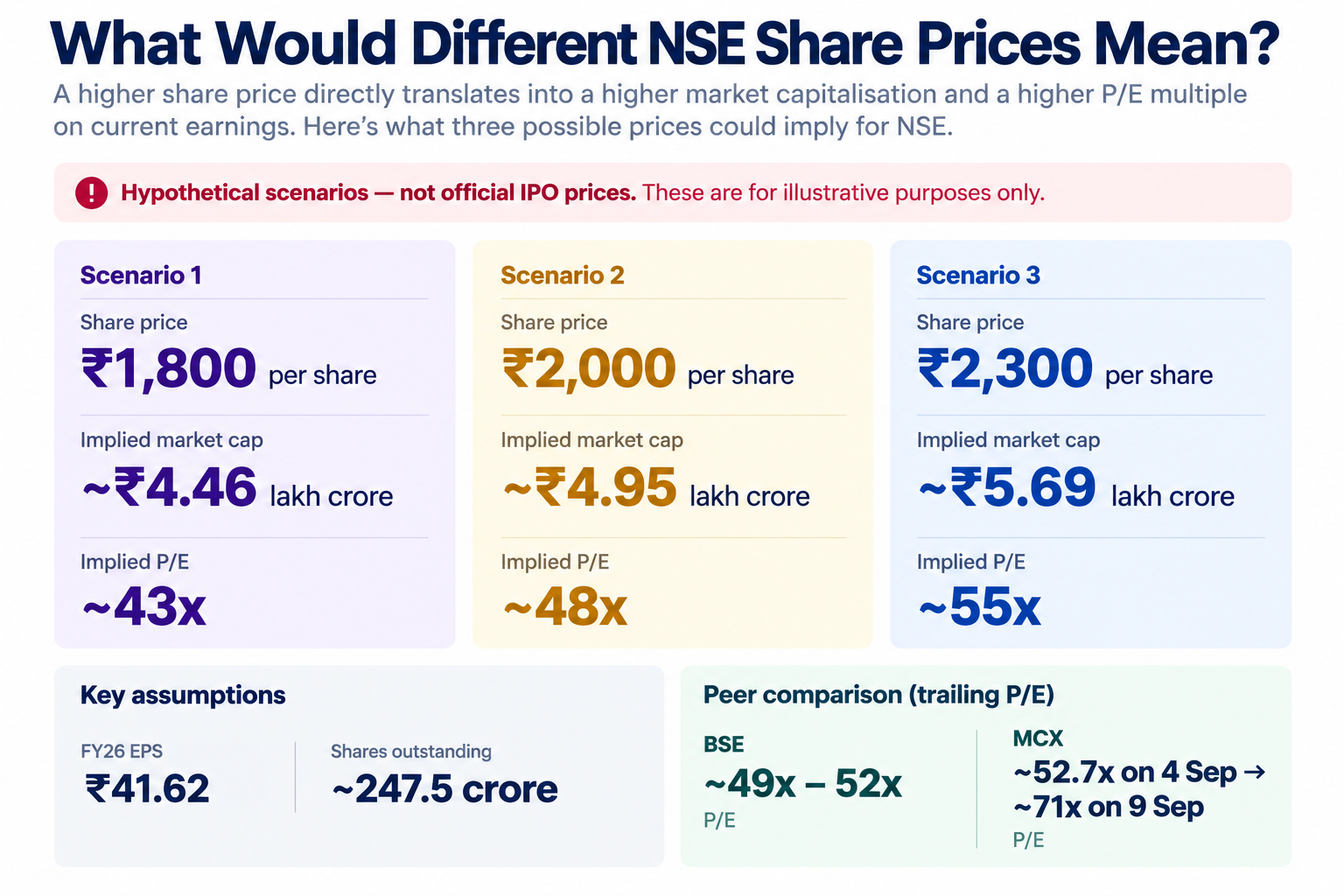
Notice what's happening. Each price isn't a prediction — it's an assumption about how much investors should pay for NSE's current earnings. ₹2,300 doesn't just mean "NSE is worth more." It means believing NSE's FY26 earnings are durable, that options revenue won't erode further, and that its scale justifies paying meaningfully more than what BSE commands for a rupee of profit.
Does NSE Deserve a Premium? The Case For and Against
There's a real case for paying up: NSE's cash and futures dominance borders on total, margins are high, and it generated ₹23,836 crore of operating cash flow in FY26, with 12.9 crore registered investors and growing data and listing revenues.
But there's an equally real case for caution. FY26 profit fell, and equity options — the largest source of that profit — face a contestable market share and a regulator already curbing excessive derivatives activity. This IPO also brings no fresh capital, so none of the proceeds fund NSE's own growth.
A premium over BSE would require believing NSE's leadership and margins make its earnings meaningfully more durable than a close rival's. Parts of that hold up, but it's a judgment call, not a certainty — exactly why the eventual price deserves scrutiny, much like how an IPO actually moves from private ownership to a public listing shows for large listings generally.
Conclusion
NSE doesn't have a confirmed price yet, and once it lists, most conversation will still be about that single number. But there are really two questions here: what NSE is worth on fundamentals, and what it might actually list at given how few shares will be freely tradeable and how much demand is reportedly waiting.
The P/E scenarios answer the first; the free-float dynamic and IRCTC's precedent answer the second — and the two don't have to agree. A scarce float and genuine hype can push a listing price well past what fundamentals alone would justify. The right response isn't memorising a "fair" P/E for exchanges — it's asking what assumptions a price forces you to make, and deciding whether you believe them, on day one or afterward. That habit outlasts NSE's listing day, including the next time an IPO's price feels disconnected from its fundamentals.
Key Takeaways
- NSE's IPO is a pure offer for sale — the company receives no proceeds, so this listing is about existing shareholders selling, not NSE raising growth capital.
- A share price means nothing on its own. Multiply it by total shares to get market capitalisation, then divide by profit to get the P/E — the real measure of what you're paying for.
- NSE's FY26 profit fell to ₹10,302 crore from ₹12,188 crore a year earlier, so any valuation built on FY25's stronger numbers would understate the current multiple.
- BSE is a more useful comparison than MCX, but neither peer's P/E should be treated as a fixed "fair" number for NSE — both shifted meaningfully within just a few days in early September 2026.
- With only about 6% of NSE's shares in free float — even scarcer than IRCTC's roughly 12.6% in 2019 — a small supply meeting large, monopoly-driven demand can push the listing price well above what P/E logic alone would suggest.