Why Zoho Never Took VC Funding?
A deep dive into how Zoho built a billion-dollar software business without ever taking a rupee of venture capital.
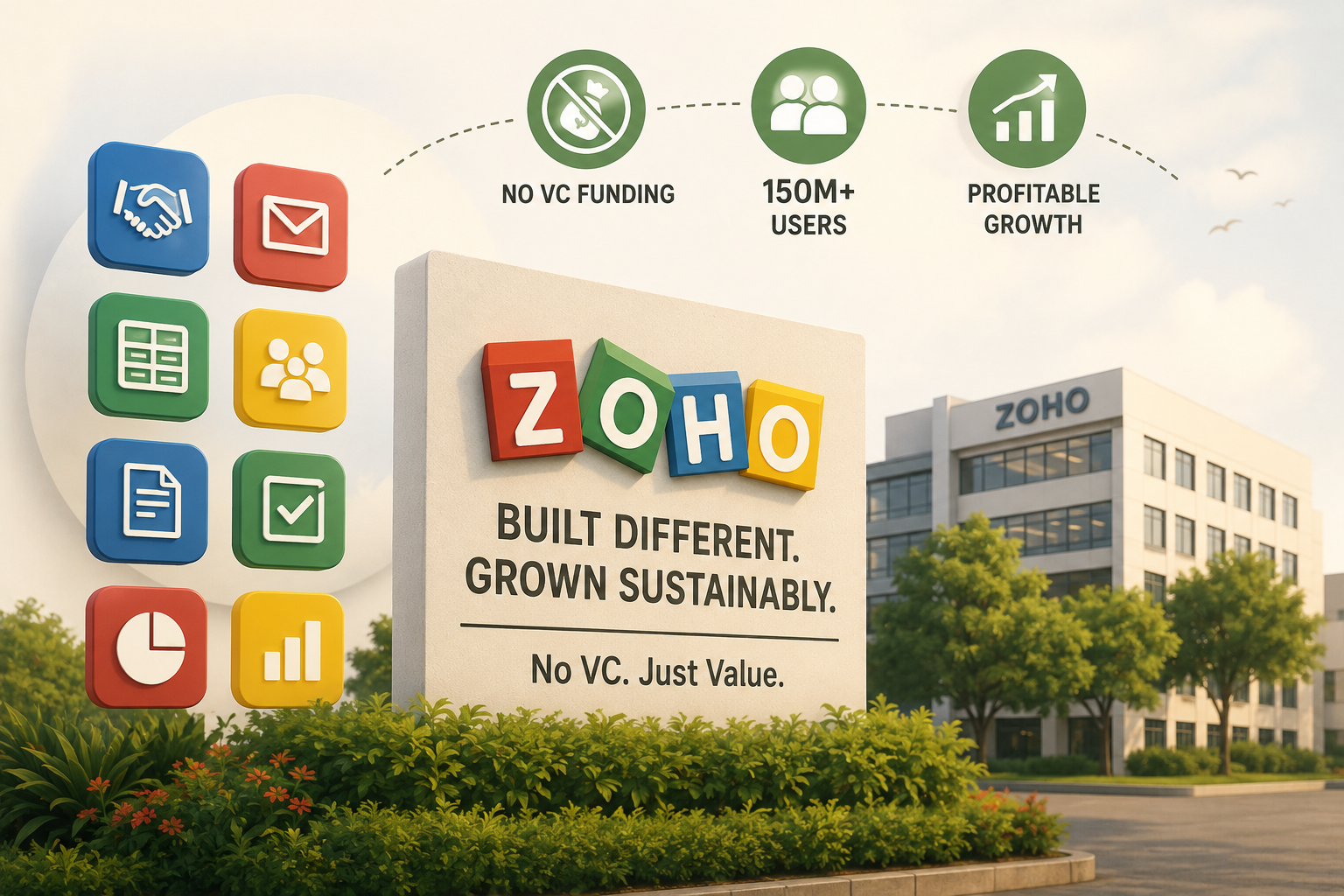
How a Chennai-headquartered software company built a multi-billion-dollar business without ever taking a single rupee from investors, and what its unconventional playbook teaches about business.
Most tech giants chase investors, headlines, and rapid scale. One of India's most successful software companies has spent three decades quietly doing the opposite.
This article discusses a privately held company. Revenue and user figures below are drawn from public filings and company disclosures as of mid-2026 and may change as Zoho reports future results.
The Billion-Dollar Company That Never Took a Rupee of VC Money
If you wanted to build a global software company, what's the first thing you'd need?
Most people would say money. Big money. The kind that comes from venture capitalists writing large checks in exchange for a slice of your company.
That's the standard startup playbook. Raise funding, grow fast, raise more funding, and hope it ends in an IPO or a big acquisition.
Zoho never played that game.
The Chennai-headquartered software company now serves more than 150 million users worldwide, offers more than 50 integrated business apps, and generates well over a billion dollars in annual revenue. And it did all of this without ever raising a single round of venture capital.
So how does a company grow this large without the fuel that seemingly every other tech giant relies on? That's the question this article is going to answer.
From a Small Networking Company to a Software Giant
To understand Zoho, you have to go back to a company you've probably never heard of: AdventNet.
In 1996, Sridhar Vembu and Tony Thomas founded AdventNet in the United States, building network management software for telecom companies. It was unglamorous, business-to-business work, far from the consumer apps most of us associate with tech success stories. Over the following years, the company built up its engineering base in Chennai, which eventually became its global headquarters.
But here's the interesting part. Instead of chasing the dot-com boom happening around them, AdventNet kept building steadily and profitably.
In the mid-2000s, the company made a pivotal shift, building cloud-based tools like Zoho Writer, an online word processor, and Zoho CRM, a tool to help businesses manage customer relationships. This was years before "cloud software" became a buzzword in India.
AdventNet eventually rebranded itself around this new direction, becoming Zoho Corporation. From there, it kept expanding, building tools for email, finance, HR, and project management, eventually bundling nearly all of them into a single subscription called Zoho One in 2017, effectively an "operating system for business."
Zoho has kept growing since. Marking its 30th anniversary in early 2026, the company reported crossing 150 million users globally and more than one million paying customers, with revenue of 12,313 crore rupees, or roughly 1.4 billion dollars, for the financial year ending March 2025, up nearly 18 percent from the year before.
Which raises the obvious question. How did a company with no outside funding manage to compete with, and often beat, giants with billions in investor backing?
Why Zoho Deliberately Avoided Venture Capital
You might assume Zoho avoided VC funding because nobody offered it any. That's not the case. Zoho chose this path on purpose, reportedly turning down outside investment even in its early years when the offer was on the table.
Think about how venture capital actually works. Investors give you money, but in return, they expect fast growth and a profitable exit, usually within seven to ten years. That pressure shapes almost every decision a VC-backed company makes, from pricing to hiring to how quickly it expands.
Sridhar Vembu has been vocal about avoiding exactly this kind of pressure. Without investors to answer to, Zoho didn't need to chase short-term growth at the cost of long-term stability.
This gave the company something rare: patience.
Zoho could price its products lower than competitors because it wasn't trying to maximize revenue every quarter to satisfy shareholders. It could invest in unconventional ideas, like setting up offices in rural towns, without needing to justify the decision to a boardroom of investors.
Of course, this approach came with trade-offs. Without VC money to spend on aggressive marketing, Zoho grew far less visible than venture-backed rivals of similar size. Many people still haven't heard of it, even though its products power businesses across the world.
But visibility was never the goal. Sustainable, founder-controlled growth was. And that mindset shaped everything else about how Zoho built its business.
One Company, More Than 50 Apps: Zoho's Business Model
So how does Zoho actually make money, and why does it need so many products?
Zoho runs on a SaaS model, short for Software as a Service. Instead of selling software once, customers pay a recurring subscription, monthly or yearly, to keep using it. Think of it like Netflix, except instead of movies, you're paying for tools that run a business.
This recurring revenue is valuable because it's predictable. A large share of Zoho's revenue comes from existing customers renewing their subscriptions rather than new customers signing up, a pattern typical of mature SaaS businesses.
But here's what makes Zoho unusual. Instead of building one great product, it built more than 50 of them, covering everything from CRM and email to accounting, HR, and analytics.
Why bother building so many tools instead of focusing on one?
Because once a business starts running its sales, finance, HR, and operations through Zoho's ecosystem, switching to a competitor becomes genuinely difficult. This is called a switching cost, and it's one of the most powerful forces in business.
Imagine moving houses, except every piece of furniture has to be individually disassembled, transported, and reassembled elsewhere, and some pieces might not even fit in the new place. That's what switching away from an integrated software ecosystem feels like for a growing business.
Zoho's pricing makes this even more compelling. Its bundled plan, Zoho One, is positioned to cost significantly less than paying separately for Microsoft 365, Salesforce, and QuickBooks. For cost-conscious small businesses, that combination of lower price and one unified system is hard to walk away from.
This is where Zoho's story stops being just about software, and starts being about something bigger: the kind of culture needed to sustain that strategy for decades.
The Culture Behind the Code
You might wonder how a bootstrapped company competes for talent against tech giants offering massive salaries and stock options.
Zoho's answer is unconventional, and it starts with education.
Instead of only hiring from top engineering colleges, Zoho runs Zoho Schools of Learning. Students, often straight after high school, are trained directly by Zoho in software and business skills, then hired as full-time employees. No traditional degree required, reflecting a philosophy Vembu often repeats: practical skill matters more than a paper credential.
Zoho has taken this further by setting up offices in small, rural towns instead of concentrating everything in major cities. The goal is to create high-quality jobs where people already live, instead of pulling talent into overcrowded urban centers.
This isn't just a feel-good initiative, it's a retention strategy. Employees trained and rooted close to home tend to stay far longer than industry averages. And a company free of investor pressure to cut costs or conduct mass layoffs offers one more advantage most startups can't: stability employees can actually trust.
But no strategy is without risk. So where does Zoho's approach start to show cracks?
Where Zoho's Model Faces Real Challenges
It would be misleading to present Zoho's story as a strategy with no downsides.
For one, Zoho still struggles with brand visibility. Despite its scale, it isn't nearly as recognized as venture-backed competitors that spend heavily on marketing.
Large enterprises also tend to default to bigger, more established names like Microsoft and Salesforce for mission-critical operations. Zoho has to continuously prove it belongs in these conversations, something reflected in its recent push to position itself as "enterprise-ready."
There's also the question of capital flexibility. In fast-moving areas like artificial intelligence, where infrastructure costs can be enormous, not having access to outside capital could eventually become a limiting factor.
Succession planning, once a purely hypothetical concern for a founder-led company, is already playing out. In a leadership transition completed in early 2025, Vembu stepped back from his executive role to become Chief Scientist, handing day-to-day charge to Shailesh Kumar Davey as Group CEO. Whether Zoho's culture and pace of decision-making hold steady under a founder no longer at the operational helm is a genuinely open question, and one worth watching over the next few years.
None of this erases what Zoho has built. But it's a reminder that even the most unconventional success stories come with genuine trade-offs.
Conclusion
Zoho's story isn't really about software. It's about what happens when a company chooses patience over pressure.
By staying bootstrapped, Zoho avoided the short-term demands that shape most startups, and used that freedom to build an integrated ecosystem, invest in unconventional talent strategies, and grow at its own pace.
It didn't become the biggest name in tech. But it built something arguably more durable: a profitable, founder-founded business that now answers to a new generation of leadership, not to a boardroom of investors chasing an exit.
In a world obsessed with rapid growth, Zoho is proof that slow, deliberate compounding can still build something massive.
Key Takeaways
- Zoho grew into a company generating well over a billion dollars in annual revenue without ever raising venture capital, relying entirely on customer revenue to fund its growth.
- Avoiding VC funding gave Zoho freedom from short-term growth pressure, letting it prioritize long-term stability over quarterly targets.
- Zoho's 50-plus integrated apps create high switching costs, since businesses that adopt multiple tools find it difficult and risky to leave the ecosystem.
- Its recurring subscription, or SaaS, model provides predictable revenue, with a large share coming from existing customers renewing rather than new signups.
- Zoho's unconventional culture, including its own training schools and rural offices, has helped it retain talent and build stability, even as it now navigates a major leadership transition away from founder Sridhar Vembu.