How Do Cashbacks Actually Work?
An explainer of the hidden math behind your ₹50 cashback, and why it was never actually free.
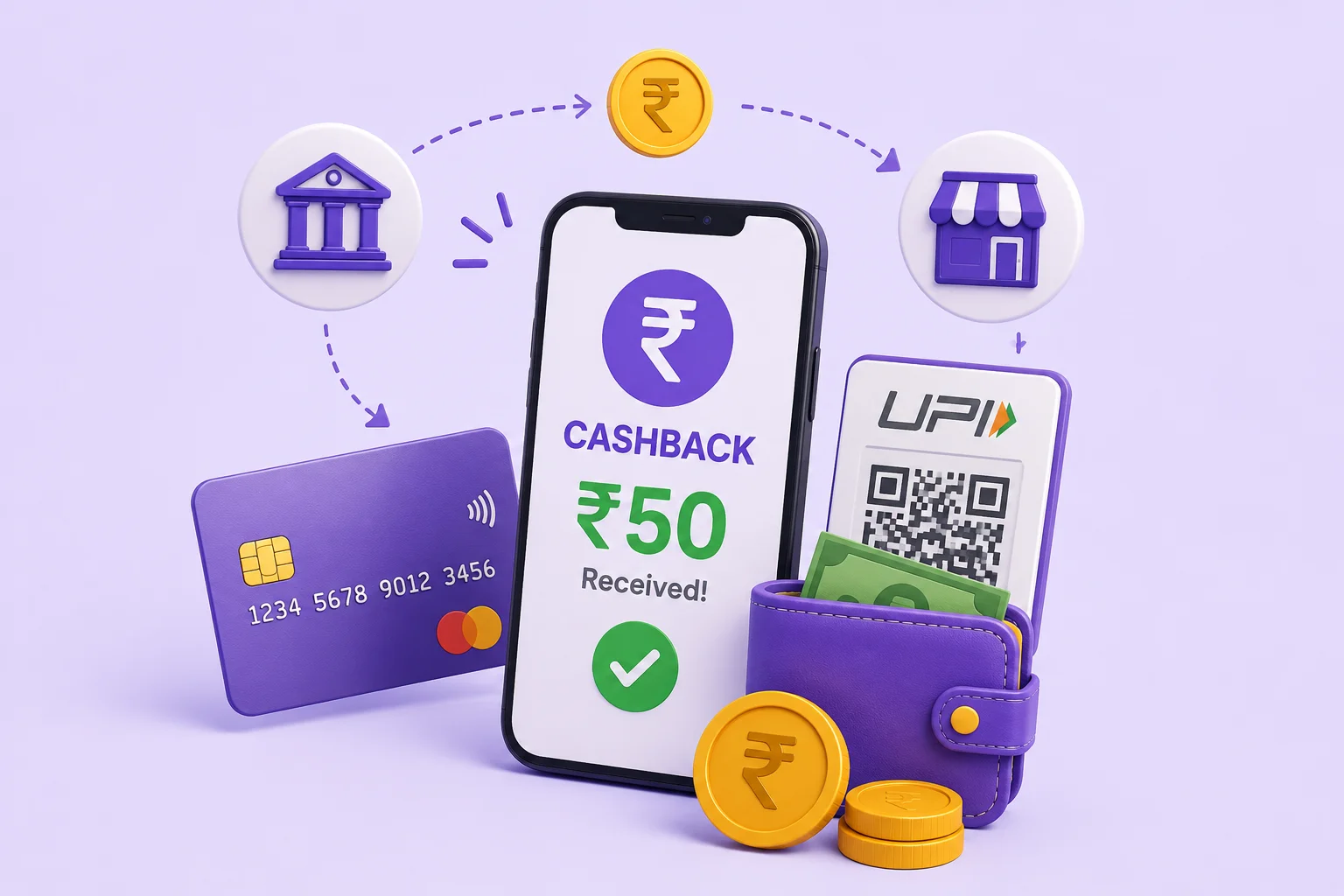
You order food, pay with a card, and ₹50 lands back in your account within seconds. But before you get excited, it's worth asking where that money actually came from.
Cashback Is Not the Same as a Discount
Think about the last time you got a cashback. Maybe it was ₹50 on a Swiggy order, or a "scratch card" on a UPI app. In that moment, it feels like free money.
But companies don't hand out money for no reason. Somewhere in that transaction, someone paid for it.
Start with the difference. A discount lowers the price you pay right now: ₹1,000 becomes ₹900, and that's it. A cashback works differently. You pay the full ₹1,000 first, and only later does part of it come back, as cash, wallet balance, or points.
You might wonder why companies bother with this roundabout method instead of simply charging less. To answer that, you need to see where the money for cashback comes from, and that starts with a fee you've probably never noticed.
The Hidden Fee Behind Every Card Swipe
Every time you pay a shop with a card, something happens you never see: the shop doesn't receive the full amount.
Say you buy something for ₹1,000, and the shop only receives ₹980. That missing ₹20 is the Merchant Discount Rate, or MDR: a small fee merchants pay to accept digital payments. It's split between your bank, the payment network (Visa or RuPay), and sometimes a payment app in between.
That ₹20 is a pool of money changing hands with every transaction you make, and a portion of it is exactly what funds your cashback.
The biggest chunk usually goes to the bank that issued your card, through the interchange fee. That fee is the real engine behind most credit card cashback.
Why Your Bank Is Happy to Pay You Back
Your bank earns interchange fees every time you swipe your card. It also earns interest when you don't clear your bill on time, plus annual fees and other charges.
Some of this revenue gets redirected straight back to you as cashback, to keep you using that card instead of a rival's, or instead of cash.
So when your bank offers 1-2% cashback, it isn't being generous. It's spending part of what it already earns from you, and from the merchants you shop at, to keep you loyal.
That explains credit cards. But UPI apps work almost nothing like this, and the reason reveals something important about how young companies grow in India.
Why Early UPI Apps Gave Away So Much Money
If you've wondered why Paytm, PhonePe, and Google Pay once showered users with cashback, the surprising part is that most of that money had nothing to do with merchant fees.
Standard UPI payments have carried zero MDR by RBI and government mandate since January 2020, so there was barely any fee pool to share with you. Instead, the cashback came largely from venture capital and marketing budgets. Investors funded these apps, and the companies paid you directly just to get you to install the app and build the habit.
This is a customer acquisition strategy, and it has a name worth knowing: Customer Acquisition Cost, or CAC. It's how much a company spends to win one new active user.
But spending to acquire you only makes sense if you're worth more than what they spent. Worth more, how?
The Real Bet: Are You Worth More Than the Cashback?
This is where a second concept comes in: Lifetime Value, or LTV. It's the total profit a company expects to earn from you over the years you stay with them.
The entire cashback strategy rests on one bet: LTV must eventually beat CAC. Spend ₹200 in cashback to acquire a user who generates ₹2,000 in profit over a few years, and that ₹200 was smart money.
But if you grab the cashback and never return, the company just lost ₹200. Multiply that across millions of users, and you understand why so many once-generous apps eventually cut back.
Which brings up an interesting pattern: almost every major cashback app in India followed the same lifecycle.
The Cashback Lifecycle: From Land-Grab to Loyalty
Between 2016 and 2019, Paytm and PhonePe ran aggressive campaigns, especially after the 2016 demonetization drive pushed millions toward digital payments. Those campaigns were funded heavily by investor capital and aimed at building a user base fast.
Google Pay's scratch card era worked similarly, turning every UPI transfer into something like a mini lottery. Amazon Pay ran high introductory cashbacks on bills and recharges to pull payment volume into its ecosystem.
In every case, the pattern was the same: heavy, broad cashbacks during the early land-grab phase, followed by narrower, more targeted offers once the user base was already built.
So what happens once the free money slows down? By then, something else has already been shaping your behavior, and it isn't the money at all.
Why ₹500 Cashback Feels Better Than ₹500 Off
Here's a quirk of the human mind: "Get ₹500 cashback" feels more exciting than "₹500 off," even though they're worth the same. Cashback is framed as a gain - you're earning something - while a discount just means paying less, and our brains respond more strongly to gains.
There's also mental accounting at play. Most people treat cashback as "found money," a separate pot that doesn't count as part of their regular budget - which is why even a small cashback can feel like a win.
Companies understand this well, and it shapes behavior beyond the cashback itself. You might add an extra item to cross a minimum-spend threshold, or return to an app specifically to "use up" your rewards.
In other words, cashbacks aren't just designed to save you money. They're designed to change what you buy, where you buy it, and how often you come back.
When "Free Money" Actually Costs You Money
Not every cashback deal works in your favor. A few common traps are worth knowing.
Spending more to qualify: buying an extra item just to reach a minimum spend for ₹200 cashback often means spending more overall than if you'd skipped the offer.
Ignoring interest: chasing card cashback while not paying your bill in full can mean interest charges far larger than the reward.
Choosing a pricier option: a store offering 10% cashback but charging 20% more than a competitor isn't actually a good deal - compare total cost, not just the reward.
Wallet breakage: cashback credited as non-transferable wallet balance can quietly expire unused, and the platform keeps that money.
The rule worth remembering: treat cashback as a bonus on a purchase you'd already planned, never as a reason to spend more than intended.
Conclusion
Pulling it together, the answer depends on where the offer came from. Banks pay using interchange and interest income earned from your card use. Merchants pay through MDR and promotional budgets when they co-fund an offer. Platforms like UPI apps, e-commerce sites, and food delivery services pay through marketing budgets and investor capital, especially while they're still growing. Payment networks occasionally chip in on co-branded campaigns.
None of this money appears out of nowhere - it's part of a system where fees, interest, and marketing budgets are constantly redistributed, timed to land right when you're about to spend.
You benefit from cashback when you'd have made the purchase anyway, stay disciplined about interest and fees, and compare total cost rather than just the reward. Companies benefit when you spend more, stay loyal for years, and eventually use their higher-margin products.
Understanding this doesn't mean you should stop using cashback offers. It just means you can finally answer where that money came from - and use it a little more wisely.
Key Takeaways
- Cashback isn't free money - it's funded by fees like MDR and interchange, by marketing budgets, or by investor capital, depending on who's offering it.
- Credit card cashback is usually funded by your bank's interchange and interest income, while early UPI app cashback was largely funded by venture capital to acquire new users.
- Companies keep offering cashback only if your Lifetime Value (LTV) ends up higher than what it cost to acquire you (CAC) - which is why generous offers tend to shrink over time.
- Cashback feels more rewarding than an equivalent discount because of how our brains process gains versus lower prices - a psychological effect companies design for.
- Always compare total cost, not just the cashback amount, and treat rewards as a bonus, never a reason to spend more than planned.