What You Have at 25 That You Won't Have at 35
By Madhvendra
An explainer of why starting a SIP at 25 instead of 35 can be worth ₹1.76 crore more by 65, and what waiting actually costs in extra monthly investment.

A bigger salary at 35 sounds like the obvious win. So why does the money you invest at 25, when you're earning the least you ever will, end up mattering more than any raise that comes later?
Every rupee you invest in your twenties through a SIP carries something no later rupee can fully replace, and the reason has less to do with money than with time.
Think about it for a second. What financial advantage do you actually have at 25 that you won't have at 35?
It's not a bigger salary. At 25, most people earn less than they will a decade later. It's not better stock picks either; nobody has a reliable edge there.
The one thing a 25-year-old has that a 35-year-old simply cannot get back is ten extra years. And as it turns out, those ten years are worth a lot more than they sound.
The Ten-Year Head Start That's Worth ₹1.76 Crore
Here's a way to see it in numbers.
Say two people, Investor A and Investor B, each invest ₹5,000 every month into an equity mutual fund through a SIP (Systematic Investment Plan). Investor A starts at 25. Investor B starts at 35, doing everything else exactly the same.
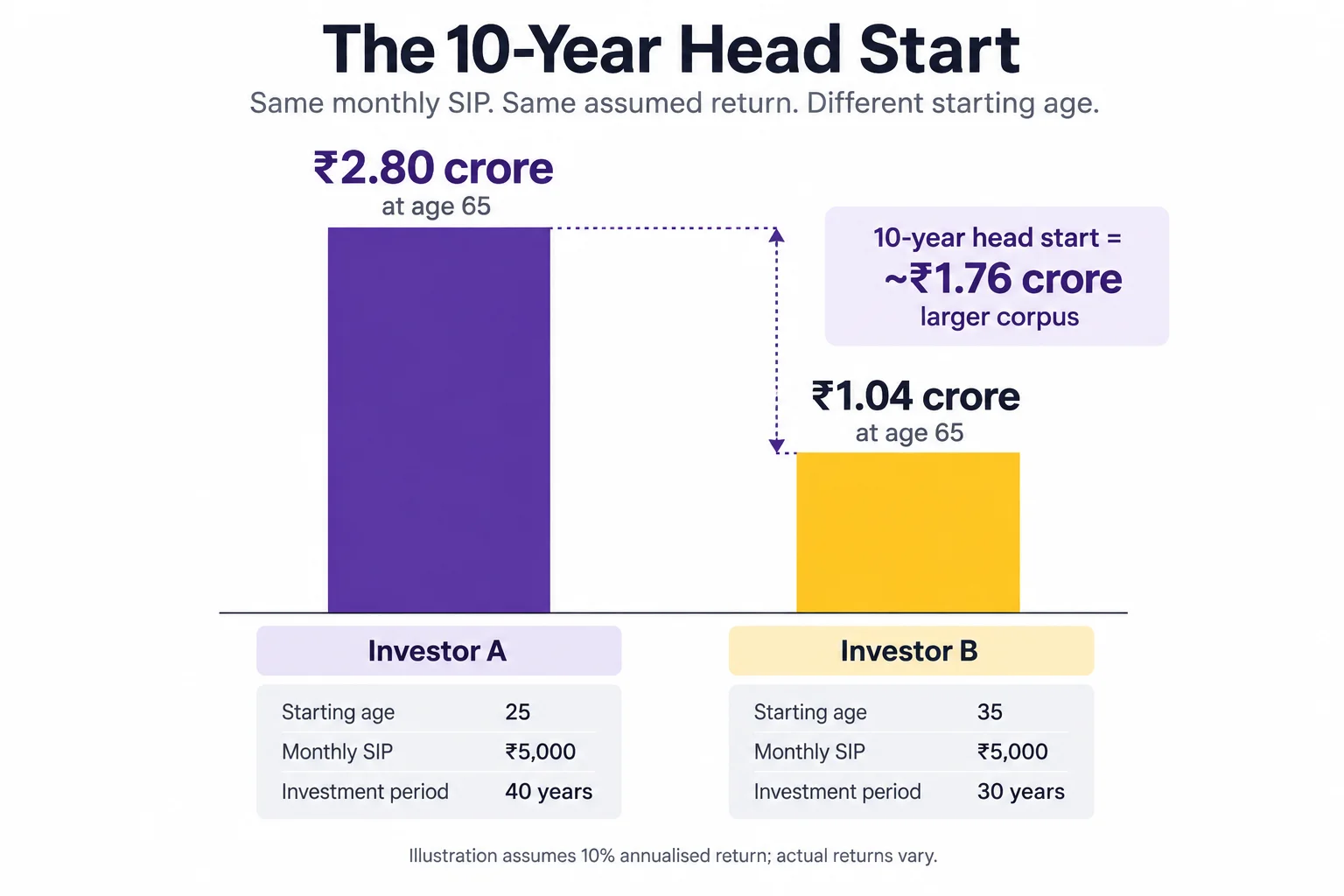
Assuming a 10 percent annualized return, by the time both reach 65, Investor A ends up with an estimated corpus of about ₹2.80 crore. Investor B ends up with about ₹1.04 crore.
That's a gap of roughly ₹1.76 crore, purely because of when they started.
To be clear, this is a mathematical illustration, not a promise. Markets don't move in a straight line, and 10 percent a year is an assumption, not a guarantee. But the pattern it reveals holds regardless of which return you assume: the earlier starter ends up meaningfully ahead.
So what actually created that gap? That's where it gets interesting.
Why the Gap Isn't Really About Investing More
You'd assume Investor A simply put in more money overall. Ten extra years of ₹5,000 a month does add up, after all.
But when you break the ₹1.76 crore gap down, contributions barely explain it.
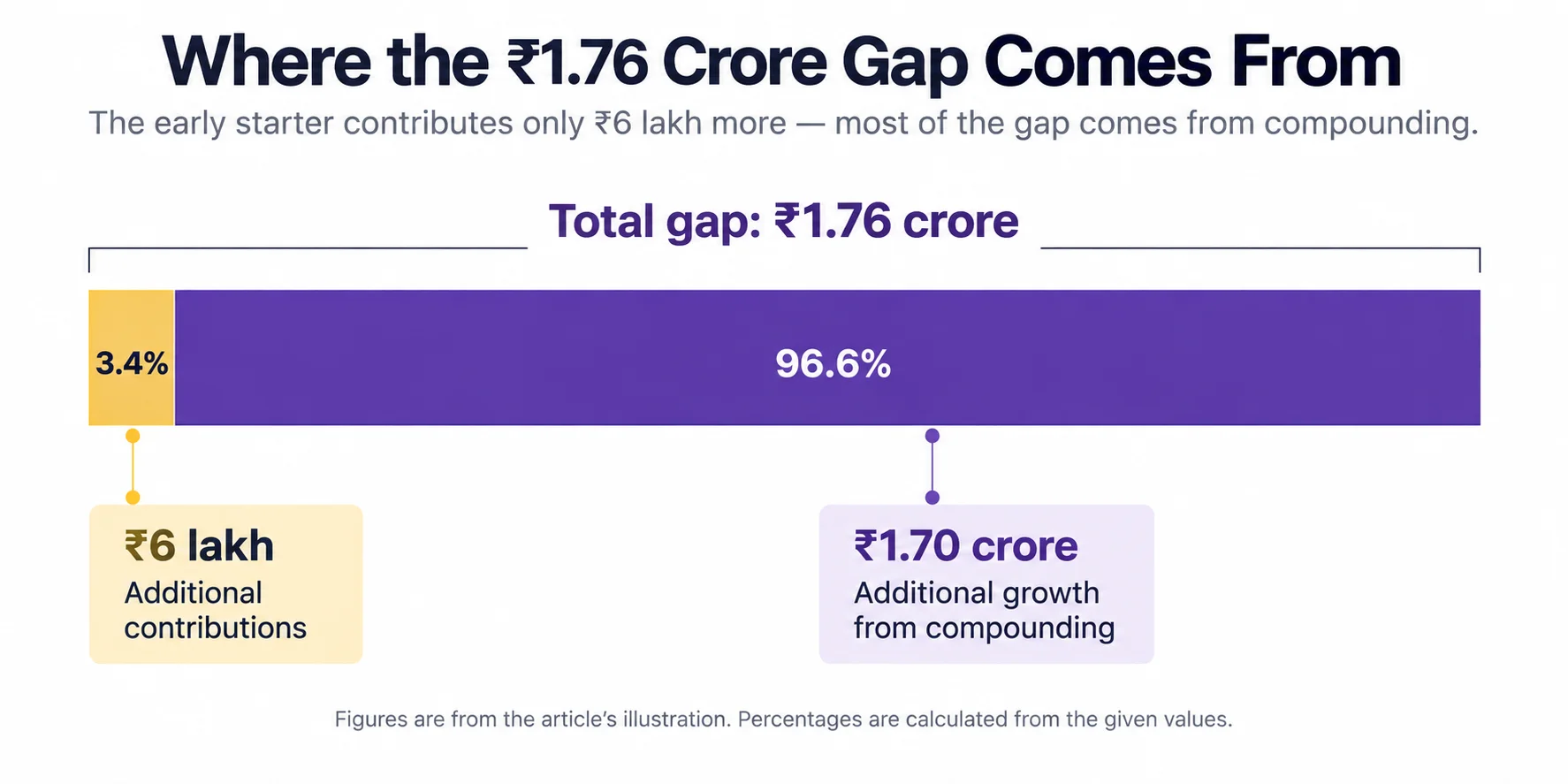
Investor A's extra ten years of instalments add up to about ₹6 lakh more than Investor B invested in total. That's it. Six lakh, out of a gap of nearly two crore.
The remaining ₹1.70 crore comes from something else entirely: compounding. Those early instalments didn't just sit there for ten extra years. They earned returns, and then those returns went on to earn their own returns.
This is the real lesson hiding inside the numbers. The advantage of starting early isn't that you contribute more money over your lifetime. It's that your earliest money gets the longest possible runway to grow. A SIP instalment made at 25 can compound for 40 years by the time you're 65. The same instalment made at 35 only gets 30.
Which raises a natural follow-up: does this mean you need a large amount to start with? Not really.
Start Small, But Start Now
You might be thinking none of this applies to you yet, because right now you can only spare ₹2,000 a month, not ₹5,000.
The amount matters less than you'd expect, because time does most of the work.
At the same 10 percent assumption, a ₹2,000 monthly SIP grows to about ₹14.48 lakh over 20 years. Over 30 years, it becomes roughly ₹41.59 lakh. Stretch it to 40 years, and it turns into an estimated ₹1.12 crore.
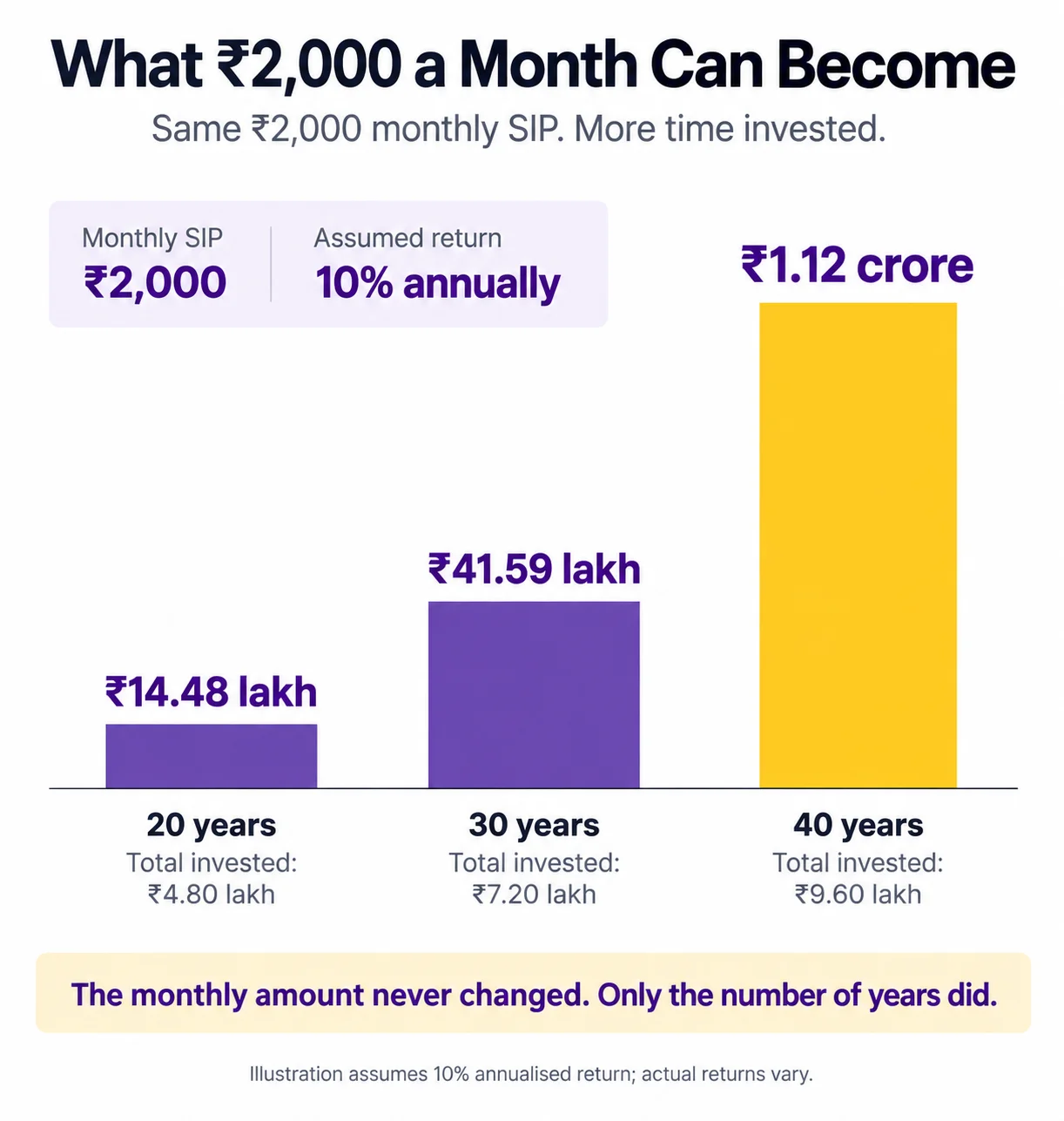
The monthly amount never changed. Only the number of years it stayed invested did.
This is why waiting to "start properly" once you earn more is often the more expensive choice, not the safer one. A modest, consistent habit started today has more time working in its favor than a bigger one started later. If you're still figuring out how to fit any investing into a tight student or early-career budget, this is worth working through alongside the basics of budgeting and SIPs for young earners.
But to really trust that time is doing this much work, it helps to understand what's happening under the hood.
What's Actually Happening Behind the Scenes
But what does compounding actually mean, beyond being a word thrown around in every finance conversation?
Say you invest ₹10,000 and it earns 10 percent in a year. You'd have ₹11,000. Simple enough.
This is where it gets interesting. If that full ₹11,000 stays invested and earns another 10 percent the next year, you don't just get another ₹1,000. You get ₹1,100, because now the return is being calculated on ₹11,000, not the original ₹10,000.
With a SIP, this happens on a rolling basis, month after month. Every instalment you invest has its own individual holding period. Your first instalment compounds for the longest time of all; your very last instalment barely compounds at all. That's exactly why the earliest years of a SIP matter disproportionately more than the later ones, even though they often feel the least exciting.
In fact, the first few years of any SIP can look almost disappointingly slow. Most of what you see in your account early on is simply your own money, not growth. It's only once the corpus itself becomes large that the same percentage return starts producing meaningfully large rupee gains. A 10 percent return on ₹10 lakh adds about ₹1 lakh. A 10 percent return on ₹1 crore adds about ₹10 lakh. Nothing changed except scale, and scale takes years to build.
This is also why waiting to start has a cost that's easy to underestimate.
The Real Cost of Waiting
What would it actually take for Investor B, who started at 35, to catch up to Investor A?
If B wants to match A's estimated ₹2.80 crore corpus by age 65, B can't just invest ₹5,000 a month starting ten years later. At a 10 percent return assumption, B would need to invest roughly ₹13,453 every month instead, nearly 2.7 times more than A ever had to.
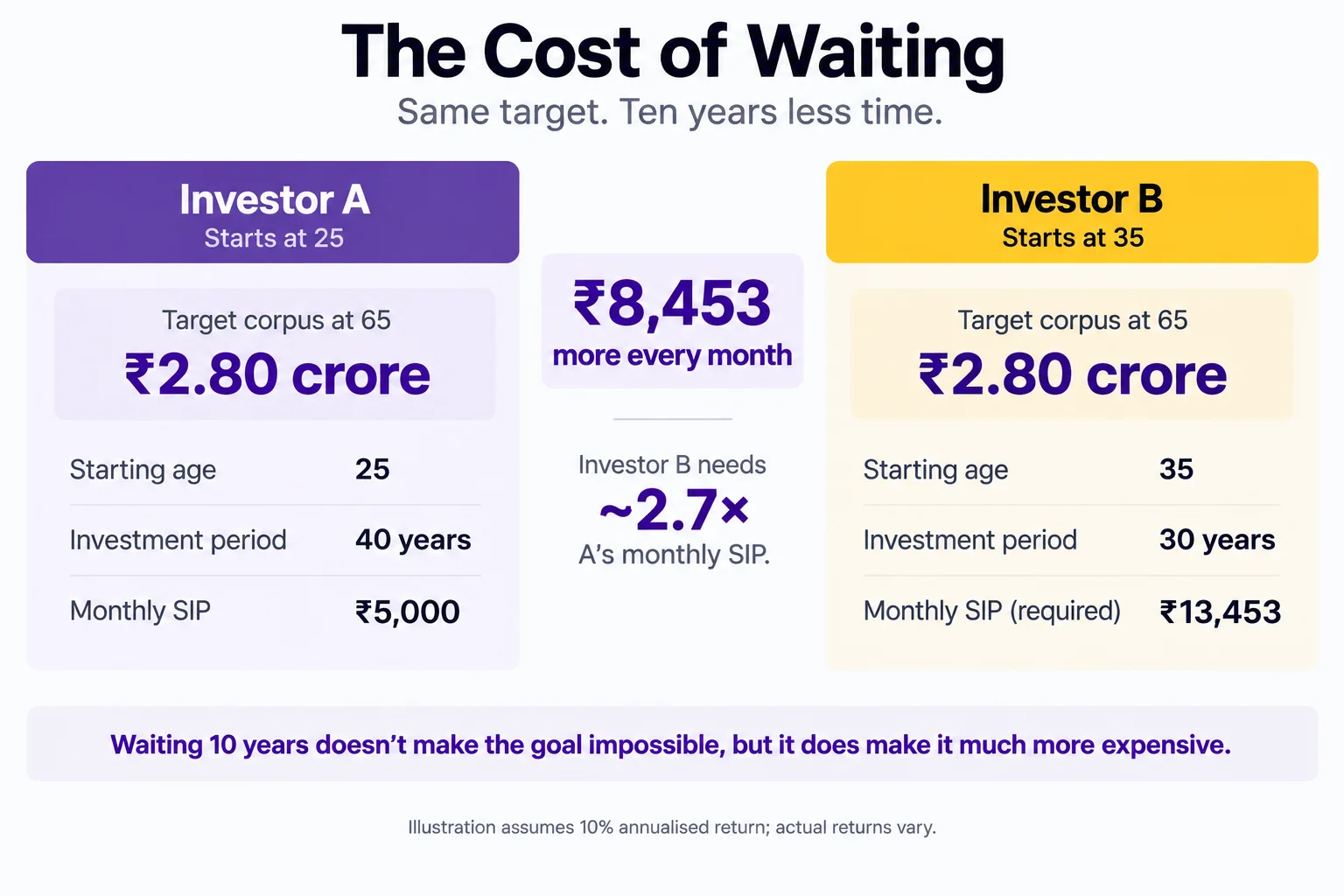
That's about ₹8,453 extra every single month, for 30 straight years, just to end up in the same place.
This is the part that rarely gets said out loud: waiting doesn't make investing impossible. It just makes the monthly burden a lot heavier for the same result. The ten years you spend "waiting until things settle down" don't disappear. They get converted into a bigger number you'll need to find later.
Of course, none of this happens in a vacuum. It's worth asking how this plays out against what's actually happening in Indian markets and among Indian investors.
Before You Get Too Excited About That Crore
It would be easy to walk away from all this thinking a crore or two, decades from now, sounds like a lot of money. It is, but perhaps not as much as it sounds.
A ₹1 crore corpus received 30 years from now, assuming inflation averages around 5 percent, would only be worth about ₹23 lakh in today's purchasing power. After 40 years, it shrinks further to roughly ₹14 lakh in today's terms. Investing early builds a bigger nominal number, but that number still has to be measured against what things will actually cost by the time you use it.
There's good reason to take the "start early" idea seriously in India specifically. Monthly SIP contributions have climbed from ₹15,814 crore in August 2023 to ₹32,297 crore in August 2026, with contributing SIP accounts crossing 10 crore for the first time that month, according to AMFI (Association of Mutual Funds in India) data. Over the 20 years to early 2026, the Nifty 50 Total Return Index has delivered annualized returns of around 12.44 percent, per NSE's Nifty 50 index data, a number that shows why long horizons have historically rewarded patience, alongside how the genius of index funds lies precisely in capturing that kind of broad, long-run growth without needing to pick winners.
But that history comes with real volatility attached. The same index fell 51.3 percent in 2008 and then rose 77.6 percent in 2009. Anyone using 8, 10 or 12 percent as an assumption should treat it exactly as that: an assumption, not a forecast. Past performance never guarantees what comes next, and every mutual fund investment carries market risk that a SIP reduces the timing of, but never eliminates.
Conclusion
The honest answer to "what's the real advantage of your 20s" isn't glamorous. It isn't a hack, a shortcut, or a specific stock. It's simply time, and time, unlike income, is not something you can make up for later by trying harder.
Someone starting at 25 doesn't need a bigger salary or sharper market instincts to end up meaningfully ahead of someone starting at 35. They just need to start, stay invested, and let a decade of extra compounding do quiet, unglamorous work in the background.
The number that matters most in this whole story isn't ₹2.80 crore or ₹1.76 crore. It's the ten years those numbers were built on: years that, once spent waiting, cannot be bought back at any price.
Key Takeaways
- The biggest financial edge in your 20s is time, not income: a rupee invested at 25 can compound for years longer than the same rupee invested at 35.
- Most of the gap between an early and a late starter comes from extra compounding, not extra contributions: in this illustration, ₹6 lakh in additional contributions produced roughly ₹1.70 crore in additional growth.
- A smaller SIP started early can build a larger corpus than a bigger SIP started later, because it has more years to compound.
- Delaying investing doesn't make it impossible, but it can nearly triple the monthly amount needed later to reach the same goal.
- Treat any return assumption, whether 8, 10 or 12 percent, as an illustration, and always weigh a future corpus against inflation, taxes and costs before calling it "enough."