· Economy
Will You Really Pay Extra to Use UPI From October 15?
An explainer of India's new UPI MDR rule from October 15, 2026: what the 0.4% charge covers, who actually pays it, and why most users won't notice.
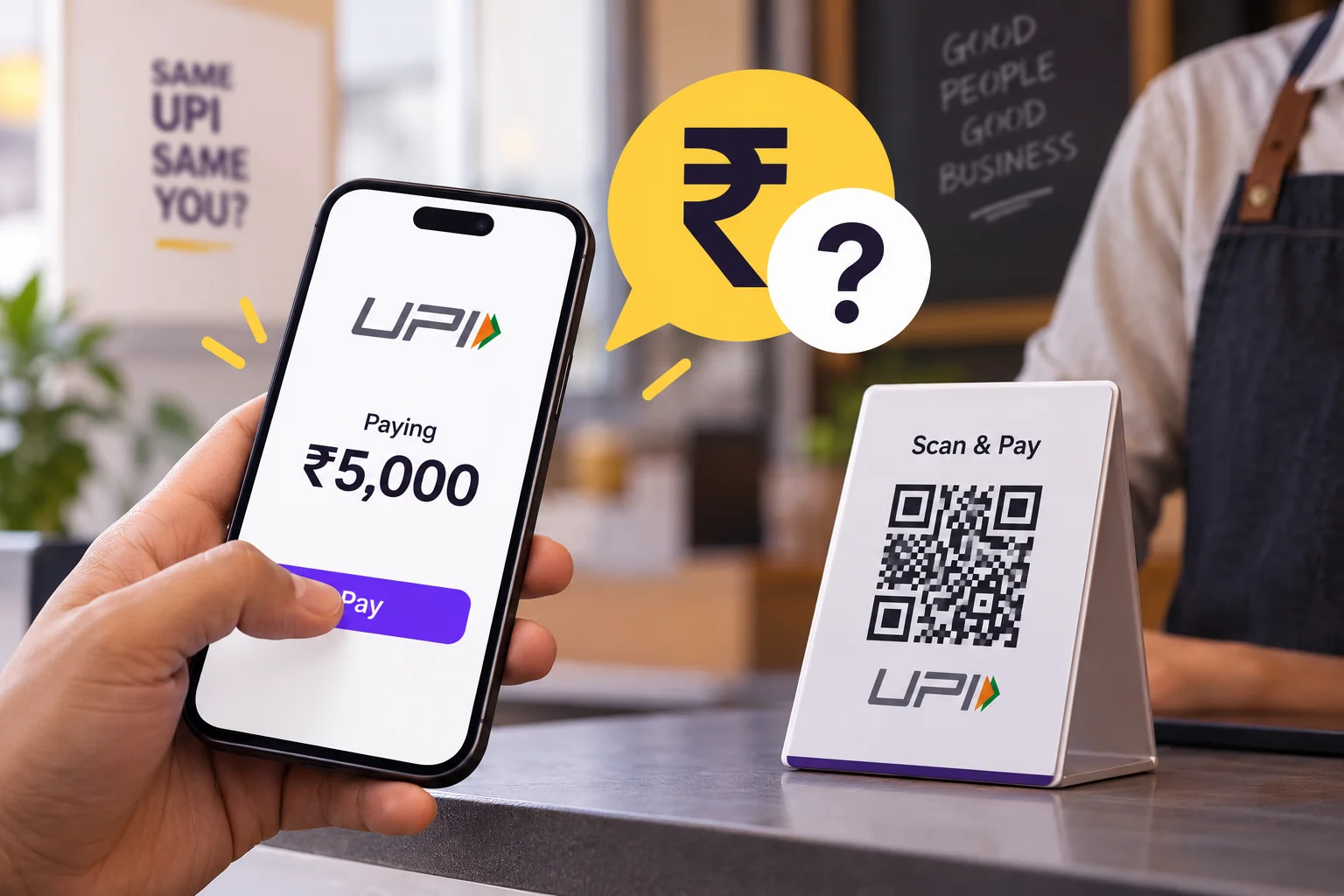
NPCI says almost nothing changes for the average UPI user. So why has one WhatsApp forward convinced half of India that their next big payment is about to get costlier?
Last updated: 18 September 2026. This article reflects the NPCI and Ministry of Finance framework announced on 15 September 2026, effective 15 October 2026. Implementation details can shift before and after the rollout, so treat specifics as current as of publication and verify with NPCI or your bank if you're making a business decision around it.
Somewhere between a headline and a WhatsApp forward, "UPI (Unified Payments Interface) payments above ₹2,000 will attract 0.4% MDR" turned into a rumour that your next big UPI payment might just get more expensive.
You open your UPI app to pay a shopkeeper ₹5,000.
And somewhere in the back of your mind, a headline from last week pops up: UPI payments above ₹2,000 will now cost you extra.
So you pause. Is that ₹5,000 payment about to become ₹5,020?
Here's the thing. It's a fair question to ask, because the headline sounds like it applies to you, the customer, scanning a QR (Quick Response) code.
But that's exactly where the confusion begins. Because the fee everyone's talking about was never really about you in the first place.
What is actually changing on October 15
Let's slow down and look at what was actually announced.
On 15 September 2026, the National Payments Corporation of India (NPCI), along with the Department of Financial Services, released a new framework for UPI merchant payments. It kicks in from 15 October 2026.
The new rule introduces a Merchant Discount Rate, or MDR, of 0.4% on certain UPI payments made to merchants above ₹2,000.
Notice the word merchant. That word is doing a lot of work here.
MDR isn't a customer charge. It's a fee that a merchant, like a shop or a business, pays for accepting a digital payment. Think of it the way a shopkeeper already pays a small fee to a card machine company every time you swipe a card. UPI simply didn't have this fee for merchants since 2020. Now, in specific cases, it's coming back.
So before we go further, here's the one line worth remembering: this is a merchant-side cost, not a customer-side charge.
But if it's a merchant fee, why does it matter to you at all? That's what we'll unpack next.
The ₹5,000 example that clears up the confusion
Let's take the exact number everyone's asking about: ₹5,000.
Scenario one. You send ₹5,000 to a friend on UPI. This is a person-to-person, or P2P, transfer. Under the new framework, P2P transfers remain completely free, no matter how large the amount. Your friend still receives the full ₹5,000.
Scenario two. You pay a shop ₹5,000 for a purchase using a normal UPI QR code. This is a person-to-merchant, or P2M, payment. Here, if the merchant falls under the standard category, a 0.4% MDR applies, which works out to ₹20.
But here's the part that matters most: you still pay ₹5,000. Not ₹5,020. The government has been clear that ordinary consumers will continue to use UPI free of cost, and banks have been advised to ensure merchants don't pass the MDR cost onto customers. The ₹20 is a cost the merchant may bear, not something added to your payment.
So the shopkeeper's settlement might come to ₹4,980 instead of the full ₹5,000, before any tax treatment is considered. You wouldn't even notice the difference from your side of the screen.
Which raises the next obvious question: does this apply to every merchant, every time?
Not every merchant payment is treated the same way
This is where the framework gets more layered than the headline suggests.
First, size matters. The 0.4% rate only applies above ₹2,000. Payments up to ₹2,000, which NPCI says make up more than 95% of all merchant UPI payments by volume, remain at zero MDR. So most of the transactions happening every day at your local kirana store or tea stall aren't affected at all.
Second, the fee doesn't grow forever. It's capped at ₹300 per transaction once the payment reaches ₹75,000 or more. So a ₹1 lakh merchant payment still only carries a ₹300 cap, not ₹400.
Third, and this is important, small merchants get specific protection. If a merchant receives UPI QR payments directly into their own bank account and stays within ₹1 lakh a month in such receipts, they remain at zero MDR, even for individual payments above ₹2,000. Only if they cross that threshold for three consecutive months do they move into the standard category.
So a small vendor selling you a ₹3,000 saree isn't necessarily paying the same fee as a large electronics showroom selling you a ₹75,000 television.
But some categories don't follow the 0.4% rule at all. Let's look at those next.
The exceptions: railways, fuel, mutual funds, and more
A few categories run on entirely different rules.
Railways, telecom services, insurance, and fuel, among other specified categories, don't pay the standard 0.4%. Instead, they're charged a flat ₹5 per transaction above ₹2,000, regardless of how large the payment is.
Capital market payments, like buying mutual funds, securities, or paying a stockbroker, follow a different formula again: 0.02% of the transaction value, capped at ₹300. So if you invest ₹5,000 into a mutual fund through UPI, the MDR involved would be roughly ₹1, nowhere close to the standard rate.
This matters because a lot of the online confusion mixed these categories together, as if every payment above ₹2,000 automatically meant a 0.4% charge. It doesn't. The rate depends heavily on what you're paying for.
Which brings us to the one question everyone actually wants answered: could a shop just pass this fee on to you anyway?
Could shops charge you extra for using UPI?
This is where things get a little less black-and-white.
The stated policy intent is clear: consumers shouldn't pay directly for using UPI. Reports around the framework mention that banks have been advised to ensure merchants don't pass the MDR cost onto customers.
But "advised" is different from a hard legal ban. The research behind this framework didn't turn up a specific law that stops every business from ever reflecting payment costs in its pricing. A shop raising its overall prices for its own reasons is a different thing from adding a separate "UPI fee" line at checkout, and the distinction between the two may come down to a merchant's agreement with its bank or payment provider.
There's also an open question around Goods and Services Tax (GST). Some reports suggest an 18% GST could apply to the MDR component itself, which would push that ₹20 merchant fee to around ₹23.60. This kind of GST-on-MDR treatment isn't unheard of; it's already the practice on some UPI-linked charges, such as RuPay Credit Card transactions routed through UPI, where an 18% GST is added on top of the MDR. But no official notification has confirmed this treatment for the new P2M framework specifically, so it's a detail to watch rather than treat as settled.
In short: the intent is that you don't pay more. Whether every merchant sticks to that in practice is something only time, and enforcement, will tell.
So if this fee mostly hits merchants and not you, why bring it back at all? That's really the bigger story here.
Why "free" UPI never actually meant cost-free
Here's the part that's easy to forget while scanning a QR code in two seconds: UPI was never actually free to run.
Someone has to pay for the banks, the servers, the fraud detection, the customer support, and the infrastructure that lets a ₹10 tea payment go through instantly, every single time, for hundreds of crores of transactions a month. In August 2026 alone, UPI processed 24.51 billion transactions worth ₹29.82 lakh crore, the highest monthly volume on record.
Since 2020, this cost was mostly absorbed by banks, payment companies, and government incentive schemes, like the ₹1,500 crore scheme that supported low-value merchant transactions in FY 2024-25. Consumers never saw a bill, but someone was quietly footing it.
The new MDR framework is essentially an attempt to share that cost differently, by asking select higher-value merchant transactions to contribute, while keeping small payments, small merchants, and all person-to-person transfers untouched. If you want to understand this cost question in more depth, Why Is UPI Free? The Real Cost Behind India's ₹0 Payments walks through exactly who has been paying for your "free" UPI all along.
It's also not the first time this exact debate has surfaced. If this feels familiar, Is Free UPI Really Coming to an End? covers the earlier round of speculation on this same question.
Conclusion
So, will you pay more to use UPI from October 15?
For the vast majority of what most people actually do, sending money to friends, paying for a ₹200 auto ride, buying vegetables from a small vendor, the answer is no. Nothing changes.
The new 0.4% MDR is narrowly targeted: it applies to select merchant payments above ₹2,000, with the standard business paying the fee, not you. Small merchants have protection, certain categories get entirely different rates, and P2P transfers stay untouched no matter the amount.
What this framework really tells us is that "free" digital payments were always being paid for by someone, somewhere in the system. The bigger question isn't whether you'll notice a charge on your next UPI payment. It's whether merchants absorb this new cost quietly, or find ways, direct or indirect, to eventually pass a piece of it back to you.
Key Takeaways
- The new 0.4% MDR applies only to select merchant (P2M) UPI payments above ₹2,000. Friend-to-friend transfers remain free at any amount.
- As a customer, you still pay the exact amount you intend to pay. The MDR is a cost the merchant may bear, not an addition to your transaction.
- Small merchants receiving up to ₹1 lakh a month through UPI QR codes stay at zero MDR, even on payments above ₹2,000, unless they cross that threshold for three straight months.
- Special categories like railways, telecom, insurance, and fuel pay a flat ₹5 fee above ₹2,000, while capital market payments like mutual funds carry a separate 0.02% rate, both very different from the standard 0.4%.
- The rule that merchants shouldn't pass this cost to customers is a stated policy intent backed by bank advisories, not a confirmed blanket legal ban, so it's worth watching how it plays out after October 15.