Why Is UPI Free? The Real Cost Behind India's ₹0 Payments
By Anish Pujari
UPI transactions cost banks and NPCI real money to process. Here's who actually pays for India's "free" payment system and why that might change.
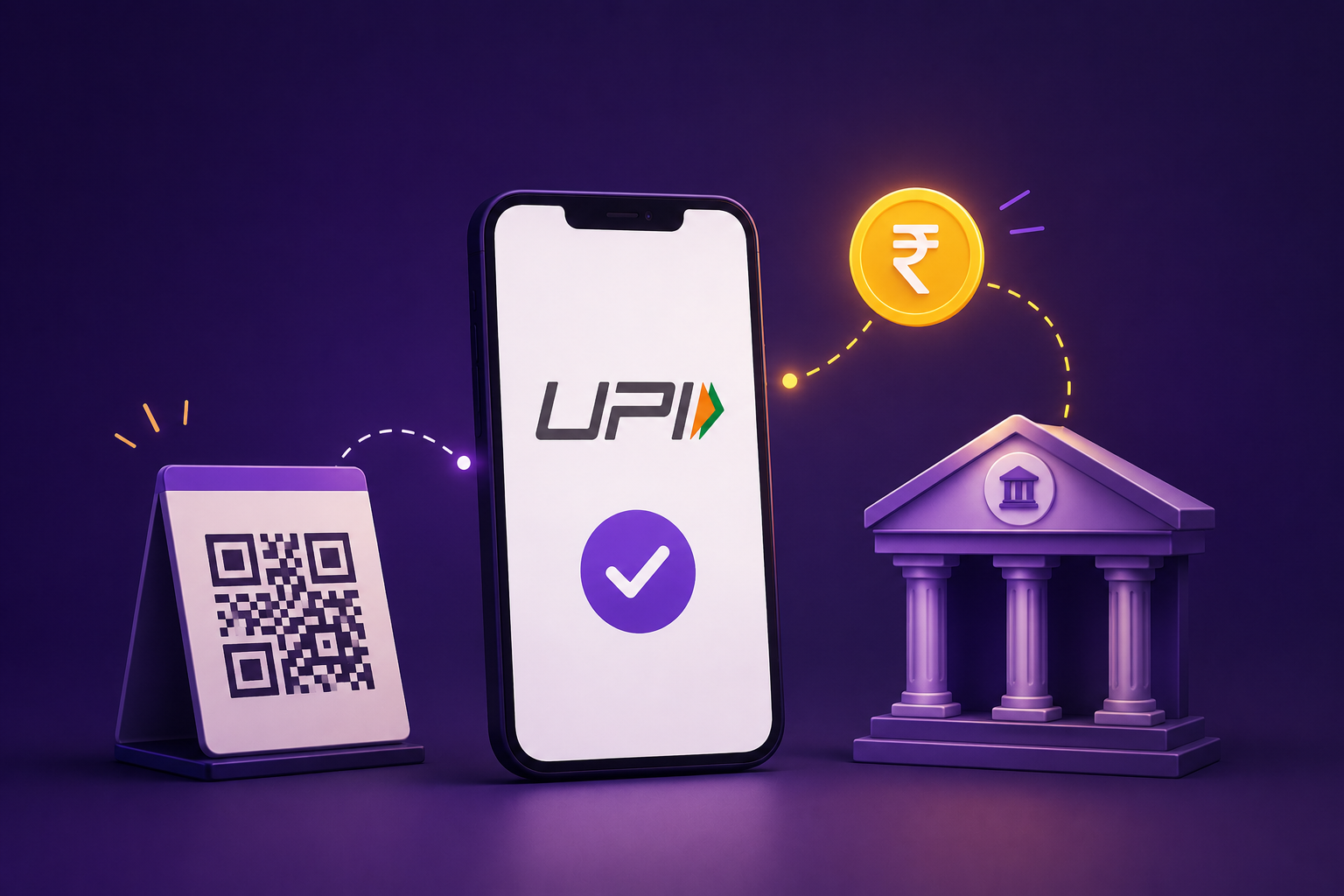
Every month, Indians make tens of billions of UPI payments without paying a single rupee in fees. That should be impossible. So who's actually covering the bill?
The ₹0 that shouldn't exist
Think about it. You scan a QR code at a chai stall, pay ₹50, and the money moves instantly from your bank account to the vendor's. No fee. No deduction. Nothing.
Now compare that to a credit card swipe. The merchant loses 1-3% of the transaction to fees. That money doesn't vanish, it pays for card networks, banks, fraud protection, and infrastructure.
UPI runs on similar infrastructure. Servers, fraud detection, real-time settlement between banks, round-the-clock uptime. None of that is free to build or maintain.
So why does UPI cost you nothing?
Here's the thing: it isn't actually free. It just doesn't charge you.
Following your ₹50 payment
To understand who pays, you have to follow the money past the "Payment Successful" screen.
When you scan that QR code, your UPI app doesn't move the money directly. It sends a request to NPCI, the National Payments Corporation of India, a not-for-profit body that acts as the central switch for UPI. NPCI checks the details and routes the request to your bank.
Your bank verifies your balance and debits ₹50. NPCI then signals the vendor's bank to credit the same amount. Within seconds, both apps confirm the payment, and NPCI handles the settlement between the two banks in the background.
That's five parties involved in one ₹50 transaction, your app, your bank, NPCI, the vendor's bank, and the vendor. Each one runs servers, security systems, and compliance checks around the clock. Industry estimates put the real cost of processing a single UPI transaction somewhere between ₹0.30 and ₹2.50, depending on the transaction's value and risk profile.
That cost doesn't disappear. It just doesn't show up on your screen.
The rule that made UPI free: Zero MDR
Which raises another question: if processing costs money, why isn't anyone charging for it?
The answer traces back to a single policy decision. Normally, merchants pay something called MDR, or Merchant Discount Rate, whenever a customer pays digitally. It's how card networks and banks recover their costs, and it typically eats up 1-3% of the transaction value.
In December 2019, the government announced that RuPay debit cards and UPI transactions funded directly from a bank account would carry zero MDR, starting 1 January 2020. This wasn't just an announcement, it was written into law through amendments to Section 10A of the Payment and Settlement Systems Act, 2007, and Section 269SU of the Income Tax Act, 1961.
The result: neither you nor the merchant pays anything on a standard bank-to-bank UPI transaction. It's now the legal default across the country.
But that's where it gets interesting. Zero MDR doesn't mean zero cost. It means the cost has to be absorbed by someone else, or covered another way entirely.
So who's actually footing the bill
Three groups quietly carry UPI's real costs.
Banks take on the biggest share. Running 24x7 banking systems, monitoring for fraud, and maintaining UPI infrastructure carries a real cost, industry estimates put the combined cost borne by banks, NPCI, and payment apps at around 0.25% of a merchant transaction's value. Across the scale UPI operates at, that adds up to tens of thousands of crores a year, all absorbed without a direct fee to you.
NPCI itself spends roughly ₹400-500 crore annually just to keep UPI's switch running. Spread across hundreds of billions of transactions, that works out to a few paise each, an amount only manageable because of UPI's massive scale.
The government fills part of the gap too. Since zero MDR meant banks and apps were absorbing losses, the government created an incentive scheme reimbursing a small percentage of low-value UPI transactions. Between 2021-22 and 2024-25, this scheme paid out more than ₹8,000 crore to banks and payment apps.
But here's the catch: a parliamentary committee reviewing this in 2026 found that these incentives cover only about 11% of the ecosystem's total costs. The rest is simply absorbed, mostly by banks.
How PhonePe, Google Pay and Paytm make money instead
You might wonder how PhonePe or Google Pay stay in business if they're not charging you anything on UPI transfers. The truth is, ticket-level UPI fees were never their real business model.
Instead, these apps monetise the relationship they build with you.
Merchants pay for hardware, soundboxes that announce "payment received," QR stands, and point-of-sale devices, often through monthly rentals. Apps also earn commissions, typically 2-4%, when they sell you loans, insurance, mutual funds, or credit cards through the app.
Then there's the data. Every UPI transaction tells these companies where you shop, how often, and how much you spend. That behavioural data feeds into lending decisions and targeted financial products, making it one of the most valuable byproducts of an otherwise "free" transaction.
Banks benefit differently. Even without transaction fees, UPI keeps your money parked in a bank account rather than a wallet. Banks earn interest on that balance, called the deposit float, and use UPI as a way to keep you as a customer they can later sell loans, cards, and investments to.
Can free UPI last forever?
So what happened next? As UPI scaled from 2 crore transactions in 2016-17 to over 24,000 crore in 2025-26, the strain on this model grew louder.
The 2026 parliamentary committee didn't mince words: zero MDR, in its current form, isn't financially sustainable. The subsidy barely dents the real cost, and banks are absorbing losses that scale with every new user UPI onboards.
A few paths are being debated. One option is introducing a small MDR only for large merchants or high-value transactions, while keeping everyday, small-ticket UPI free. Another is treating UPI like public infrastructure and funding it directly through the government budget, similar to how public roads are tax-funded rather than charged per use.
Nothing has been decided yet. But the direction of the conversation makes one thing clear: "free" was never really free, it was subsidised, and subsidies have limits.
Conclusion
UPI feels free because you were never meant to see the cost. Every scan-and-pay transaction quietly moves through banks, NPCI, and payment apps, each absorbing a sliver of the real expense so that the experience on your end stays instant and free.
That system worked when UPI was smaller. At its current scale, processing over 24,000 crore transactions a year, the gap between what it costs to run and what the incentive schemes cover keeps widening. Whether that gap gets closed through new fees, bigger subsidies, or a different funding model altogether will shape how digital payments look in India for the next decade.
For now, enjoy the ₹0 on your screen. Just know it isn't the whole story.
Key Takeaways
- UPI transactions aren't actually free to process, they cost between ₹0.30 and ₹2.50 each, covered by banks, NPCI, and the government instead of you.
- Zero MDR, a policy introduced in January 2020, is the legal reason banks and merchants can't charge you for standard UPI transfers.
- Payment apps like PhonePe and Google Pay make money through merchant hardware, financial product commissions, and data, not UPI transaction fees.
- Government subsidies only cover about 11% of UPI's real infrastructure costs, leaving banks to absorb most of the rest.
- A 2026 parliamentary review flagged free UPI as financially unsustainable long-term, meaning the ₹0 you see today could eventually change.