Is Your Portfolio Safe in the Hands of AI?
An explainer of what agentic AI actually does in Indian investing today, and what RBI and SEBI expect from it before it's allowed to act on your money.
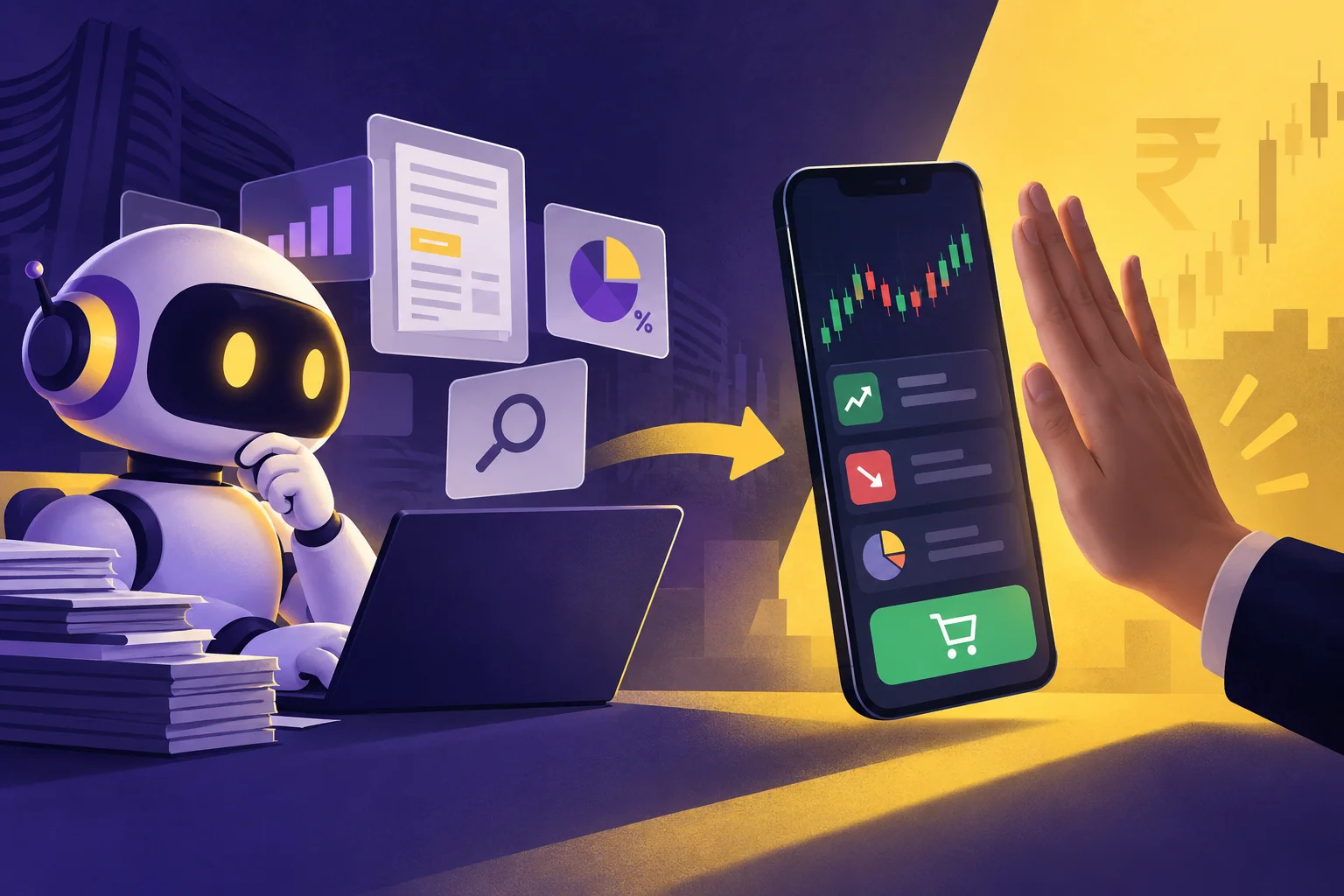
Jio Financial now says its app runs on roughly 130 AI agents, and Anthropic just built a version of Claude for financial advisors. So why can't any of them legally place a single trade in your portfolio without a human signing off first?
Somewhere between a chatbot that explains your mutual fund and an agentic AI system that quietly moves your money lies a question every Indian investor should be asking right now.
The Moment AI Stops Talking and Starts Acting
An artificial intelligence (AI) tool that reads a company's annual report and summarizes it for you is useful. Nobody worries much about that.
But here's the thing. What if that same AI decides your portfolio has become too concentrated in one sector, sends a sell order through your broker's API, and reallocates the money on its own?
That's a completely different situation.
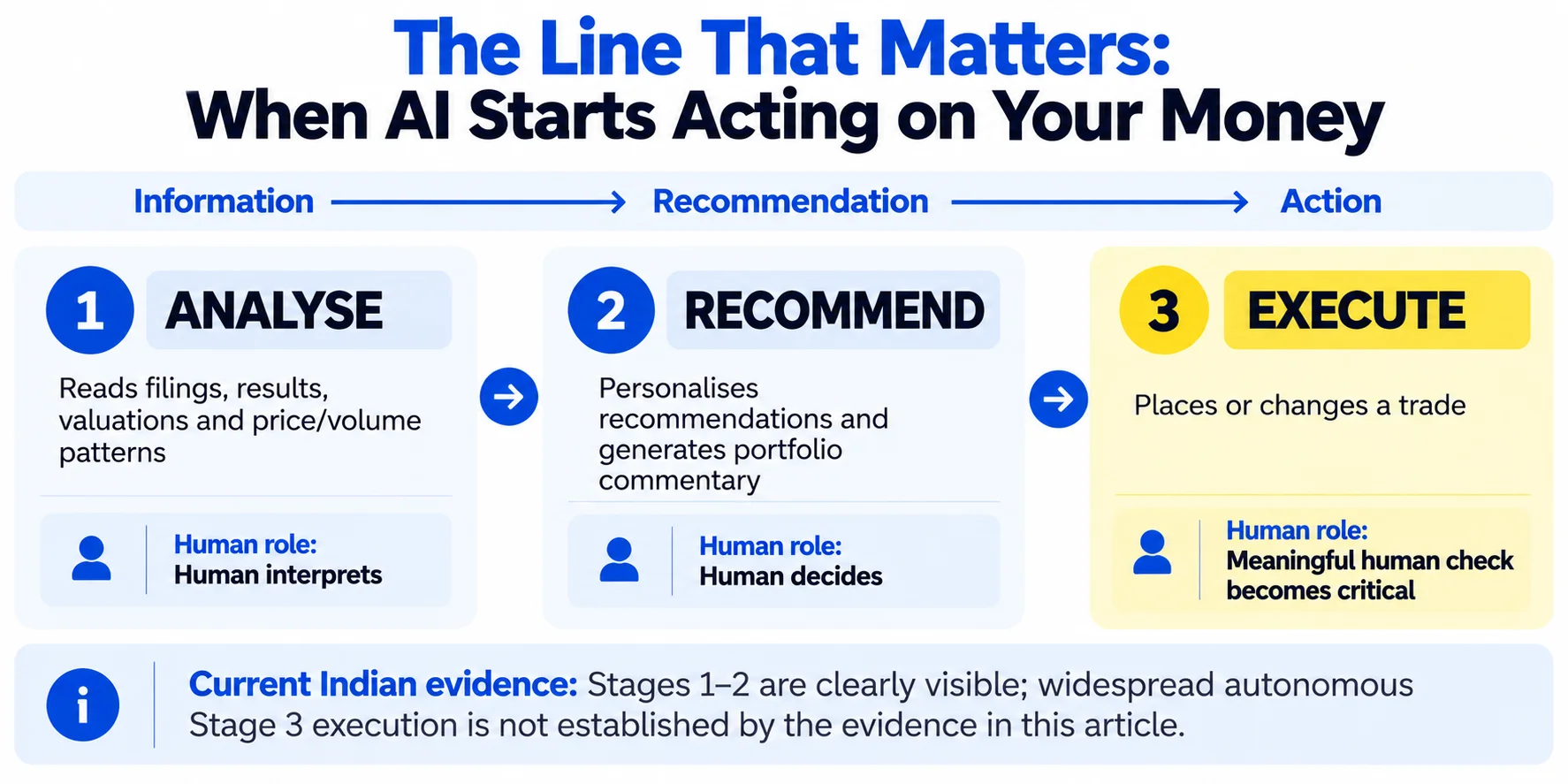
The first is information. The second is action. And the moment AI can act on your money, not just talk about it, the stakes change.
So the real question isn't whether a platform uses the word AI. It's this: can this system move your money, and if it goes wrong, who is responsible?
That question is exactly what agentic AI in investing is about.
What Actually Makes an AI "Agentic"?
You've probably used a generative AI chatbot. You ask a question, it writes an answer. That's the whole interaction.
Agentic AI works differently. Instead of just answering, it pursues a goal through steps. It gathers information, weighs options, plans a course of action, uses tools or software to act, checks what happened, and adjusts.
Think about it like the difference between a friend who explains what a rebalance is, and a friend who actually opens your app and does the rebalancing for you.
But here's the part that gets missed. Autonomous doesn't have to mean unsupervised. Most systems described as agentic are still tightly bound by permissions, approval steps and rules. A well-designed agent has a safety gate before it acts, checking risk limits, identity and authorization before anything actually happens to your money.
Which raises another question. Is any of this actually happening in Indian markets yet?
Agentic AI in Indian Investing: What's Actually Happening
The most visible Indian example right now is Jio Financial Services. Its JioFinance app is described, in the company's own AGM disclosures, as a Neural Agentic Marketplace, using agentic AI to personalize services across loans, credit cards, insurance and more.
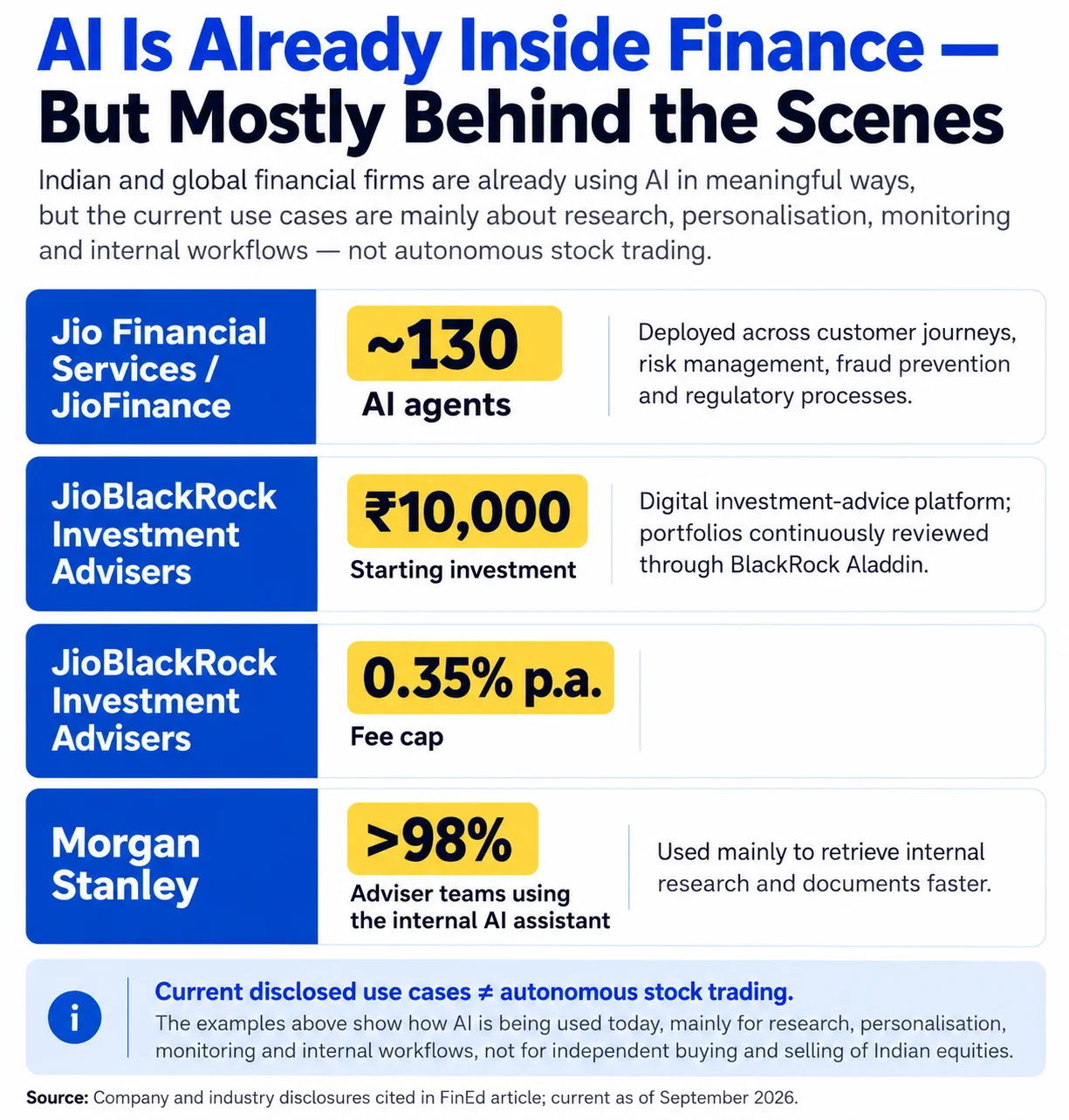
By its annual general meeting in August 2026, the company had disclosed around 130 AI agents deployed across its businesses, supporting customer journeys, risk management, fraud prevention and regulatory processes.
Separately, JioBlackRock Investment Advisers launched a digital investment-advice platform in February 2026, with portfolios continuously reviewed through BlackRock's Aladdin technology, a starting investment of ₹10,000, and a fee capped at 0.35% a year.
Here's the important limitation, though. None of this is public evidence that an AI agent is independently buying and selling Indian equities on someone's behalf. Continuous monitoring and personalized recommendations are not the same as autonomous execution.
What agentic AI can more clearly do, subject to proper data access, is read filings and results, track shareholding changes, compare valuation metrics like the P/E ratio across companies, and flag unusual price or volume patterns. That's a genuinely useful research capability.
What it should never be mistaken for is an ability to reliably predict which stock will rise next. Fast processing of information is not the same as accurate forecasting.
Given that AI isn't yet autonomously trading Indian shares, where does automated trading actually fit in?
Algorithmic Trading Isn't the Same as Agentic AI
This is where a lot of confusion creeps in.
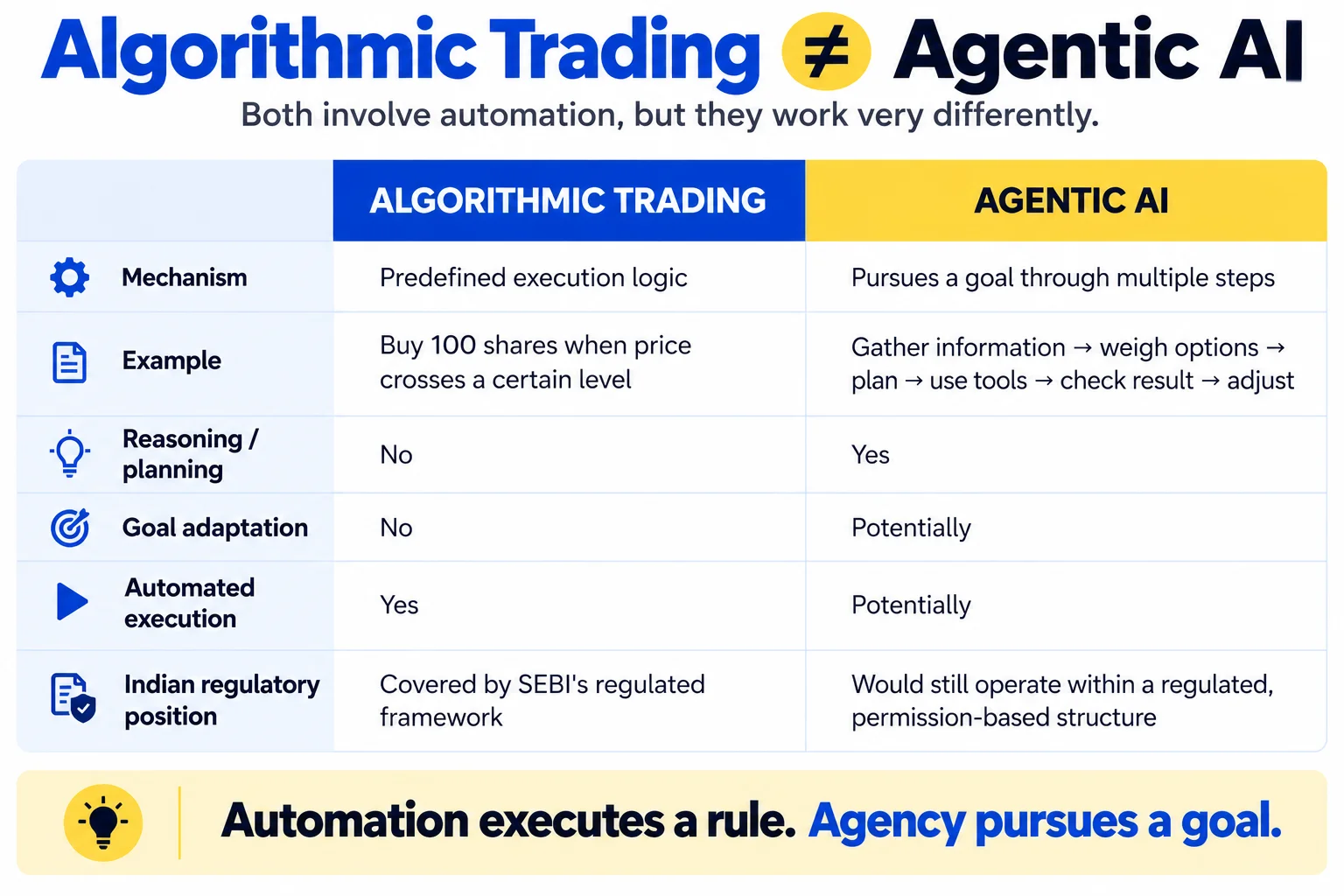
The Securities and Exchange Board of India (SEBI) defines algorithmic trading simply as any order generated using automated execution logic. A basic rule like "buy 100 shares when the price crosses a certain level" counts as algorithmic trading.
But that's not the same as agentic AI. A fixed rule doesn't reason, plan multiple steps, or adapt its own goals. It just executes a condition someone else already decided.
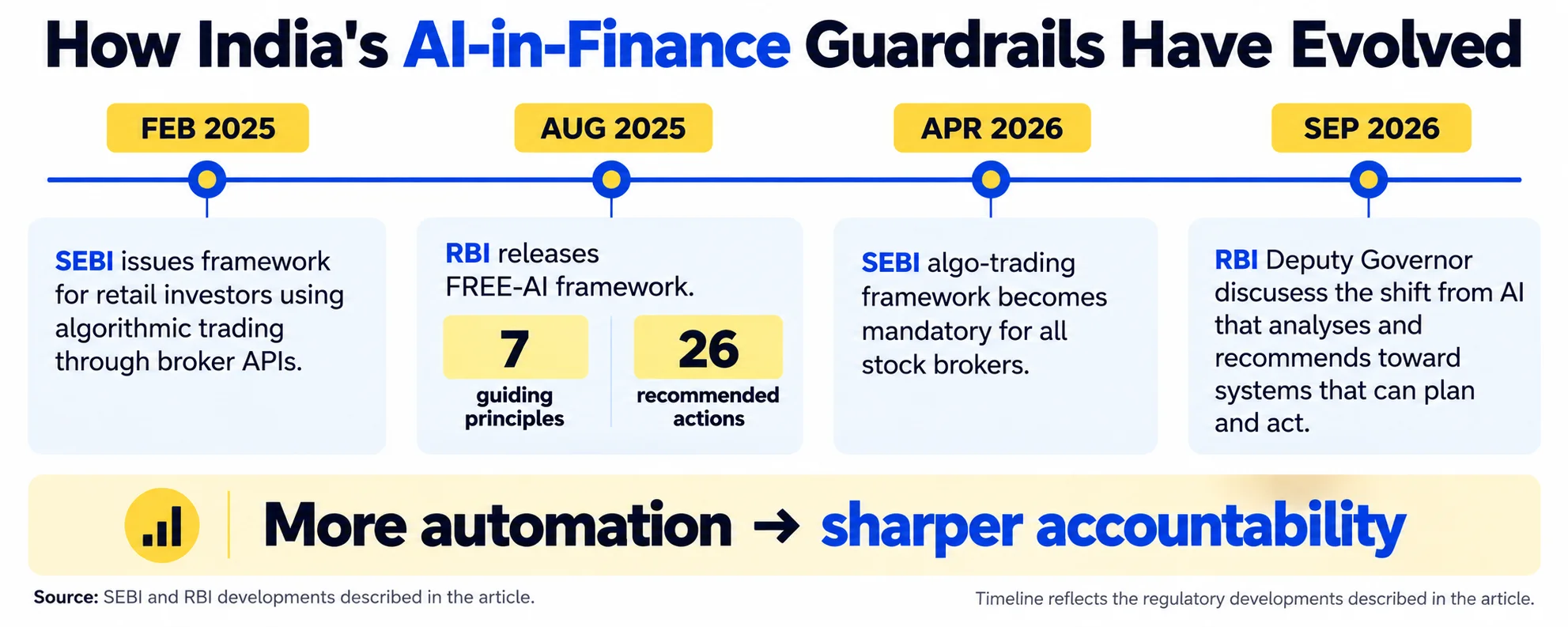
In February 2025, SEBI issued a framework for retail investors using algorithmic trading through broker APIs, which became mandatory for all stock brokers from April 2026. Under this framework, brokers are treated as the principal, and any algo provider is technically acting as the broker's agent. Every order needs a unique identifier, APIs must be locked down to specific vendor-client keys, and open, unrestricted API access isn't allowed.
A genuinely agentic system that wants to place real trades in India, then, would still have to work inside this same regulated, permission-based structure. The AI doesn't get a special lane of its own. It has to earn access exactly like any other automated trading system would.
That raises a more personal question for a lot of readers. If AI isn't quite trading on its own yet, could it at least replace the human adviser guiding your decisions?
Will AI Replace Your Financial Adviser?
The honest answer, at least for now, is no. But it is already making advisers faster.
At Morgan Stanley, an OpenAI-powered internal assistant is reportedly used by more than 98 percent of adviser teams, mainly to retrieve internal research and documents faster. It doesn't trade client accounts on its own; advisers remain the decision-makers.
BlackRock's Aladdin Wealth platform has a feature that turns portfolio data into ready client commentary, first rolled out with Morgan Stanley's advisers. Again, it explains a portfolio. It doesn't decide what to buy or sell.
In September 2026, Anthropic launched Claude for Financial Advisors, built to help advisory firms prepare for client meetings, review portfolios and handle follow-up work using tools from firms like BlackRock and Schwab. Salesforce's Agentic Advisor and Savvy Wealth's Savvy Intelligence have launched similar adviser-support tools this year, both requiring adviser approval before anything client-facing goes out.
Notice the pattern. Every credible example so far is AI as the adviser's assistant, not AI as an unsupervised decision-maker. In India, this matters even more, because a SEBI-registered adviser's legal responsibility for a client's advice doesn't disappear just because AI was involved somewhere in the process.
Which brings the conversation to the regulators themselves. What exactly are RBI and SEBI actually saying about all this?
What RBI and SEBI Are Actually Saying
At the Global FinTech Fest in September 2026, the Reserve Bank of India (RBI)'s Deputy Governor, Shirish Chandra Murmu, spoke about a shift from AI systems that merely analyze and recommend, toward systems that can plan and act. His message wasn't a ban on this shift. It was a warning that algorithms should never replace human accountability for financial decisions, and that the firm offering a service remains responsible for it.
That thinking sits behind RBI's FREE-AI framework, released in August 2025, built around seven guiding principles that include putting people first, accountability, and making AI understandable by design. The framework recommends 26 specific actions, but it doesn't approve any particular product or authorize an agent to trade on someone's behalf.
SEBI takes a similar stance from the securities side. Under its proposed responsibility framework, any regulated entity using an AI or machine-learning tool, whether built in-house or bought from a vendor, remains solely responsible for the data, the output and legal compliance. In plain terms, "the algorithm did it" isn't a valid excuse for a broker or adviser.
Both regulators are pointing at the same idea from different directions. As finance gets more automated, accountability is expected to get sharper, not softer.
Conclusion
So, is your portfolio actually safe in the hands of AI?
Right now, in India, agentic AI is real, but it's mostly working behind the scenes: reading filings, monitoring portfolios, drafting adviser notes, personalizing recommendations. Genuine autonomous execution, where an AI independently buys and sells your shares with no meaningful human check, isn't something the public evidence currently supports.
That could change. But when it does, safety won't come from how advanced the AI sounds. It will come from the same things RBI and SEBI keep repeating: accurate data, clear accountability, human oversight, and the ability to stop or reverse an action before it's too late.
The real question isn't whether AI will become part of investing. It already has. The real question is whether you can see the guardrails between an AI's suggestion and an action that actually touches your money.
Key Takeaways
- Always separate the three stages: an AI analyzing information, recommending an action, and executing that action are very different levels of risk.
- Algorithmic trading and agentic AI are not the same thing; a fixed rule executing a trade lacks the reasoning and adaptability that defines a true agentic system.
- The strongest current evidence, from Morgan Stanley to Jio Financial, shows AI acting as a research and workflow assistant, not an autonomous decision-maker.
- RBI and SEBI both keep responsibility with the regulated firm, not the AI, no matter how autonomous a system is described as being.
- Before trusting any "AI-powered" investing platform, ask whether it can be stopped mid-action, whether a human reviews it, and who you can complain to if it gets something wrong.