· Economy
India Is Building Roads, Ports and Airports Faster Than Ever. But Is Any of It Making Us Richer?
By Anish Pujari
India built 55,000+ km of highways and doubled port capacity since 2014 - but is any of it creating real economic value? Here's what the data shows.
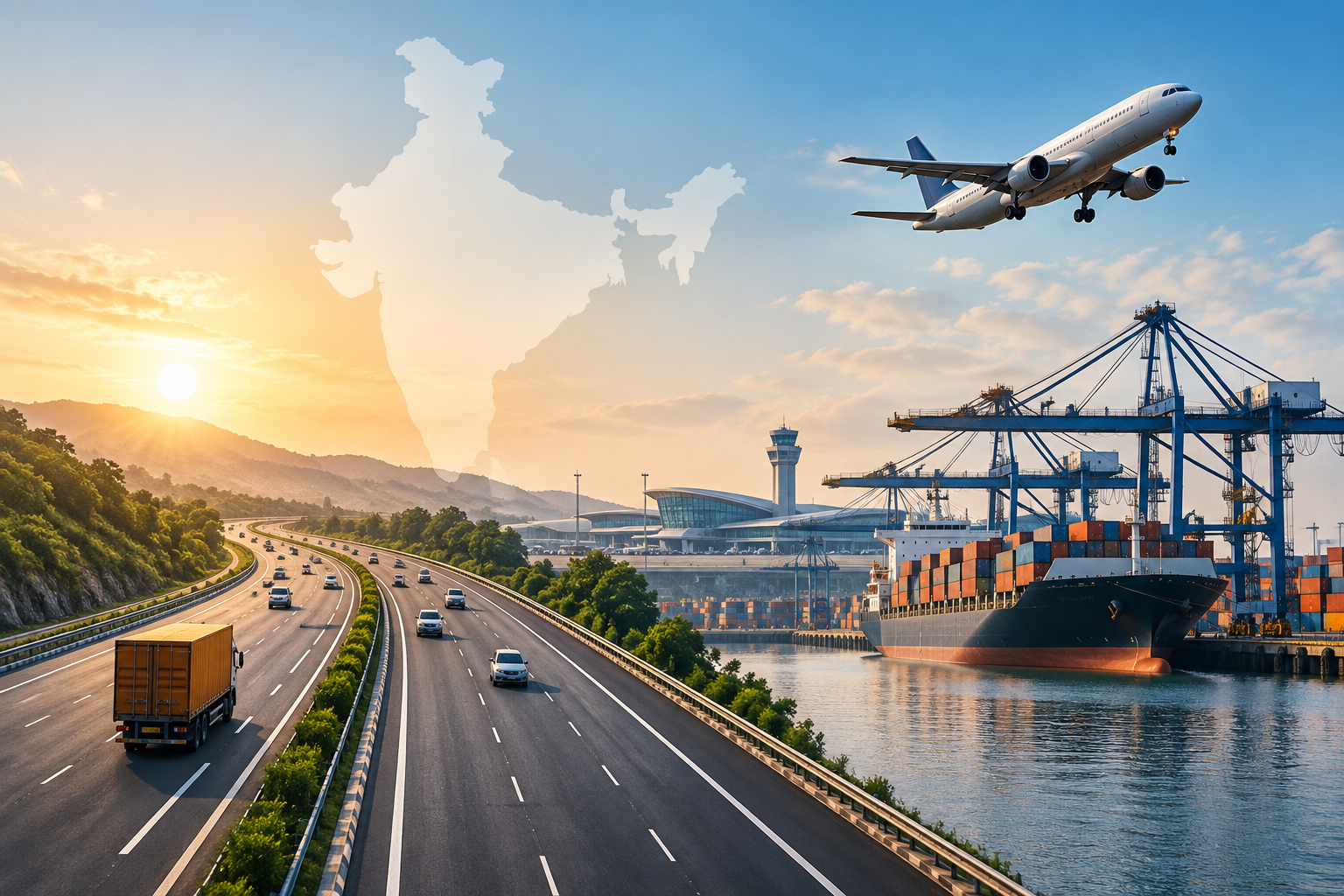
Kilometres of highway and tonnes of port capacity look impressive on paper. Here's how to tell if they're actually paying off.
Since 2014, India's national highways have grown from 91,287 km to 146,572 km, and the question worth asking isn't how much got built, but whether it's working.
The Trillion-Rupee Question Nobody's Asking
Picture this. A new highway opens near your town. News channels cover it. Politicians cut the ribbon. Everyone calls it progress.
But here's the thing. A highway is just asphalt until someone actually uses it.
You might wonder: does building more roads, ports and airports automatically make a country richer? It feels obvious that it should. More infrastructure, more growth, right?
Except that's not always how it plays out. Sometimes a shiny new corridor sits half-empty for years. Sometimes a village road quietly changes hundreds of lives. The difference between the two isn't how much concrete was poured. It's whether that concrete removed a real bottleneck in someone's life or business.
So what actually determines whether India's infrastructure spending is paying off? To answer that, you first need to see the scale of what's been built.
What India Has Actually Built
The numbers are hard to ignore.
India's national highway network grew from 91,287 km in 2014 to 146,572 km by March 2026, according to government data cited by the India Brand Equity Foundation (IBEF). Four-lane and wider highways more than doubled, from 18,371 km to 45,516 km.
Operational airports jumped from 74 to 165, according to the Ministry of Civil Aviation's Modified UDAN factsheet. Nearly the entire railway network, 99.6 percent, is now electrified, up from about 20 percent before 2014. Major ports can now handle roughly 1,726 to 1,728 million tonnes annually, almost double their 2014 capacity.
Government spending tells the same story. Union capital expenditure rose from around ₹2.63 lakh crore in FY2017-18 to a proposed ₹12.2 lakh crore in FY2026-27, according to the Union Budget 2026-27.
That's a genuinely enormous expansion, and yet none of this, by itself, tells you whether India is getting richer because of it.
Why Concrete Alone Doesn't Create Wealth
Think about it like this. Buying a 100-seat bus doesn't create value just because it has 100 seats. It creates value only if enough passengers actually ride it, saving them time or money that justifies the cost of running it.
Infrastructure works the same way.
A highway, port or airport is an input, not proof of economic value. It creates lasting wealth only when it reliably lowers the time, risk and cost of moving people, goods or information, and when businesses and workers actually use that new connectivity productively.
This is the trap in judging infrastructure by kilometres built or capacity added. A highway kilometre isn't the same as an airport passenger. A port's installed capacity isn't the same as cargo actually handled. And an announced industrial corridor is not an operating factory.
Which parts of India's infrastructure push actually show evidence of real economic impact, then? Two examples stand out, and they involve very different kinds of roads.
The Road That Proved Its Own Worth
The Golden Quadrilateral
Researchers wanted to answer a tricky question: did the Golden Quadrilateral, the highway network connecting Delhi, Mumbai, Chennai and Kolkata, actually cause economic growth, or did it just get built in places that were already growing?
To find out, World Bank and academic researchers compared districts sitting 0-10 km from the upgraded highway with districts 10-50 km away, deliberately excluding the four big cities from the comparison. That's a much stronger test than simply noting that Gross Domestic Product (GDP) rose after a road opened.
The result: formal manufacturing output in districts near the upgraded highway grew by an estimated 49 percent over the following decade, with higher rates of new manufacturing plants and productivity gains closer to the corridor.
That doesn't mean every highway produces a 49 percent manufacturing boost. It means that when a highway connects places with existing labour, power and market potential, it can unlock real productivity.
The Village Roads That Changed Who Could Work Where
Rural roads tell a different, quieter story. A World Bank evaluation of PMGSY (Pradhan Mantri Gram Sadak Yojana), India's rural road connectivity programme, found that non-farm employment in connected villages rose by about 12 percentage points, and overall employment rates rose 5.5 percentage points between 2009 and 2017.
Here's the twist. The same research found only limited effects on farming itself. The real value wasn't turning every village into a farming powerhouse. It was letting workers reach jobs outside their own village, often for the first time.
That's an important corrective. Not every rural road transforms local farms and incomes overnight. Its biggest win might simply be widening what a worker can reach.
Which raises another question. If roads can prove their worth, what about the freight moving on rails and through ports?
Freight, Ports and the Hidden Cost of Moving Goods
Passenger travel gets the headlines, but freight quietly shapes prices across the entire economy, from steel and cement to milk and electronics.
India's Dedicated Freight Corridors, built to separate freight trains from congested passenger routes, reported daily train operations rising 42 percent to 241 trains a day in FY2023-24, according to the Dedicated Freight Corridor Corporation of India Limited's (DFCCIL) annual results. Transit time from Sonnagar to Dadri fell by around 40 percent. A freight journey from the National Capital Region to a west-coast port that once took roughly 72 hours now takes 24 to 28 hours.
That matters because a study by the Department for Promotion of Industry and Internal Trade (DPIIT) and the National Council of Applied Economic Research (NCAER) estimated rail freight costs at just ₹1.96 per tonne-km, against ₹11.03 per tonne-km for road. Faster, cheaper freight means lower inventory costs, fewer missed deadlines, and more competitive exports.
Ports show similar gains. Cargo handled at major ports hit a record 915.17 million tonnes in FY2025-26, according to the Ministry of Ports, Shipping and Waterways, while average vessel turnaround time fell to 48.8 hours from 94 hours in 2014.
Not everything holds up quite this well, though. Major ports' installed capacity of around 1,728 million tonnes a year, set against roughly half of the 915.17 million tonnes handled across the full year, points to major ports running at somewhere near a quarter of their installed capacity in any given six-month stretch. Built capacity and used capacity are two very different numbers, and only one of them creates economic value.
If some of this spending is clearly working, what's the part that isn't?
The Cost Overruns Nobody Wants to Talk About
Every big infrastructure push comes with a less flattering side.
As of January 2026, India's Project Assessment, Infrastructure Monitoring and Analytics for Nation-building (PAIMANA) system, run by the Ministry of Statistics and Programme Implementation (MoSPI), tracked 1,702 central government projects with an original approved cost of ₹33.71 lakh crore, according to PAIMANA's own flash report. By June 2026, a MoSPI-based report found 1,847 monitored projects carrying cumulative cost overruns of ₹4.92 lakh crore.
Delayed land acquisition, litigation, environmental clearances and rising material costs are common culprits. And a project can be technically finished while still being an economic dud, if traffic never shows up, industries never arrive, or the surrounding region lacks power and skilled workers to make use of it.
This is why the same government capex numbers that fund India's growth story also fund projects that may never pay off. It's a reminder that infrastructure spending and infrastructure impact are two different things, a distinction that matters just as much when governments decide how much to borrow to fund it.
Pulling all of this together, what's the honest answer to whether India's infrastructure boom is making the country richer?
The Takeaway
India isn't becoming richer simply because it's pouring more concrete. It becomes richer when that concrete removes a real bottleneck, when a truck reaches a port faster, a worker reaches a better job, or a business invests because logistics finally became cheap and dependable.
The evidence so far is genuinely mixed, in a useful way. Roads and rail lines built with clear purpose, like the Golden Quadrilateral, PMGSY and the freight corridors, show real, measurable gains in manufacturing, employment and shipping times. But cost overruns running into lakhs of crores, and ports running at roughly a quarter of their capacity, show that scale alone guarantees nothing.
India's infrastructure story isn't finished being written. Whether it ends up creating durable wealth or expensive, underused concrete depends on choices still being made today: which projects get finished, how well they're maintained, and whether businesses and workers actually show up to use them.
Key Takeaways
- Infrastructure is an input, not proof of value. A highway, port or airport only creates wealth when it's actually used to lower costs, save time, or connect people to opportunity.
- The strongest evidence favours targeted connectivity. The Golden Quadrilateral and PMGSY rural roads both show credible gains in manufacturing and employment, because researchers compared similar places with different levels of access.
- Freight matters more than it seems. Cheaper, faster freight on rail and through ports can quietly make entire industries more competitive, even for people who never see a train or a port.
- Capacity is not the same as usage. India's major ports run at roughly a quarter of installed capacity, a reminder to always check how much of a built asset is actually being used.
- Cost overruns are the other side of the boom. Projects worth several lakh crore rupees are running over budget, which is why project selection and execution quality matter as much as the total amount spent.