· IPO
How Does an IPO Actually Work?
A beginner-friendly walkthrough of how an Indian company goes from private ownership to a listed stock, step by step, term by term.
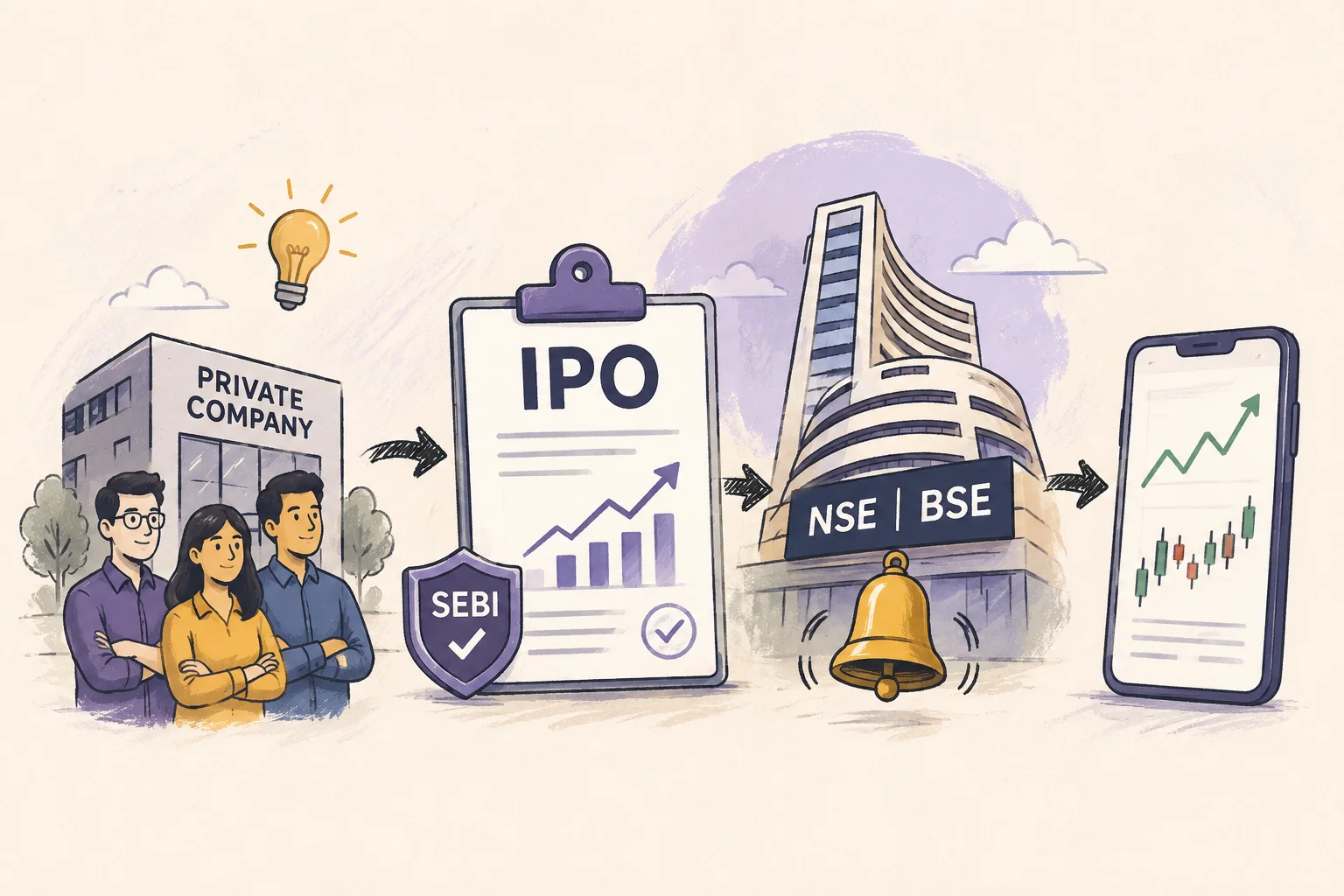
Every time you open your trading app and see a new stock listed with green or red numbers next to it, there's a long, quiet story behind how it got there.
Think about the last IPO that flooded your Instagram feed. Maybe it was Swiggy. Maybe it was Tata Technologies. Everyone was talking about the grey market premium and the subscription numbers, but here's the thing: most people who apply don't actually know what happens between a company deciding to go public and its shares finally showing up in their demat account. They just know the app said "Apply" and they tapped it.
So how does a company owned by a handful of founders and investors turn into something you and I can own a tiny piece of? That's the central question this guide answers, and once you understand the full journey, every IPO headline will suddenly make more sense.
Why Do Companies Go Public in the First Place?
Before we get into the process, you might wonder why a company would even want to do this. Going public means opening your books to the world, answering to lakhs of shareholders, and getting judged every quarter. That sounds stressful. So why bother?
A private company is owned by a small group: founders, family, employees, and maybe some private equity or venture capital investors. Its shares aren't available to just anyone. A public company, on the other hand, lists its shares on exchanges like the NSE or BSE, where any eligible investor can buy or sell them.
Companies usually make this jump for a few practical reasons. Some need fresh capital to fund expansion, new factories, or technology. Some want to pay down debt. Some are simply giving early investors, like PE and VC firms, a way to cash out after years of backing the company privately. And some do it purely for credibility, since being listed makes lenders, customers, and suppliers trust you more.
Take Tata Technologies' 2023 IPO. The entire ₹3,042.51 crore issue was an offer for sale, with no fresh issue component at all, meaning every rupee raised went to selling shareholders rather than the company itself. Compare that to many tech and consumer IPOs from 2024 onward, which raised fresh capital specifically to fund growth. Same event, very different purpose.
Which raises the next question: once a company decides to go public, who actually makes it happen?
Getting Ready: Bankers, the DRHP and SEBI's Review
Going public isn't something a company just decides one morning and does the next week. It starts with the board weighing whether the business is ready for public scrutiny, with stable enough financials and solid governance, before formally approving the plan.
Once that's settled, the company appoints merchant bankers, officially called Book Running Lead Managers, or BRLMs. Think of them as the wedding planners of the IPO world. They handle due diligence, structure the offer, shape pricing strategy, and coordinate with SEBI and the exchanges. Alongside them come legal advisors who check every disclosure, auditors who verify the financials, and a Registrar to the Issue who eventually manages applications and share allotment.
Together, this team drafts one of the most important documents in the entire process: the Draft Red Herring Prospectus, or DRHP.
The DRHP is essentially the company's tell-all book, filed with SEBI and the exchanges before the price is even finalized. It lays out the business model, the industry it operates in, years of financial history, every risk factor worth knowing, and exactly how the IPO money will be used. If you ever want to understand a company before its IPO hype takes over, the DRHP is where you go, not Twitter, not GMP forums.
SEBI then reviews this document closely, checking whether the disclosures are fair, whether the financials add up, and whether the company meets basic eligibility norms. This review can take weeks or months, and SEBI can genuinely delay or block an IPO if something doesn't meet the bar. Once SEBI is satisfied, the company files an updated version called the Red Herring Prospectus, or RHP, which includes the final price band and offer details.
With the paperwork cleared, there's still one big decision left: how the shares themselves will be structured.
Fresh Issue vs Offer For Sale: Two Different Reasons to List
Here's something a lot of first-time investors miss. Not all IPO money goes to the company.
When a company issues a Fresh Issue, it's creating brand new shares, and the money raised goes directly into the company's accounts, to be used for expansion, debt repayment, or other business needs.
An Offer For Sale, or OFS, works differently. Here, existing shareholders, such as promoters or PE and VC investors, sell part of their existing stake. The money from this portion doesn't go to the company at all. It goes straight into the pockets of whoever is selling.
Many IPOs combine both. Imagine a company launching a ₹5,000 crore IPO, where ₹2,000 crore is a fresh issue that funds the company's plans, and ₹3,000 crore is an OFS that lets early investors partially exit. Reading the prospectus tells you exactly how much of your investment is actually fueling the company's growth versus simply cashing out someone else's stake.
Once the company decides this split, the next challenge is figuring out what price to sell those shares at.
Setting the Price: Price Bands, Book Building and Who Gets to Buy
You might assume a company just picks a price and goes with it. Some do; that's called a fixed price IPO. But most large Indian IPOs use something called book building instead.
In book building, the merchant bankers set a price band with a floor price at the bottom and a cap price at the top. Investors then bid within that range, specifying how many shares they want and at what price. As bids come in, this collective "book" of demand reveals what price the market is actually willing to pay, and the final cut-off price is set based on that demand. Retail investors often just select "cut-off," which basically means "I'll take it at whatever the final price turns out to be."
But not everyone bidding is the same kind of investor, and SEBI makes sure the pie is split fairly. Qualified Institutional Buyers, or QIBs, such as mutual funds, insurance companies, and foreign investors, usually get around half the issue in large IPOs. Non-Institutional Investors, often high-net-worth individuals, get another meaningful chunk. And Retail Individual Investors, meaning people like you applying up to ₹2 lakh, are guaranteed a reserved portion too, often over a third of the issue.
There's also a special category called anchor investors: large QIBs who commit money a day before the IPO opens to the public, partly to signal confidence and stabilize demand, and their shares come with lock-in periods so they can't flip them immediately.
Now that the price and the buyer categories are set, it's time for the IPO to actually open.
Applying, Subscription Numbers and the Grey Market Premium
When the IPO opens, you apply through your broker or bank app, choosing your lot size, your bid price or cut-off, and your payment method: either ASBA, where your bank simply blocks the required funds instead of debiting them immediately, or UPI, where you approve a mandate request in your UPI app.
As applications roll in, you'll start seeing subscription numbers everywhere: 2x, 10x, even 100x. This simply compares total shares bid for against total shares available in that category. A 10x retail subscription means retail investors together asked for ten times more shares than were actually on offer. Oversubscription means more demand than supply; undersubscription means the opposite, and it can sometimes require underwriters to step in.
Around the same time, you'll hear people obsessing over the Grey Market Premium, or GMP: an unofficial premium at which IPO shares trade informally before listing, outside any exchange or SEBI oversight. If the issue price is ₹500 and the GMP is ₹100, grey market traders are effectively pricing the stock at ₹600 already.
But here's where it gets interesting. GMP is just crowd sentiment, not a guarantee. Some IPOs with sky-high GMP have listed exactly where the buzz predicted. Others, despite strong GMP chatter, listed flat or even below the issue price once real market forces took over. Treating GMP as a promise of profit is one of the most common IPO myths out there, alongside believing that heavy oversubscription automatically means a good long-term investment, or that IPO investing carries no risk. None of that is true. IPOs carry the same business and valuation risks as any other stock, just with extra hype attached.
So once the issue closes, what actually decides who gets the shares?
Allotment, Listing Day and Life as a Public Company
Once the IPO closes, the registrar tallies every bid and applies SEBI's allotment rules. In heavily oversubscribed retail categories, this often turns into something close to a lottery, with many applicants getting zero shares. Non-retail categories usually get proportionate allotment instead, where your allocation roughly matches your bid size. If you don't get shares, your blocked funds are simply released back to you.
Then comes listing day, when the stock finally starts trading on the NSE or BSE under its own ticker. The listing price is the very first trade price. If it's higher than the issue price, that's called a listing gain; lower, and it's a listing loss. Prices can swing sharply on day one, driven by pent-up demand, GMP expectations finally meeting reality, and general market mood, though circuit limits exist to prevent runaway volatility.
Here's the part beginners often forget: listing day isn't the finish line, it's the starting gun. From here, the company must publish quarterly results, disclose material events, and operate under constant public scrutiny. Analysts start covering the stock. Promoters and anchor investors remain under lock-in periods, unable to sell immediately. And the stock's price now depends on actual business performance, not IPO-week excitement.
Think of it like a graduation ceremony. The IPO is the ceremony itself: exciting, well-marketed, full of anticipation. But what happens after graduation, how the company actually performs in the real world, matters far more than the ceremony ever did.
Conclusion
An IPO isn't a single event. It's a long, regulated journey that starts with a company deciding it's ready for public scrutiny and ends with it answering to shareholders every quarter, forever. Along the way, merchant bankers structure the deal, SEBI checks every disclosure, prices get discovered through investor demand, and shares land in your demat account through a process far more deliberate than the one-tap "Apply" button suggests.
The bigger lesson goes beyond IPOs themselves. Whether it's GMP, oversubscription numbers, or listing-day fireworks, the noise often distracts from what actually matters: what kind of business you're buying into, and why it decided to go public in the first place.
Key Takeaways
- Companies go public mainly to raise capital, pay down debt, give early investors an exit, or build credibility, and reading whether an IPO is a fresh issue or an offer for sale tells you which of these is really happening.
- The DRHP, not social media buzz, is the most reliable place to understand a company's business, risks, and plans before its IPO.
- Book building means the final IPO price is discovered through investor demand within a price band, not fixed in advance.
- Subscription numbers and Grey Market Premium reflect sentiment and demand, not a guarantee of listing gains or long-term performance.
- Listing day is the beginning of a company's public life, not the end of the IPO story. What happens afterward, through quarterly results and governance, matters far more.