· Economy
Why India's Stock Market Changed How It Closes Every Day
An explainer of why SEBI replaced India's old stock market closing price system with a new auction-based mechanism.
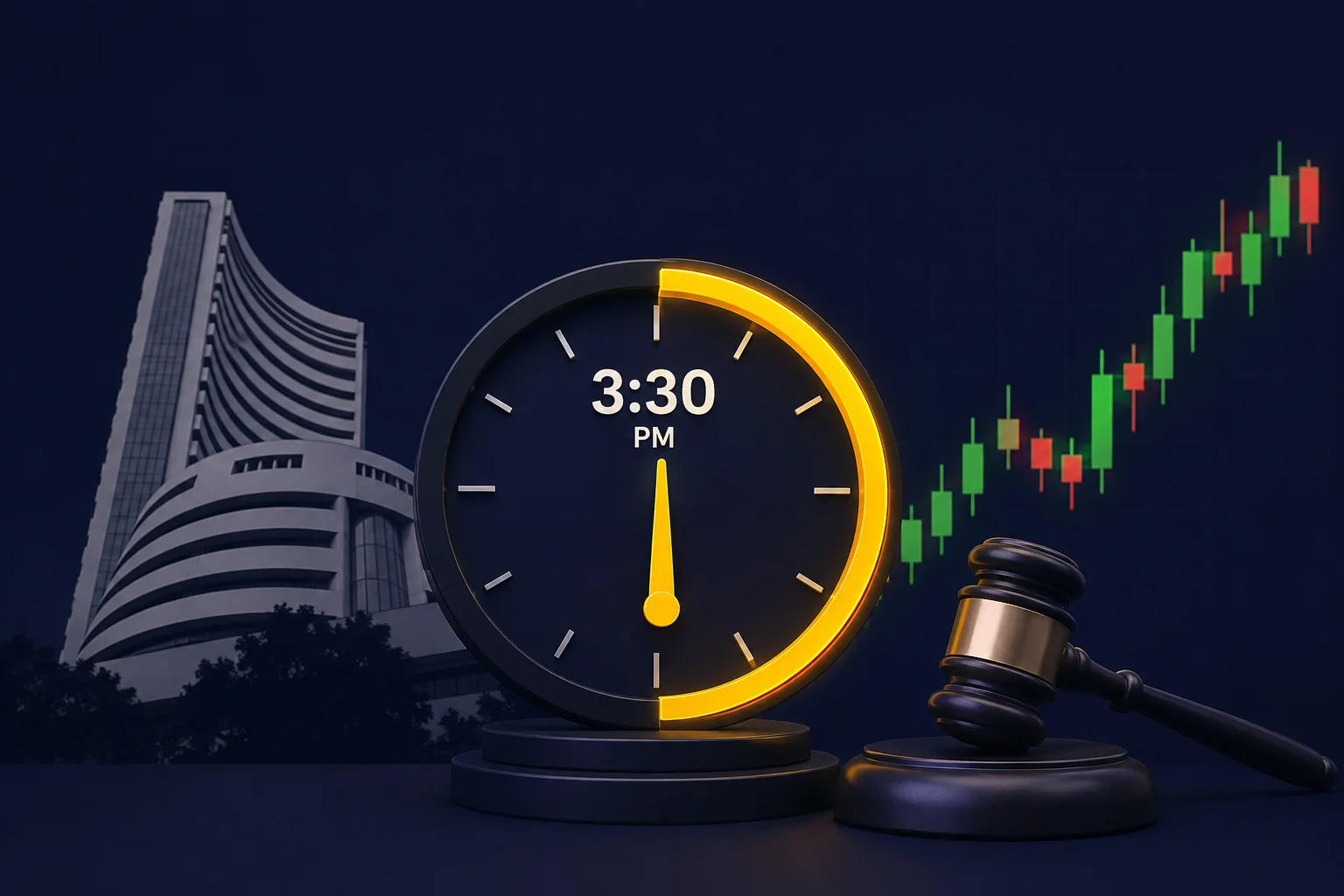
Every evening at 3:30 p.m., one number gets fixed for thousands of stocks, and trillions of rupees in derivatives, mutual funds and indices depend on getting it right.
The number nobody talks about
Here's the thing about the stock market. You hear about opening bells, big rallies, crashes. You almost never hear about the closing price. But it might be the most important number of the entire trading day.
Every futures and options (F&O) contract settles using it. Every mutual fund calculates your investment's value using it. Nifty and Sensex, the numbers that show up on the news every night, are built from it.
So what happens if that one number can be nudged?
That's exactly the question India's market regulator, SEBI, had to answer. And the answer changed how India's stock market closes every single day.
What the closing price actually does
Imagine the closing price as the final scoreboard reading at the end of a match. It doesn't just tell you who won. It becomes the official record that everyone else builds on top of.
In the stock market, that "final score" is used for:
- Settling futures and options contracts
- Calculating the NAV (net asset value) of your mutual funds and ETFs
- Computing Nifty and Sensex levels
- Valuing institutional portfolios and performance reports
If this number is even slightly off, the ripple effects touch almost everyone who has money in the market, whether they know it or not.
That raises an uncomfortable question. How was this all-important number even being calculated until now?
How the old system worked, and why it was risky
Until recently, for stocks that also had futures and options contracts, exchanges calculated the closing price using something called VWAP, or the Volume-Weighted Average Price.
Exchanges looked at every trade in the last 30 minutes of the day, from 3:00 to 3:30 p.m., and calculated an average price weighted by how many shares changed hands. It sounds fair, spreading the calculation over half an hour instead of relying on a single last trade.
But here's where it gets interesting. If someone could dominate trading during that 30-minute window with large, aggressive orders, they could tilt the average in their favor. And that's precisely what SEBI says happened.
When the closing price gets "marked"
In a 2025 order, SEBI described a practice it called "extended marking the close." In simple terms, it means placing large buy or sell orders right before the market shuts, specifically to push the closing price in a direction that benefits you.
SEBI's case against Jane Street Group, a global trading firm, is the clearest example. SEBI accused the firm of selling heavily in the final stretch of trading to push down Bank Nifty's closing value, which in turn benefited positions it held in options tied to that same index. SEBI's interim order impounded roughly ₹4,844 crore from the firm and barred it from Indian markets pending further proceedings.
This isn't a uniquely Indian problem, either. Marking the close has shown up on global exchanges too. It's hard to stop completely, for a simple reason: legitimate large investors, like index funds rebalancing their portfolios, also need to trade heavily near the close. Telling apart a genuine large order from a manipulative one isn't easy.
So SEBI needed a system that made this kind of manipulation structurally harder, not just something regulators chased after the fact.
Enter the Closing Auction Session
From 3 August 2026, SEBI introduced a new mechanism called the Closing Auction Session, or CAS, for all stocks that have F&O contracts.
Think of it like an auction at the end of a bazaar day. Throughout the day, people buy and sell at whatever price they agree on. But right before closing, everyone who still wants to trade gathers at one spot. An auctioneer collects every bid and offer, then announces a single price where the maximum number of buyers and sellers can be matched.
That single price becomes the day's official close.
Here's roughly how it plays out on the exchanges:
- 3:00–3:15 p.m.: Normal trading continues, and this window sets a "reference price."
- 3:15 p.m.: Continuous trading in the cash market stops for F&O stocks; certain stop-loss orders get cancelled.
- 3:15–3:20 p.m.: Exchanges lock in the reference price and set price bands, typically around 5% in either direction.
- 3:20–3:30 p.m.: Traders submit auction orders within those bands. This is the order collection window.
- Around 3:30–3:35 p.m.: The exchange runs its matching algorithm to find the "equilibrium price," the single price where the most shares can actually trade. That price becomes the official close.
Instead of an average built from scattered trades, the close now comes from one pooled auction where everyone shows their hand at once. A single large order finds it much harder to bulldoze the outcome, because the price is discovered collectively rather than through a running average that one aggressive trader can chase.
This isn't India inventing something new, either. Major global exchanges like the NYSE, Nasdaq, London Stock Exchange and Hong Kong Exchange have used closing auctions for years to set their official prices. SEBI has explicitly said CAS brings India's markets closer to this global standard. India's version is simpler than, say, the NYSE's auction, but the underlying idea is the same: one pooled auction, one price.
Does this change anything for you, and is it perfect?
If you're a regular retail investor who buys and holds stocks or invests through mutual funds, the honest answer is: not much, operationally. You don't need to change how you invest. Mutual fund NAVs will, if anything, become slightly more reliable.
The few things worth knowing:
- If you trade F&O-eligible stocks intraday, continuous trading now stops at 3:15 p.m. instead of 3:30 p.m.
- Stop-loss and certain special orders on these stocks get automatically cancelled at 3:15 p.m.
- Intraday square-off timings on many broker platforms have shifted slightly earlier.
For most long-term investors, CAS works quietly in the background, the same way a referee's decision doesn't change how you play the game, only how fairly it's scored.
But is the new system perfect? Not entirely, and market experts are candid about that.
Large players can still try to influence the equilibrium price, especially in thinly-traded stocks, through strategically placed auction orders. There's also a timing mismatch to watch: cash trading for F&O stocks stops at 3:15 p.m., but the futures and options contracts themselves keep trading until 3:40 p.m., which could create short-term disconnects between the two.
Still, on its first day of implementation on 3 August 2026, CAS reportedly went live smoothly across NSE and BSE, with most of the friction being retail traders adjusting to new timings rather than any system breakdown.
No closing mechanism will eliminate manipulation entirely. But CAS changes the playing field, making it structurally harder for a single participant to move the number that so much of the market depends on.
Conclusion
For years, one of the most consequential numbers in India's financial markets, the daily closing price, was set through a method that left room for manipulation. SEBI's Closing Auction Session doesn't promise a perfect system, but it replaces a vulnerable 30-minute average with a structured, pooled auction that's much harder to game, and brings India's markets in line with how the world's biggest exchanges already operate. It's a reminder that even the most routine parts of a financial system are worth re-examining, because the biggest risks often hide in the numbers everyone assumes are already fair.
Key Takeaways
- The closing price isn't just a daily statistic. It determines derivatives settlement, mutual fund NAVs, ETF prices, and index levels like Nifty and Sensex.
- India's old system used a 30-minute average (VWAP), which could be manipulated through large, aggressive trades near market close, a practice SEBI calls "marking the close."
- From 3 August 2026, SEBI's Closing Auction Session (CAS) replaces this with a pooled, single-price auction for all stocks with F&O contracts, aligning India with global exchanges like NYSE and Nasdaq.
- Regular retail investors don't need to change how they invest, though intraday F&O traders should note that continuous trading now stops at 3:15 p.m. instead of 3:30 p.m.
- CAS isn't foolproof, but it makes large-scale manipulation of the closing price structurally harder than before.