Why Do Banks Keep Asking for Your KYC?
Why does every bank, broker and app ask for your KYC again? Here's why the rules require it, and how CKYC 2.0 aims to cut down the repeats.
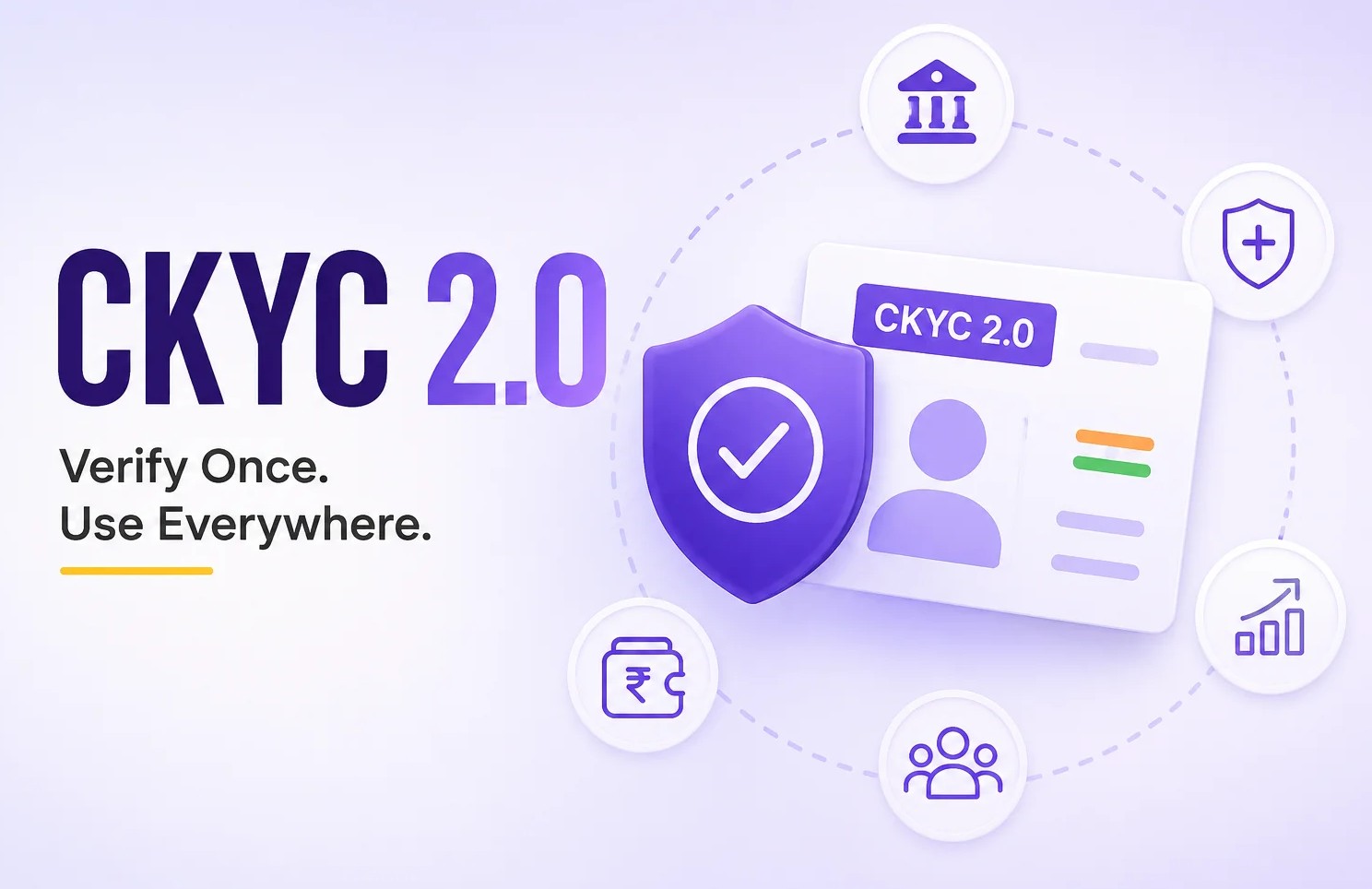
This article is about the document merry-go-round almost every Indian has been on, and why it might finally be ending.
You opened a savings account last year. Uploaded your Aadhaar, your PAN, a selfie, maybe sat through a video call to prove you're really you.
Then you tried to start a mutual fund SIP. And there it was again. Same PAN. Same Aadhaar. Same selfie.
You hadn't changed. Your identity hadn't changed. So why did you have to prove it all over again?
The Document Merry-Go-Round
Here's the thing: this isn't a glitch. It's not your bank being lazy or your mutual fund app being difficult.
It's how India's financial system has worked for years.
Every bank, insurer, broker, and NBFC you deal with is required by law to independently verify who you are before doing business with you. This process is called KYC, or Know Your Customer. It means checking your name, address, date of birth, and identity documents to confirm you're a real person and not a front for something illegal.
Sounds reasonable enough. So why does it feel so repetitive?
Why Banks Can't Just Trust Each Other's Homework
You might assume that once one institution verifies you, others could simply take their word for it.
But that's not how the rules work.
Banks are regulated by the RBI. Mutual funds and brokers answer to SEBI. Insurers report to IRDAI. Pension products fall under PFRDA. Each of these regulators requires the institutions under them to prove, on their own, that they've properly verified every customer.
These requirements exist because of laws like the Prevention of Money Laundering Act, and international standards aimed at stopping money laundering and terrorist financing. When an institution lets you open an account, it's putting its own compliance record on the line. Regulators don't accept "someone else checked" as an answer.
So each institution built its own KYC system. Your bank keeps its own copy of your documents. Your mutual fund's records live in a separate system called a KYC Registration Agency. Your insurer maintains its own file entirely.
Add outdated technology that doesn't talk to other systems, and you get exactly what you've experienced: the same documents, uploaded again and again, because nobody's system can reliably borrow from anybody else's.
Which raises an obvious question: hasn't anyone tried to fix this?
Enter the Central KYC Registry
Actually, yes. Back in the mid-2010s, India set up something called the Central KYC Registry, or CKYCR, run by an organization called CERSAI.
The idea was simple: store one standard, verified KYC record for each customer, and give that customer a unique 14-digit CKYC number. Any institution could then, in theory, pull your verified record instead of asking you to start from scratch.
Nice idea on paper. In practice? It only partly worked.
A lot of the KYC data uploaded into the registry over the years was inconsistent: scanned PDFs, patchy formats, varying quality. The technology to instantly retrieve and verify records in real time wasn't quite there either. So institutions kept falling back on their old habit, asking you for fresh documents anyway.
The registry now holds roughly 1.2 billion records, but duplicate entries and incomplete data have made many institutions reluctant to fully trust it.
Millions of Indians ended up with a CKYC number sitting somewhere in a database, while still filling out the same forms every time they opened something new.
That's the gap CKYC 2.0 is built to close.
What's Actually Changing With CKYC 2.0
Think of CKYC 2.0 as the registry finally getting the upgrade it needed, turning it from a passive filing cabinet into a live, connected system institutions can actually use in real time.
Three changes matter most here.
First, OTP-based consent. Instead of re-uploading documents, you'll be able to share your CKYC number and approve access with a one-time password, letting the new institution pull your verified data directly.
Second, centralized records in a standard, structured format, so different institutions can actually read and use the same data without translation headaches.
Third, confidence scores: a kind of quality rating attached to each record, telling an institution how reliable and well-verified your data really is before they decide whether to trust it outright or ask for a top-up.
Reuters and multiple Indian business outlets report that the rollout begins in August 2026, with banks and insurers going live first, and mutual funds, brokers, and other capital market participants joining in phases later this year. RBI, SEBI, and IRDAI are jointly implementing the system, with institutions expected to obtain customer consent for each data pull through an OTP, as laid out in an operating guidelines document reviewed by Reuters.
So what does this actually look like from your side of the screen?
Your Financial Identity, Verify Once, Reuse Often
Picture opening an account today. Full form, document uploads, video verification, the works.
Now picture doing that once, with any single bank or institution. Your record lands in the CKYC registry, tagged to your CKYC number.
The next time you sign up somewhere else, you simply share that number. The new institution requests your data from the registry, you approve it with an OTP, and if your confidence score checks out, that's often the end of it. No fresh document uploads. No repeat video calls.
It's a bit like a university ID card. Once you're verified as a student, that same card gets you into the library, the labs, and your exams. You don't reapply for identity proof every single time.
CKYC 2.0 is trying to make your financial identity work the same way: verify once, reuse it with your permission, wherever you go next.
That said, it won't mean documents disappear forever.
The Benefits, and the Catches
The upside is fairly straightforward. Onboarding that used to take days could shrink to minutes. Less paperwork for you, lower compliance costs for institutions, and potentially easier access to formal financial products for people who currently find the process intimidating.
But here's where it gets more nuanced.
This system only works if you actively consent every time your data is requested, which means understanding who's asking, what they want, and how to say no if something feels off. That responsibility now sits partly with you.
There are also real questions about privacy and cybersecurity. A single, centralized database holding sensitive identity information for millions of people is a valuable target, and its safety will depend on how seriously CERSAI and participating institutions treat encryption, access controls, and audit trails.
And no, this doesn't mean you'll never be asked for a document again. If you change your address, apply for a high-risk investment product, or your confidence score is low, expect a request for something extra. CKYC 2.0 reduces repetition. It doesn't eliminate legitimate checks altogether.
Not every institution will be ready on day one either. Smaller NBFCs and regional players may take longer to plug into the new system, so the old process might still show up here and there during the transition.
Conclusion
So, why do banks keep asking for your KYC? Because until now, verifying you has been each institution's individual job, done in its own silo, with its own paperwork.
CKYC 2.0 doesn't remove that legal requirement. What it changes is how that requirement gets fulfilled: moving from "prove it to everyone, separately" to "prove it once, and share it with permission."
If it rolls out the way it's designed to, the tedious cycle of uploading the same Aadhaar and PAN every few months could finally start fading. Not because the rules got looser, but because the system got smarter about talking to itself.
Key Takeaways
- KYC exists because regulators legally require every financial institution to independently verify your identity, largely to prevent fraud and money laundering.
- You've had to repeat KYC so often because banks, insurers, brokers, and mutual funds have historically kept separate records that don't talk to each other.
- The Central KYC Registry was meant to fix this back in the 2010s, but inconsistent data and limited technology kept it from working smoothly.
- CKYC 2.0 upgrades the registry into a real-time system using OTP consent, standardized records, and confidence scores, expected to roll out from August 2026.
- You'll still occasionally need to submit fresh documents for address changes, high-risk products, or low-confidence records. CKYC 2.0 reduces repetition, not compliance itself.