Taxes and Charges on Selling Shares in India (2026-27)
An explainer of what you keep after selling shares in India, from STT and broker charges to capital gains tax, loss set-off and the ₹1.25 lakh exemption.
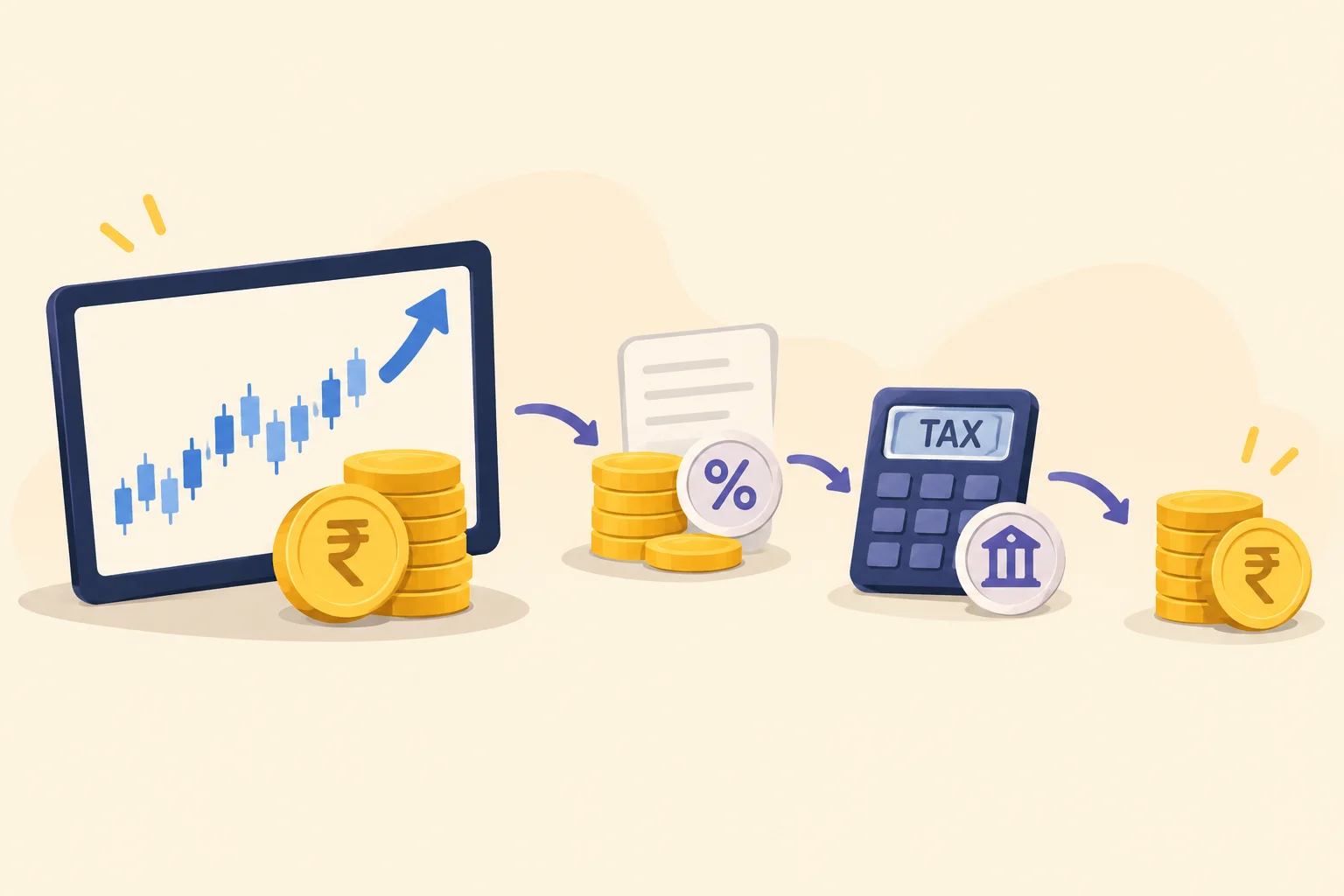
Imagine you buy shares worth ₹50,000. Six months later they are worth ₹60,000, and your app shows a neat ₹10,000 profit. You sell.
Then you add up everything that left along the way. In the example we'll walk through, you end up about ₹7,800 richer, not ₹10,000.
Nobody tricked you. Two different systems each took a share, at different moments, using different formulas. So what are the charges and tax on selling shares in India, and why don't the numbers match?
The short answer: when you sell shares from your demat (dematerialised) account, your broker deducts Securities Transaction Tax of 0.1% of the sale value, plus small exchange and regulatory fees, Goods and Services Tax (GST) on those fees and a depository charge. The tax on your profit comes separately, later in the year. It is 20% on short-term gains and 12.5% on long-term gains above ₹1.25 lakh a year, plus 4% cess.
Why Does One Share Sale Create Three Different Numbers?
You already deal with three numbers every month: the figure in your offer letter, the amount that lands in your bank account, and what you really keep after tax. They are related, but nobody confuses them.
A share sale works the same way. There are three numbers:
- The sale value shown on your screen.
- The amount credited after selling charges.
- What you keep after income tax, compared with what you originally spent buying.
The first two are settled at your broker within moments. The third is worked out separately, across the whole year. Let's start with the charges.
What Charges Are Deducted When You Sell Shares in India?
You might expect brokerage to be the biggest cost of selling a share. On a ₹60,000 sale, it isn't. The biggest charge is Securities Transaction Tax, or STT. For delivery trades, meaning shares you buy and hold in your demat account rather than trade within the day, it is 0.1% on both buying and selling. Budget 2026 raised STT on futures and options, but it left delivery trades unchanged.
The surprising part is that STT is charged on the transaction value, not on your profit. Sell shares for ₹40,000 and you pay ₹40 of STT, whether you originally paid ₹30,000 or ₹50,000. A loss doesn't make it disappear.
A few smaller items follow:
- Exchange fees and turnover fees from the Securities and Exchange Board of India (SEBI), which are tiny slices of the traded value. On Zerodha's schedule, National Stock Exchange (NSE) trades carry about 0.003% and SEBI's fee is ₹10 per crore.
- GST at 18%, but only on brokerage, SEBI fees and exchange charges, not on your share value. On a ₹1 lakh sale, you do not pay ₹18,000.
- Stamp duty of 0.015%, which in an ordinary market trade is paid by the buyer, not the seller.
- A depository participant (DP) charge, a flat fee for each company whose shares you sell from your demat account, whatever the quantity. Zerodha's schedule lists ₹15.34, including GST.
In our example, the ₹50,000 purchase carries about ₹59 in charges and the ₹60,000 sale about ₹78. Small, but not zero. And that's with a broker that charges no brokerage at all.
Is Zero Brokerage Really Zero Cost?
"Free" is a powerful word. Zerodha's standard delivery brokerage is zero. Groww's standard schedule charges the lower of ₹20 or 0.1% per executed order, with a minimum charge. On a ₹60,000 sale, that would reach the ₹20 cap.
But even at zero brokerage, STT, exchange and regulatory fees, GST and the DP charge remain. It's a bit like the story of why Unified Payments Interface (UPI) payments are "free", where a ₹0 price tag on the screen doesn't mean ₹0 of cost in the system.
Brokers, plans and account types differ, so your own contract note is the final word. Our examples apply Zerodha's standard schedule to both trades, purely for illustration.
Charges explain only about ₹137 of the roughly ₹2,200 gap between ₹10,000 and ₹7,800. The rest, about ₹2,074, comes from tax, which works very differently.
How Is Capital Gains Tax on Shares Actually Worked Out?
You might wonder: isn't STT the tax? Not really. STT is a levy on the transaction. Capital gains tax is a separate calculation on your gain, which is the sale price minus your purchase cost and eligible expenses. STT cannot be deducted in that calculation.
The rate depends on how long you held the shares. Hold for 12 months or less and the gain is short-term, taxed at 20%. Hold for more than 12 months and it is long-term, taxed at 12.5% only on eligible gains above ₹1.25 lakh in a year. These rates cover listed shares sold on a recognised stock exchange, where STT has been paid. For Tax Year 2026-27 (April 2026 to March 2027), Budget 2026 left the long-term rate and the ₹1.25 lakh limit as they were.
Add a 4% health and education cess and those become 20.8% and 13%. We assume no surcharge, which applies only to much higher incomes.
Back to our example. About ₹27 of eligible non-STT costs (exchange fees, GST, stamp duty and the DP charge) trims your taxable gain from ₹10,000 to ₹9,973. Tax with cess comes to about ₹2,074.
Notice what didn't happen. The 20.8% was not applied to the ₹60,000 sale. It was applied to the gain.
Add it all up. ₹59,922 credited after selling charges, minus ₹2,074 set aside for tax, leaves about ₹57,848. Against the ₹50,059 you spent including purchase charges, your real profit is about ₹7,789.
One catch: your broker's deductions don't settle this tax. You work out the year's gains and pay through advance tax, where your estimated liability is ₹10,000 or more, or through self-assessment. Unlike tax deducted at source (TDS) on your salary, the broker's deductions don't do it for you.
Can You Make a Profit on Shares and Still Pay No Tax?
Now flip the story. You buy ₹1 lakh of shares and sell them 15 months later for ₹1.5 lakh. After eligible costs, your long-term gain is about ₹49,960.
The tax? Zero, assuming you have no other eligible long-term gains that year, because the gain sits below the ₹1.25 lakh threshold. Charges still apply, so the real profit is about ₹49,710.
But that ₹1.25 lakh is not a fresh allowance for each stock or app. It belongs to you for the whole year, shared across all your eligible long-term gains, and it doesn't carry over if unused.
A resident with little other income may also have unused basic exemption that absorbs part of a gain. That can matter for students. (One of the stories on FinEd, a money survival guide for Indian college kids, is a useful companion read.)
Still, earning under ₹12 lakh doesn't automatically make every stock gain tax-free. The rebate that wipes out tax on income up to that level does not cover capital gains taxed at special rates.
So gains can be taxed or untaxed. What about losses? That's where the rules get surprising.
Why Can't a Loss Always Cancel a Profit?
Try this puzzle. In one year you make ₹50,000 on a share held for a few months, and lose ₹70,000 on another held for two years. Overall, you're ₹20,000 down. Do you owe tax?
Yes, ₹10,400. A short-term loss can offset both short-term and long-term gains. A long-term loss can offset only long-term gains. Your ₹70,000 long-term loss can't touch the ₹50,000 short-term gain, so that gain stays fully taxable at 20.8%.
The loss isn't wasted, though. If you file your return by the due date, it can be carried forward for eight following tax years. For most individual investors, the current due date for Tax Year 2026-27 is July 31, 2027, subject to any extension. Business or professional income can carry a later date.
Two more things worth knowing:
- Only realised losses count. A red number in your app is unrealised and cancels nothing until you sell.
- Capital losses stay inside capital gains. They can't reduce your salary or bank interest.
And a loss-making sale is not free. Shares bought for ₹50,000 and sold for ₹40,000 still carry about ₹57 in selling charges. The loss isn't refunded in cash. Its value lies in offsetting gains, now or later.
Conclusion
Selling a share creates two stories. One is told by your broker in seconds: charges deducted, cash credited. The other is told by the tax rules over a full year: gains classified, losses matched, tax paid.
That's why ₹10,000 on screen became about ₹7,789 in our example, why nearly ₹50,000 of gains could stay completely untaxed, and why a ₹20,000 overall loss could still bring a tax bill.
Before you tap sell next time, check three things: how long you have held the shares, what gains and losses you have already booked this year, and what your broker's charges will be.
Key Takeaways
- A share sale has three numbers: the screen value, the cash credited after charges, and what you keep after tax.
- STT is charged on the transaction value, even when you sell at a loss, and it cannot be deducted when calculating your gain.
- Zero brokerage is not zero cost. STT, exchange and regulatory fees, GST and DP charges can remain.
- Capital gains tax applies to the gain, not the sale value. Short-term gains are taxed at 20%, and long-term gains at 12.5% above ₹1.25 lakh a year, before cess.
- A long-term loss cannot offset a short-term gain, so file your return on time to carry unused losses forward.
Frequently Asked Questions
How much tax do you pay when you sell shares in India?
It depends on how long you held them. Gains on listed shares held 12 months or less are taxed at 20%, and gains on shares held longer are taxed at 12.5% above ₹1.25 lakh in a year, plus 4% cess on both.
Is Securities Transaction Tax deducted from your profit?
No. STT is charged on the transaction value, at 0.1% on both buying and selling for delivery trades, whether you gain or lose. It also cannot be deducted when you work out your capital gain.
Do you pay tax if you sell shares at a loss?
No tax is due on the loss itself, but STT and other charges still apply. The loss can offset capital gains, and an unused loss can be carried forward for eight tax years if you file your return by the due date.
Is profit up to ₹1.25 lakh from shares tax-free?
Only long-term gains qualify. The first ₹1.25 lakh of long-term gains on eligible listed shares in a year is not taxed, while short-term gains get no such threshold.
Last updated: November 24, 2026. Tax rates, STT and broker charges change often, and the figures here reflect the rules and published broker schedules as of this date.