How Do ETFs Actually Work?
An explainer of concept of ETFs and how they let you buy an entire market in a single trade.
Every day, millions of people invest across entire markets without picking a single stock. Here's the piece of financial engineering that makes that possible.
The Problem ETFs Were Built to Solve
Imagine you wanted to own a small piece of all 500 companies in the S&P 500.
Buying each stock separately would mean tracking 500 prices and placing 500 orders. For most people, that's simply not practical.
Mutual funds tried to solve this by pooling investors' money into one diversified basket. But there was a catch: you could only buy or sell units once a day, after markets closed, at a price you wouldn't know in advance.
Then came the 1987 stock market crash, which exposed a real weakness. In its aftermath, regulators found there was no single tradable product that let investors move in and out of the broad market quickly, the way they could with an individual stock.
That gap is what eventually led to the ETF, or exchange-traded fund. In January 1993, the SPDR S&P 500 ETF Trust, better known as SPY, launched in the US and became the first widely recognized ETF. It let investors buy the entire S&P 500 in a single trade, just like buying a single stock.
That one idea quietly reshaped how the world invests.
So What Exactly Is an ETF?
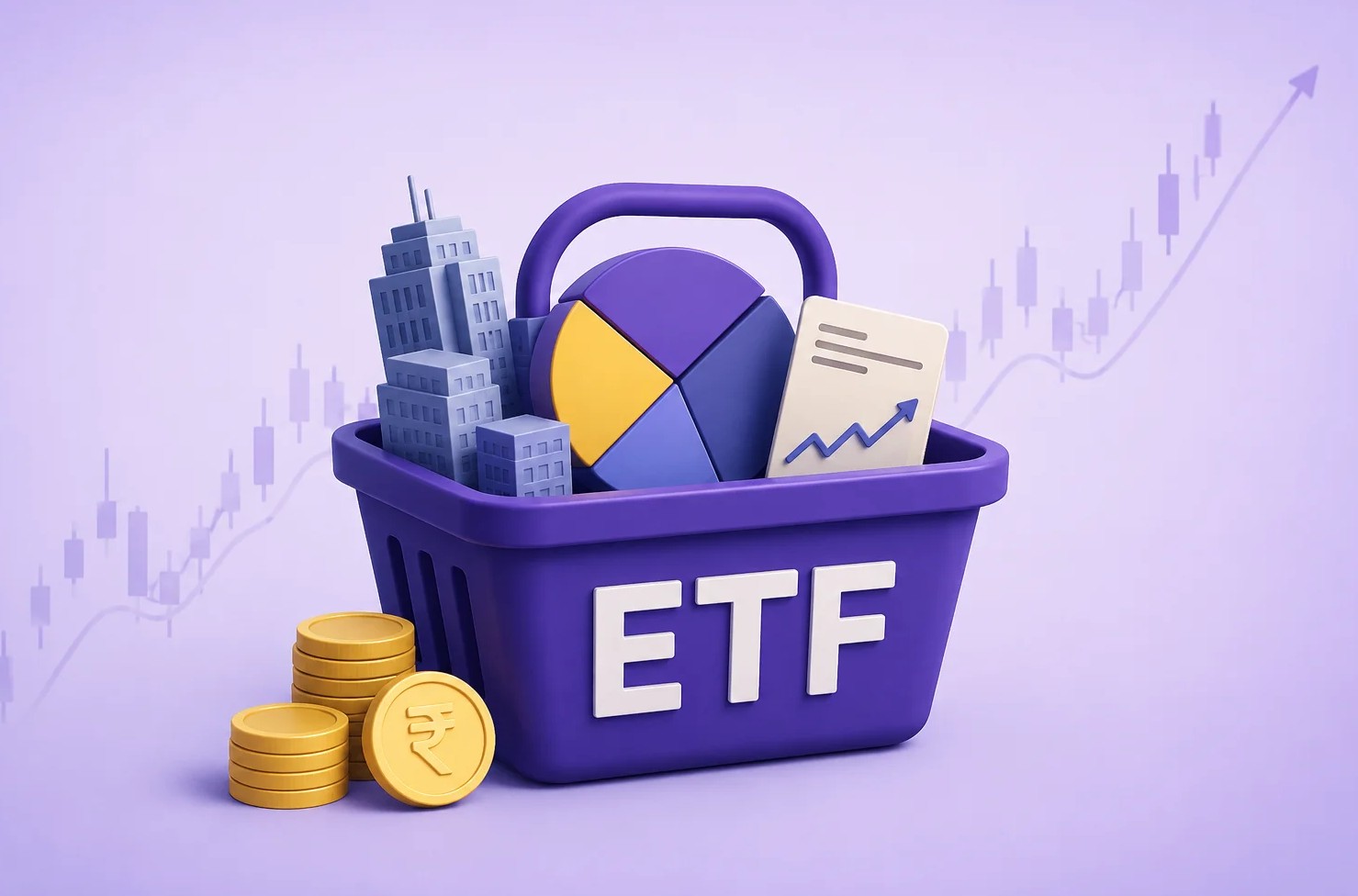
Here's the simplest way to think about it. An ETF is like a ready-made basket at a supermarket.
Instead of walking down every aisle to pick out fifty different items, you grab one basket that already contains everything you need. An ETF works the same way. It's a fund that holds a collection of assets, like stocks or bonds, and packages them into one unit that trades on the stock exchange.
When you buy one share of an ETF, you're not buying just one thing. You're buying a tiny slice of everything inside that basket.
Most ETFs are built to track an index, like the S&P 500 or India's Nifty 50. Buy an ETF tracking the Nifty 50, and you effectively own a small piece of all 50 of India's largest listed companies, in the same proportions as the index itself.
You might wonder how a single fund actually holds hundreds of stocks at once, while still trading smoothly on an exchange all day long. That comes down to some machinery working quietly behind the scenes.
The Machinery Behind Every ETF
An ETF isn't managed by magic. A few key players keep it running.
Asset management companies, or AMCs, design the ETF and manage the underlying portfolio. Stock exchanges list the ETF and let ordinary investors buy and sell it throughout the day. Market makers keep quoting buy and sell prices, so there's usually someone on the other side of your trade.
But the most interesting players are authorized participants, or APs, typically large institutions rather than retail investors.
APs can create new ETF units by handing the underlying stocks to the fund, in exchange for freshly minted ETF shares, or do the reverse and redeem shares for the underlying stocks. This creation and redemption process is the reason ETF prices rarely drift too far from what they're actually worth.
Why ETF Prices Stay Honest
Every ETF has something called a net asset value, or NAV. It's simply the total value of everything the fund holds, divided by the number of units outstanding.
But the price you see on the exchange isn't always exactly the NAV. It moves throughout the day based on how many people are buying and selling.
So what stops that price from drifting too far from the fund's real value? This is where authorized participants step back in.
If an ETF's market price rises well above its NAV, APs can hand over the underlying stocks, receive new units at the lower NAV price, and sell them on the exchange for a profit, which pushes the price back down. If the price falls too far below NAV, APs do the opposite: buy the cheap units and redeem them for the more valuable underlying stocks, pushing the price back up.
This constant back-and-forth, known as arbitrage, is what keeps ETF prices closely tied to their real value, especially for large, popular ETFs.
Why Investors Keep Choosing ETFs
So why has this product become so popular around the world?
The first reason is diversification. One ETF can spread your money across dozens or hundreds of securities, so the failure of any single company doesn't sink your entire investment.
The second is cost. Because most ETFs simply track an index rather than paying analysts to pick stocks, their annual expense ratios are often much lower than actively managed mutual funds.
The third is liquidity. Unlike mutual funds, priced once a day, ETFs trade throughout the day, so you can buy or sell whenever the market is open.
The fourth is transparency. Most ETFs publish their full holdings daily, so you know exactly what you own.
And finally, there's ease. In most cases, all you need is a brokerage or demat account, and you can start with just one unit.
But ETFs aren't the only pooled investment option out there. How do they actually compare to their closest cousins?
ETF vs Index Fund vs Mutual Fund: What's the Real Difference?
At their core, ETFs, index funds, and traditional mutual funds are all trying to do the same basic thing. They pool money from many investors and put it into a diversified portfolio.
Where they differ is in the plumbing.
An ETF trades on the stock exchange throughout the day, at a price that moves with market demand. An index mutual fund, on the other hand, is bought or sold only once a day, at a single NAV price calculated after markets close. Actively managed mutual funds work the same way, except a fund manager picks the investments instead of simply tracking an index.
Access differs too. In India, ETFs generally require a brokerage and demat account, along with a small bid-ask spread on every trade. Index funds and mutual funds can often be bought directly through the fund house, without needing a demat account, which can feel simpler for beginners.
Costs also tend to differ. ETFs and index funds are usually cheaper than actively managed mutual funds, since there's no team of analysts trying to beat the market. But ETFs add small trading costs, like brokerage fees and spreads, on every buy or sell.
None of these structures is universally better. Each simply suits a different kind of investor.
Different Baskets, Same Big Idea
ETFs today go far beyond tracking the S&P 500 or the Nifty 50.
Equity ETFs track broad markets or specific sectors like banking or technology. Gold ETFs offer exposure to gold prices without holding physical gold. Bond ETFs hold baskets of government or corporate debt. International ETFs let you invest beyond your own country, all through one exchange-traded unit.
This variety is part of why ETFs have grown so quickly. Global ETF assets have crossed 23 trillion US dollars, according to industry tracker ETFGI, more than double what they were just three years ago. Industry surveys, including one from PwC, suggest that figure could climb past 35 trillion dollars by 2030 as more investors shift from picking individual stocks to simply buying entire markets. In India, the ETF market has expanded well beyond simple index and gold products, now including sector, smart beta, and ESG-focused ETFs, as SEBI continues refining the rules around how they trade.
Of course, ETFs aren't perfect. Niche or thinly traded ones can have wider bid-ask spreads, and tracking error, where returns drift slightly from the index, can creep in due to fees or sampling methods. None of this makes ETFs risky by design, but it's worth knowing.
Conclusion
So, what is an ETF really? At its heart, it's a simple idea wrapped in some clever machinery: a basket of investments, packaged into one tradable unit, kept honest by institutions constantly creating and redeeming shares behind the scenes.
That simplicity is exactly why ETFs have grown from a single fund in 1993 into a global industry worth trillions of dollars today. They took something that used to require picking hundreds of individual stocks, and turned it into something you can do with a single trade.
Key Takeaways
- An ETF is a fund that holds a basket of assets, like stocks or bonds, and trades on the exchange like an individual share.
- Authorized participants create and redeem ETF units behind the scenes, keeping the fund's market price closely aligned with its real value.
- ETFs are popular for their diversification, low costs, intraday liquidity, transparency, and easy access through a single brokerage account.
- ETFs, index funds, and mutual funds all pool investor money, but differ mainly in how and when you can trade them.
- ETFs now span far beyond stock indices, covering gold, bonds, sectors, and international markets, making them one of investing's most versatile tools.