FinEd Decodes #1 : How to Research a Company Before You Invest in Its Stock
By Shravan Mutha · Reviewed by Deepan Datta
An explainer of how to research a company before investing, from its business model and financials to risks and valuation, in seven steps.

Most beginners open a share price chart first, and it feels like the obvious start. So why does the best research route leave the price for last?
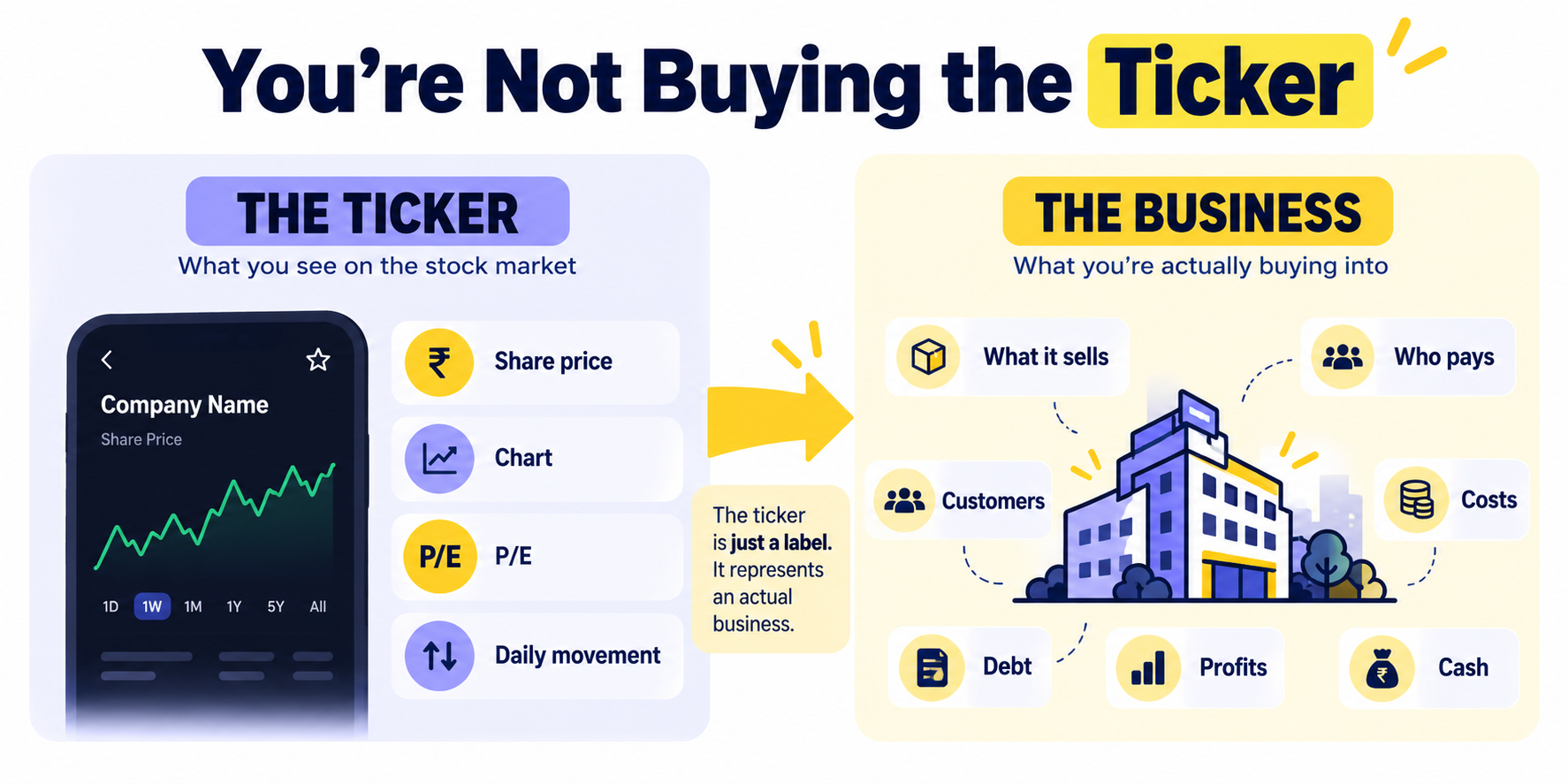
Every stock is a shortcut label for a real business with customers, competitors, debts and decisions being made right now. Learning how to research a company before investing starts with seeing that business clearly.
Are You Buying a Stock Ticker or a Business?
You use its app. You buy its products. Then one day its share price moves, and the question in your head is simple: should I buy it?
Here's the thing though. That's the wrong first question.
A ticker is just a label for people building products, chasing customers, borrowing money and taking risks. So ask something more basic first. What exactly would I own?
Imagine a friend asking you to become a part-owner in their café. You wouldn't just glance at the rent and say yes. You'd want to know what it sells, who walks in, and whether it makes money. Buying a stock is no different. So if not the price, where do you start?
What Are the Seven Steps to Research a Company Before Investing?
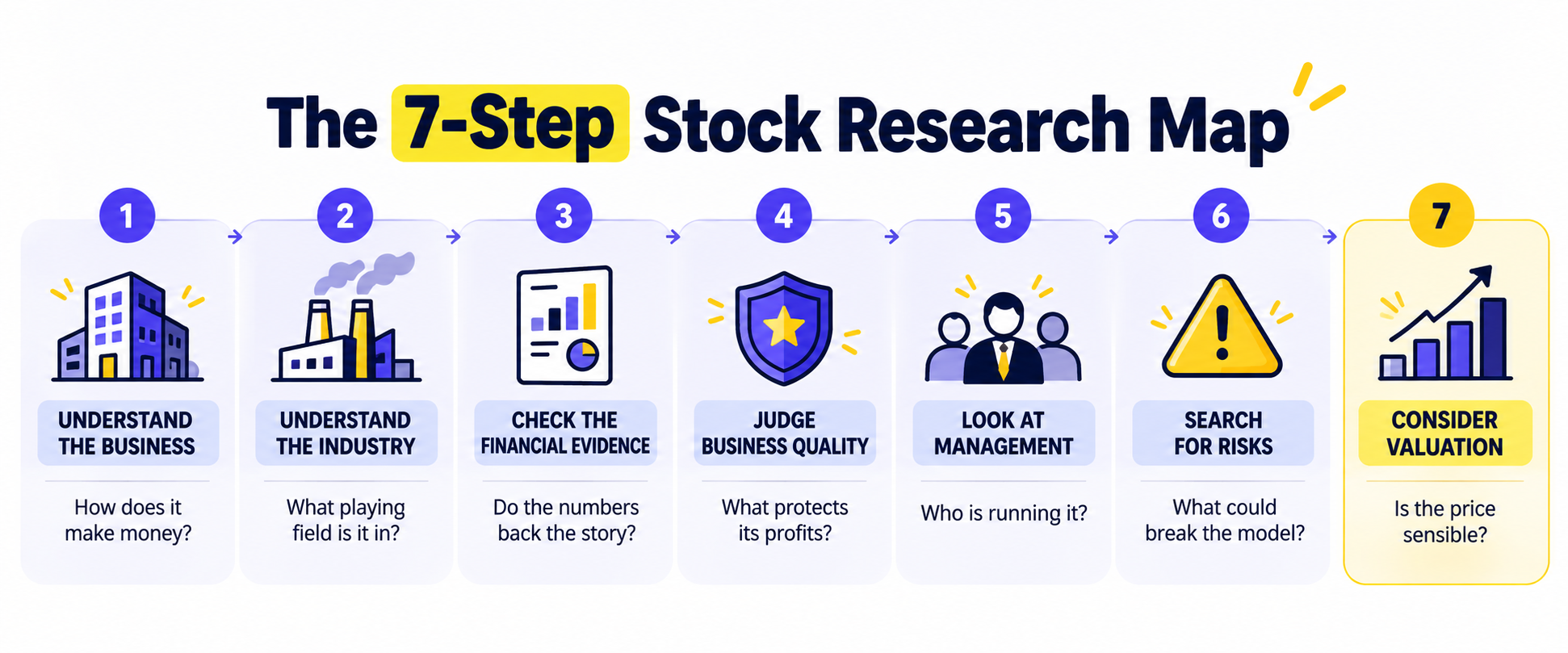
Most beginner guides throw ratios at you, like P/E (price-to-earnings) and ROE (return on equity), before you know what the company does. A better approach is one sequence, a beginner-friendly take on fundamental analysis. To research a company before investing, work through seven steps in order:
- Understand the business: how it makes money
- Understand the industry: what the playing field looks like
- Check the financial evidence: whether the numbers match the story
- Judge business quality: what protects its profits
- Look at the management: how they use your money
- Search for risks: what could break the model
- Consider valuation: whether the price is sensible
Along the way, four documents do most of the work: the annual report, quarterly earnings, the investor presentation, and the earnings call.
Notice where valuation sits. Last, not first. Skip a step and you may fall for a familiar brand or a "cheap"-looking ratio without checking the business behind it.
Step 1: What Does the Company Actually Sell?
Can you explain how the company makes money in five sentences or less? What does it sell (products, services, subscriptions, loans)? Who pays it (consumers, enterprises, the government)? What makes revenue rise or fall (more customers, higher prices, new stores)?
For a paint company, don't stop at the brand on the can. Ask how it reaches millions of homes and how raw material costs eat into earnings. Start with the business overview in its annual report, available on the National Stock Exchange (NSE) annual reports page.
Step 2: Is the Industry Helping or Hurting the Company?
Ever seen a talented footballer stuck on a poorly run team? A well-managed company can face the same problem in a brutal industry. Is the market growing or stuck in cycles? Are five giants dividing the pie, or fifty small players cutting prices to survive?
Look at the management discussion and analysis (MD&A) section of the annual report. The Securities and Exchange Board of India (SEBI) Listing Regulations require listed companies to discuss industry structure, opportunities and threats there. The quarterly earnings call is where you see whether management is walking the talk: analysts quiz them directly, and the answers show what the numbers alone don't.
Step 3: Do the Numbers Back Up the Story?
By now you have a story. The financial statements test it. The profit and loss statement shows whether sales and profits are growing. The balance sheet shows what the company owns, owes, and how much is funded by debt. The cash flow statement asks a sneakier question: is reported profit turning into real cash?
Check whether several years of numbers agree with the story. Results are published every quarter and year on NSE and BSE (formerly the Bombay Stock Exchange). But numbers still don't tell you who's holding the wheel, or what could go wrong.
What Are the Last Four Steps Before Price Enters the Picture?
Step 4: Is the Business Actually Durable?
Ask what protects its profits from being copied: a trusted brand, a hard-to-replicate distribution network, lower costs, or high switching costs. Can it raise prices without losing customers? You want evidence of a "moat" (a lasting competitive advantage), not an assumption because the brand feels familiar.
Hint: it's hidden in the gross margin. A higher gross margin usually means the company has pricing power.
Step 5: Can You Trust Who's Running It?
Shareholders are minority owners handing capital to someone else. How has management used profits: reinvesting, paying down debt, buying back shares, or paying dividends? Has promoter shareholding (the stake held by the founders or controlling group) gone up or down, and are any shares pledged as loan collateral? Both appear in the quarterly shareholding pattern filed with the exchanges. None of this proves wrongdoing, but check it.
Step 6: What Could Actually Break This?
Ask what must stay true for the business to keep working: customer concentration, heavy debt, regulatory shifts, or rivals who could undercut the model. The MD&A must cover "risks and concerns," and the auditor's report flags worries about the accounts.
Step 7: Is the Price Actually Sensible?
Only now does valuation enter. An excellent business can still be a poor investment if its price assumes years of perfect growth. A "cheap"-looking P/E ratio may just mean the market sees trouble ahead. Valuation is the price tag on a house, not the house itself.
Where Can You Find All of This for Free?
None of this needs insider access or a paid screener. Listed companies must publish it, and NSE and BSE make it searchable by name. SEBI maintains a guide to where each filing sits on NSE and BSE, and earnings-call transcripts are public too (see NSE's guidance on analyst and investor meets).
Conclusion
So, should you buy the stock?
That was never really the right question. The real question was always: do you understand the business well enough to have an opinion worth having?
Follow the seven steps in order and you'll stop mistaking a familiar brand or an attractive-looking ratio for a decision you understand. This is a research process, not a recommendation.
This is Part 1 of our series on researching a company, so consider it the map for the rest. Next up: how to read a profit and loss statement.
Key Takeaways
- A stock is a shortcut label for a real business. Research the business, not just the ticker.
- Understand how a company makes money before you look at a single ratio.
- An industry's economics can make or break even a well-managed company.
- Use the profit and loss statement, balance sheet and cash flow statement together.
- Put valuation last. A good company and a good investment at today's price are not the same thing.