· Economy
The Real Cost of the NEET Protests: How India Actually Estimates It
By Anish Pujari
An explainer of how India puts a price tag on protest disruption, using the 2026 NEET protests as the real-world example.
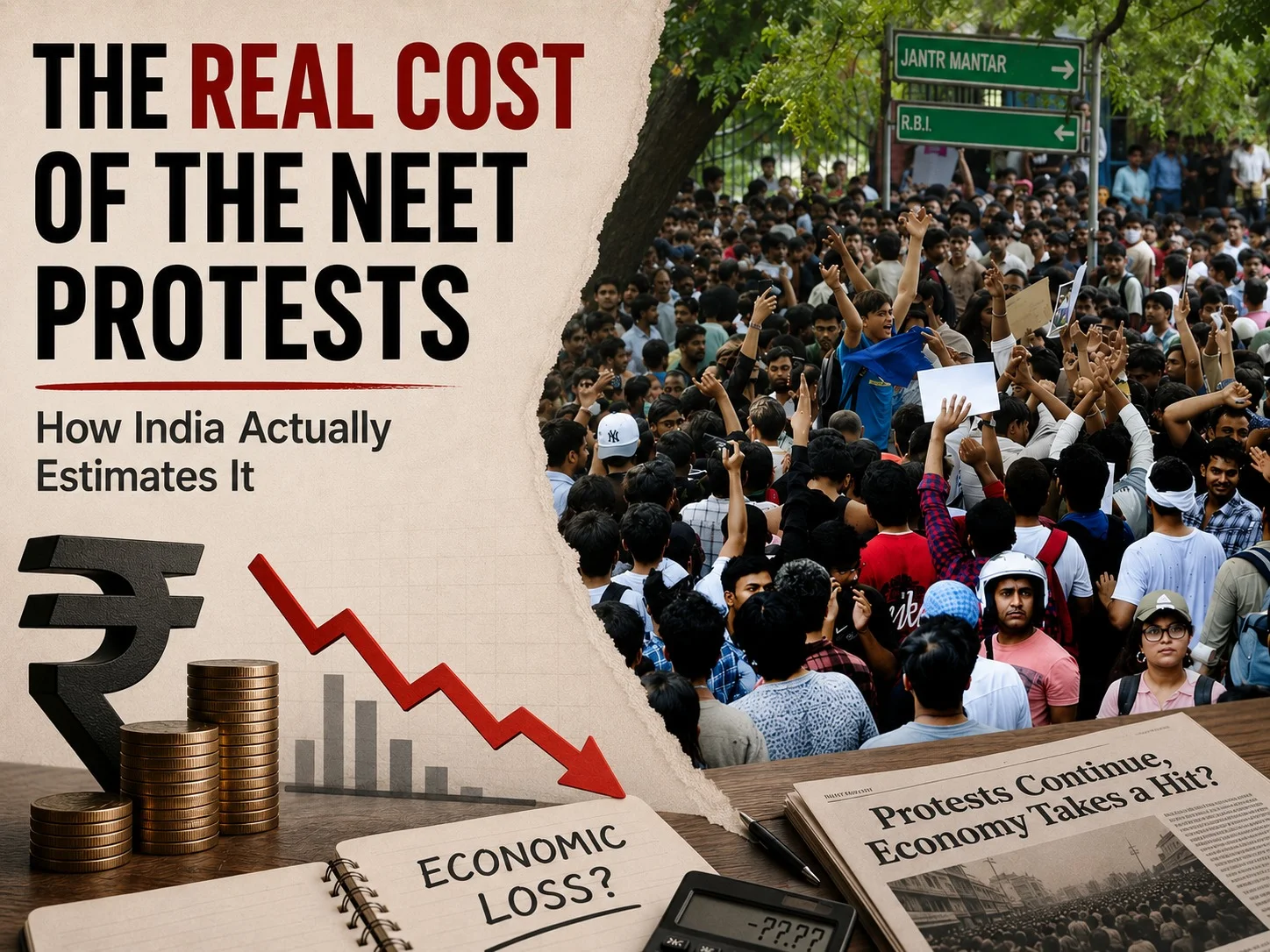
Across several Indian cities, students, parents, and coaching institutes have been out on the streets, and headlines keep mentioning economic losses. But where do these numbers actually come from?
Sometime in May 2026, nearly 2.28 million students sat for NEET-UG, India's medical entrance exam. Then came the news: the National Testing Agency scrapped the exam over paper leak concerns.
For students who'd spent years preparing, this wasn't just an administrative decision. It was months of coaching fees and sacrifice, suddenly hanging in limbo.
What followed were protests, not one coordinated shutdown, but rolling demonstrations across Delhi, Patna, Jaipur, and Chennai. Roads blocked. Coaching classes disrupted. Rallies at Jantar Mantar that grew to include anger over youth unemployment and education costs. In the months since, that anger hasn't faded, it has organized into one of the largest sustained student movements India has seen in years.
And with every news cycle came a familiar headline: claims about the "cost" of these protests, sometimes in the thousands of crores. Which raises a question most readers never stop to ask.
How does anyone arrive at these numbers? What actually gets counted as a loss? And once protests end, does that money vanish, or does the economy catch up?
What's Actually Happening With the NEET Protests
Before the economics, it helps to see what these protests actually look like on the ground, because the picture has shifted considerably since they began.
In the weeks right after the exam was cancelled, the disruption was scattered: a rally here, a blocked road there, a coaching hub going quiet for an afternoon. Coaching centers in hubs like Kota and Patna saw classes cancelled or rescheduled, and government offices, particularly the NTA, were consumed by inquiries and re-exam logistics instead of routine work.
That changed once education activist Sonam Wangchuk began an indefinite hunger strike at Delhi's Jantar Mantar in late June, backed by a student-led movement that has since come to be known as the Cockroach Janta Party. What began as a sit-in has spread to Mumbai, Guwahati, and other cities, drawn in opposition MPs, and stalled Parliament's monsoon session. Delhi has periodically shut metro stations and suspended mobile internet near the protest site to manage crowds.
So this still isn't a single declared bandh, the kind where an entire state shuts down for a day. But it's no longer just scattered disruption either. It's now a sustained, multi-week movement concentrated in specific cities, with real spillover into transport, connectivity, and government functioning in those pockets.
That mixed picture, part-symbolic, part-genuinely disruptive, part-nationwide, part-localized, is exactly what makes estimating its cost tricky.
Why There's No Official Number Yet
You might expect that after months of protests, someone would have put out a clear figure by now. Nobody has.
The reason comes down to how these protests are structured. A one-day, nationwide bandh is easy to measure, everything shuts at once, and economists can estimate what fraction of the day's output was affected.
NEET protests don't work that way. They're spread across weeks and cities, sometimes intense, sometimes quiet, sometimes concentrated in a single square in Delhi. There's no single day to point to and say "this is when the economy stopped." So the usual shortcuts don't apply cleanly.
What does exist are related figures. Political leaders have pointed out that Indian families spend an estimated ₹1.32 lakh crore a year on NEET coaching, fees, and travel for around 22 lakh aspirants. Separately, some coverage has pegged the government's damage-control bill, covering the NEET-UG re-exam process and a related CBSE Class 12 evaluation controversy, at close to ₹1,000 crore.
These numbers show the scale of the exam ecosystem and its administrative fallout. They're not an estimate of what the protests themselves have cost the economy. So how would you actually build that number?
How Economists Actually Calculate Protest Losses
Here's the thing about protest cost estimates. There isn't one method, which is exactly why organizations often report wildly different numbers for the same event.
The most common approach, used by industry chambers, works almost like a formula. Take India's annual GDP, divide by working days in the year, and you get daily output, currently around ₹20,000 to ₹30,000 crore.
Then comes the tricky part. Analysts estimate what percentage of that output was disrupted, maybe 20 percent, maybe 50, and multiply. That percentage is essentially a judgment call.
During the 2010 Bharat Bandh over fuel prices, FICCI estimated the loss at ₹13,000 crore, ASSOCHAM said ₹10,000 crore, and CII put it at just ₹3,000 crore. Same day, same country, three numbers, because each assumed a different share of the economy was hit.
A protest loss figure in the news is really one organization's assumption, dressed up as fact.
Breaking Down the Cost: Who Actually Loses
If economists tried to build a NEET-specific estimate, what would they even count? It helps to break the disruption into a few buckets.
Offices and government departments see the mildest hit. Meetings get postponed, but most work eventually gets done. It's friction, not money that disappears forever.
Businesses near protest zones feel it more directly. Restaurants lose the lunch crowd, retail stores near coaching hubs see footfall drop, and small, informal businesses, the photocopy shop outside a coaching center, the tea stall near a rally site, have no cushion to absorb a bad day.
Transport takes a hit too. Blocked roads mean delivery riders take longer routes and complete fewer trips, directly cutting earnings since most are paid per delivery. Government spending also rises: police deployment, barricades, and crowd control all cost money, separate from whatever GDP is lost.
But the group hit hardest isn't a sector at all. It's daily wage workers, street vendors, construction workers, auto-rickshaw drivers, gig workers, domestic help, who typically get paid only for days actually worked. When a protest keeps them off the road, that day's income is simply gone.
Which brings up a distinction headline numbers tend to blur.
Not All Losses Are Equal: Permanent vs Temporary
Think about it this way. If you planned to buy a phone this weekend but couldn't step out because of a protest, you'd probably just buy it next week. The sale isn't lost, it's delayed.
But if you'd planned to eat at a restaurant that evening and didn't, that meal is gone for good.
This distinction matters. Retail purchases, factory output, and office work are mostly recoverable. Restaurant meals, hotel bookings, cancelled events, and daily wages are usually gone for good.
So a headline "cost" figure often mixes genuinely vanished income with output that will simply show up a week later. Economists studying these events note that treating all disruption as permanent loss overstates the real damage.
What Past Bandhs Tell Us About These Numbers
India has plenty of history with this kind of estimation, and the pattern repeats every time.
During the 2013 two-day national trade union strike, ASSOCHAM estimated a GDP hit of ₹15,000 to ₹20,000 crore, assuming a large share of activity was disrupted. Some independent economists have argued that industry-chamber estimates like this tend to run lower than the real number, since chambers have an incentive to make disruption look costly. Figures like these are worth treating as one institution's estimate rather than an audited fact, a gap that shows how much these calculations depend on starting assumptions.
Big rupee figures get published quickly, grab headlines, and are rarely challenged with the same energy they're announced with. Independent economists tend to be far more cautious, treating them as rough estimates rather than audited facts.
What Happens If the Protests Drag On
A single day of disruption is one thing. A movement stretching across weeks or months, as the NEET protests now have, is a different story.
Short, one-off protests mostly just shift the timing of economic activity. Businesses catch up, workers eventually get paid, and the economy barely notices.
But prolonged unrest changes the conversation. Businesses may delay investment or hiring decisions if uncertainty drags on. Sectors tied to the protests, like coaching companies, might rethink expansion. Extended coverage can also make a region look less stable, quietly affecting tourism and sentiment.
For NEET specifically, the bigger long-term cost may not be about lost GDP at all. It may be about trust, in the exam system, in institutions, and in the promise that preparation is rewarded fairly.
Conclusion
So, how much do the NEET protests actually cost India? Nobody can honestly give an exact figure, and any number claiming otherwise deserves a skeptical eyebrow.
What we do know is how these estimates are usually built: GDP arithmetic, assumptions about disrupted activity, and judgment calls that vary wildly between institutions. Headlines also tend to blur income that's genuinely lost with output that's simply delayed.
Most importantly, the people who feel these disruptions aren't abstract GDP statistics. They're daily wage workers, small shop owners, delivery riders, and students, real people whose income or time gets interrupted, often with no cushion to fall back on.
The next time you see a headline claiming a protest cost India a specific sum, ask who made the estimate, what assumptions went into it, and who actually bore the cost.
Key Takeaways
- There's no official estimate yet for what the NEET protests have cost India, partly because the disruption has been spread across weeks and cities rather than one declared shutdown.
- Loss estimates are usually built by dividing India's annual GDP by working days, then assuming what share of activity was disrupted, which is why different organizations report very different numbers for the same event.
- Not all reported losses are permanent. Purchases and office work can often be made up later, while restaurant meals, cancelled trips, and daily wages are usually gone for good.
- Daily wage workers, street vendors, delivery riders, and construction workers, tend to bear the sharpest financial impact, since they're paid only for days actually worked.
- Treat headline "₹X crore lost" figures with healthy skepticism. They're estimates built on assumptions, not audited facts, and the real story is often about who bears the cost.